
With 4.75 million Indians currently residing in the UAE, the verification of academic credentials has reached a scale where technical precision is the only guarantee of regulatory compliance. The process represents a multi-national legal chain of trust where Indian state, Indian federal, and UAE federal authorities must align with absolute accuracy. You likely recognize that securing your residency visa or professional license depends on a document trail that spans two countries and multiple government departments. The confusion between HRD and SDM requirements, coupled with the fear of losing original documents during international transit, often creates significant friction during time-sensitive applications.
This technical breakdown masters the complex process of indian degree certificate attestation in uae for the 2026 landscape. We provide a clear roadmap that incorporates the September 2025 regulatory shifts and the implementation of the eDAS 2.0 digital system. You’ll learn the exact six-step verification sequence, including the updated protocols that allow for final MOFA attestation to be completed within India. This guide ensures your documents meet every federal standard without the need for personal travel or logistical uncertainty, providing the stability required for your professional transition.
Key Takeaways
- Grasp why Indian credentials require a specific chain of authentication rather than simple notarization to satisfy GCC institutional standards.
- Learn how to navigate the multi-step indian degree certificate attestation in uae, starting from university verification through to state HRD and federal MEA seals.
- Pinpoint the primary reasons for application failure, including technical mismatches between degree nomenclature and passport data.
- Analyze the 2026 turnaround times for standard and express cycles to better plan your employment or residency transition.
- Evaluate the strategic benefits of institutional expertise and fixed-fee models when managing high-stakes document verification across international borders.
Understanding Indian Degree Certificate Attestation in UAE
Attestation is a formal authentication process where government authorities verify the legitimacy of signatures and seals on a document. It’s a foundational requirement for international mobility. For professionals moving from India, indian degree certificate attestation in uae serves as the primary mechanism for establishing academic credibility within the Emirates’ legal framework. This isn’t a simple notarization. It’s a rigorous sequence of validations where each authority confirms the preceding one’s seal, creating a verifiable record of your educational history.
Unlike countries that participate in the Hague Convention, the UAE requires a full chain attestation process. A basic notary stamp only confirms the identity of the signer; it doesn’t validate the document’s content or the university’s accreditation. Understanding Document Legalization is essential here, as the process creates a bridge of trust between the Indian educational system and UAE federal entities. Educational documents follow a distinct workflow compared to personal or commercial papers, requiring specific state-level academic verification before federal bodies will intervene. This ensures that the degree wasn’t just signed, but issued by a recognized institution under the proper jurisdiction.
Why Attestation is Mandatory for UAE Residency
The Ministry of Human Resources and Emiratisation (MOHRE) utilizes attested degrees to categorize the labor force. If you’re seeking a professional or managerial designation on your Emirates ID, a validly attested degree is non-negotiable. These designations often dictate your minimum salary threshold and your eligibility for specific corporate benefits. Beyond employment, the UAE’s immigration policy requires attested degrees for family sponsorship. You can’t sponsor a spouse or children without this verification, as the government uses your academic standing to determine your capacity for financial provision and professional stability.
The Legal Chain: From India to the UAE
Documents must be verified in their country of origin because only local authorities possess the records to confirm a university’s authenticity. The 2026 process involves three primary governing bodies: the State Human Resource Development (HRD) department, the Ministry of External Affairs (MEA), and the UAE Embassy. While the system was traditionally paper-heavy, the current environment utilizes a hybrid model. Physical stamps are now increasingly supplemented by QR-coded digital verifications through systems like eDAS 2.0. This evolution ensures that indian degree certificate attestation in uae remains resistant to fraud while speeding up the verification of credentials for the 4.75 million Indian nationals residing in the GCC.
The 4-Step Process for Attesting Indian Degrees
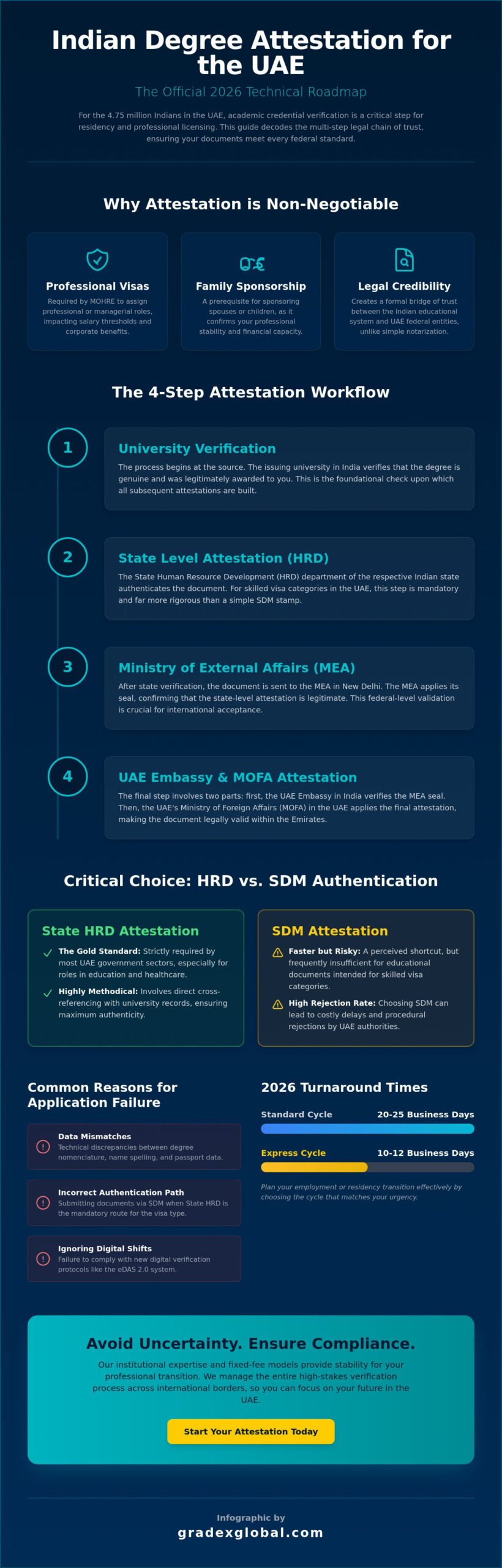
The sequence for indian degree certificate attestation in uae is a linear, hierarchical protocol where each validation serves as a prerequisite for the next. This process ensures that a document issued in an Indian state is recognized as a legitimate legal instrument by UAE federal authorities. The workflow begins at the source with university verification, where the issuing institution confirms the degree’s authenticity. Once the university provides its clearance, the document moves through a chain of state and federal departments in India before reaching the final UAE-side verification. This structured approach maintains a high level of security and prevents the submission of fraudulent credentials in the UAE labor market.
Authentication in India: HRD vs. SDM
A critical technical decision in the India-side workflow is choosing between State Human Resource Development (HRD) and Sub-Divisional Magistrate (SDM) authentication. While SDM is often perceived as a faster alternative, it’s frequently insufficient for educational credentials intended for skilled visa categories. Most UAE government sectors, particularly education and healthcare, strictly require State HRD attestation. In states like Kerala, Tamil Nadu, and Maharashtra, the HRD process is highly methodical, requiring original degrees and transcripts for university-level cross-referencing. If you’re uncertain which path aligns with your specific visa category, consulting with professional education consultancy services can prevent procedural rejections. Following state-level clearance, the Ministry of External Affairs (MEA) in India provides the essential federal-level authentication required for international use through its designated submission centers.
Final Leg: MOFA Attestation in the UAE
The finalization of the document occurs through the Ministry of Foreign Affairs (MOFA) attestation. A significant regulatory update implemented in September 2025 has streamlined this stage, allowing both the UAE Embassy verification and the final UAE Ministry of Foreign Affairs Attestation to be completed via authorized partners while the document is still in India. This change has optimized the indian degree certificate attestation in uae by reducing standard timelines from several weeks to approximately 5 to 7 working days. The current system utilizes eDAS 2.0, which generates a QR-coded digital stamp instead of the traditional physical stickers. This digital integration allows UAE authorities to instantly verify the document’s entire attestation history, providing the stability and transparency required for modern visa processing. Without this final QR-coded verification, the degree isn’t recognized by the Ministry of Human Resources and Emiratisation for professional designations.
Common Pitfalls and Why Attestation Applications Fail
Secure document verification requires meticulous attention to technical details. Even minor clerical errors result in total application rejection. A frequent cause for failure in indian degree certificate attestation in uae is the lack of alignment between the degree holder’s name and the data recorded on their international passport. If a middle name is missing or a surname is abbreviated on the certificate but fully spelled on the passport, authorities will likely halt the process. Ensuring data integrity across all identifying documents is a prerequisite for a successful submission.
The integrity of the stamp chain is equally vital. Each entity relies on the verification of the previous department. Skipping the university verification or missing the Indian Ministry of External Affairs Attestation Process seal invalidates the document for UAE use. Additionally, documents from private institutions not recognized by the University Grants Commission (UGC) or the All India Council for Technical Education (AICTE) face immediate disqualification during the initial Indian authentication phase. Verified institutional accreditation is the only guarantee that your credentials will survive the scrutiny of both Indian and UAE federal auditors.
The Problem with Laminated Certificates
Lamination serves as a physical barrier that prevents authorities from applying the necessary wet stamps or adhesive labels to the original paper. Because attestation requires the ink to bond directly with the document substrate, any plastic coating must be removed. This delamination is a high-risk technical procedure; heat application can melt the certificate’s ink or cause the paper to tear. If a document is damaged during this process, it often requires a duplicate issuance from the university, which significantly delays the visa timeline. It’s advisable to check for lamination early in your planning phase.
Equivalency vs. Attestation: Avoiding Confusion
Many professionals mistake attestation for the final step in their educational recognition. While indian degree certificate attestation in uae confirms a document’s authenticity, it doesn’t equate the degree’s academic value to UAE standards. For specialized roles such as engineers, medical practitioners, and educators, obtaining an equivalence certificate from the Ministry of Education is a mandatory subsequent requirement. Grad-Ex Consultancy provides the institutional oversight needed to bridge these two distinct legal phases, ensuring that your verified documents transition seamlessly into the equivalency evaluation without administrative gaps.
Timelines, Costs, and Preparation for 2026
Efficiency in the 2026 regulatory environment is defined by the integration of digital verification and streamlined logistics. The standard cycle for indian degree certificate attestation in uae currently spans 12 to 17 days. However, applicants requiring accelerated processing can utilize VIP services that compress this timeframe to a window of 5 to 8 days. These timelines are contingent upon the promptness of the issuing university in India during the initial verification phase. While the September 2025 regulatory shift allows for much of the process to be finalized within India, the sequence remains a rigid technical path that doesn’t permit skipped steps.
Financial planning for this process requires a distinction between mandatory federal fees and logistical service charges. Federal rates are fixed, such as the AED 150 fee for UAE Ministry of Foreign Affairs verification and the corresponding AED 150 for UAE Mission attestation in India. Beyond these government costs, you must account for processing charges from authorized submission centers and Indian Ministry of External Affairs fees. To ensure a seamless submission, you’ll need to provide your original degree, a high-resolution passport copy, and signed authorization letters that empower your chosen partner to act on your behalf across various ministries.
2026 Digital Integration: UAE Pass and E-Attestation
The UAE has transitioned toward a digital-first governance model, making a verified UAE Pass account essential for accessing e-attestation services. The eDAS 2.0 system now issues QR-coded digital stamps, replacing the traditional physical stickers that were prone to wear or tampering. These digital stamps allow for instantaneous online validity checks by employers and government entities. Despite this digital evolution, the physical original degree is still a technical requirement because Indian state HRD departments must apply wet stamps to the paper substrate before the digital chain can begin. You can secure your certificate attestation through our structured protocols that bridge these physical and digital requirements.
Checklist for a Successful Application
A successful application begins with institutional verification. You must confirm that your degree was issued by a university recognized by the University Grants Commission (UGC) or the All India Council for Technical Education (AICTE), as non-recognized institutions are ineligible for federal MEA seals. Preparing clear, high-resolution scans of all document faces is necessary for the initial advisory phase to identify any potential nomenclature mismatches or lamination issues. Once the indian degree certificate attestation in uae is successfully completed, the attestation remains valid indefinitely unless the original document is replaced or legally altered.
Why Grad-Ex Consultancy is the Strategic Choice for Attestation
Grad-Ex Consultancy operates with a level of institutional depth that smaller agencies cannot replicate. With over 15 years of experience navigating GCC institutional relationships, we’ve developed the technical infrastructure required to manage complex document workflows. Our approach to indian degree certificate attestation in uae is built on a foundation of stability and professional accountability. We don’t just facilitate document movement; we provide a controlled environment where your original credentials are protected by real-time tracking systems and rigorous internal audits. This level of oversight is essential when handling the irreplaceable academic records that define your professional identity.
Transparency is a core component of our professional standard. We utilize a fixed-fee structure to provide cost certainty for Indian expatriates, eliminating the financial volatility often associated with multi-country legal processes. Our team manages the entire lifecycle of the attestation, from the initial Indian state ministries to the final UAE Ministry of Foreign Affairs (MOFA) digital verification. This end-to-end oversight ensures that every stamp in the chain meets federal compliance standards, reducing the risk of administrative rejection at the final visa submission stage. By maintaining control over the entire process, we provide a guarantee of quality that smaller, fragmented service providers cannot match.
Beyond Attestation: Integrated Strategic Solutions
Our expertise extends beyond educational credentials. We provide comprehensive support for Indian passport assistance and business setup services, ensuring that your transition to the UAE is supported by a unified service provider. For complex cases involving non-standard documentation, we offer global translation services and online notary options. This integrated model allows you to focus on your career while we manage the bureaucratic technicalities. Our “no-hassle” approach is a professional commitment, ensuring that every legal requirement is met with precision and that your documents are ready for immediate use by UAE authorities.
Contact Grad-Ex for a Technical Consultation
Starting the process requires a methodical evaluation of your current documentation. We offer a free document review to identify potential nomenclature errors or institutional recognition issues before they become bottlenecks in your application. This initial advisory phase is a testament to our commitment to technical precision and professional stability. It’s the first step in ensuring your indian degree certificate attestation in uae is handled with the necessary care. You can secure your professional future with Grad-Ex Consultancy Attestation Services by initiating your technical consultation today. Our consultants provide the clarity needed for successful visa planning and long-term career growth within the Emirates.
Finalizing Your Educational Credentials for Global Mobility
Successful indian degree certificate attestation in uae is the foundational requirement for your professional residency and long-term career stability. It requires a meticulous alignment between Indian state authorities and the UAE’s evolving digital federal systems. By mastering the 4-step chain and avoiding technical errors like document lamination or nomenclature mismatches, you ensure your credentials stand up to the highest level of institutional scrutiny. This methodical approach is the only way to navigate the 2026 regulatory landscape with absolute certainty.
Grad-Ex Consultancy brings 15+ years of GCC strategic advisory experience to your document management. We provide a stable, fixed-fee transparency model that eliminates hidden charges while managing the entire process from university verification to the final MOFA e-stamp. Our comprehensive end-to-end management allows you to focus on your professional transition while we handle the complex technical bureaucracy. Get a Fixed-Fee Quote for Your Indian Degree Attestation and secure a verified legal path for your professional journey in the Emirates.
Frequently Asked Questions
Can I attest my Indian degree while I am currently in the UAE?
Yes, you can complete the entire verification sequence without leaving the Emirates. Professional consultancy services manage the secure transit of your original documents back to India for the required state HRD and MEA stamps. This logistical oversight ensures your indian degree certificate attestation in uae proceeds through the necessary legal channels while you remain focused on your professional responsibilities in the UAE.
How long does the Indian degree attestation process take in 2026?
Processing timelines are determined by the service tier you select for your application. A normal full attestation cycle typically spans 12 to 17 days, while express services can reduce this to 10 to 12 days. For urgent residency requirements, the VIP track offers the most efficient turnaround, finalizing the entire India-to-UAE chain within 5 to 8 days.
Is it possible to attest a provisional degree certificate for a UAE visa?
Yes, provisional certificates are legally acceptable provided they are still within their validity period, which is usually six months to one year from the date of issuance. The document must undergo the same rigorous university and state-level authentication as a final degree. You should prepare to attest the permanent degree once it becomes available to ensure long-term regulatory compliance.
What is the difference between MEA attestation and an Apostille for India?
MEA attestation is a specific multi-country verification required for nations like the UAE that aren’t members of the Hague Convention. An Apostille is a simplified, one-step verification used exclusively between member states of that convention. Since the UAE requires a more comprehensive chain of trust, a standard Apostille is insufficient for indian degree certificate attestation in uae.
Will my attested degree expire after a certain period in the UAE?
No, an attested degree certificate does not have an expiration date under current UAE regulations. Once the final MOFA QR-coded stamp is applied, the verification remains valid indefinitely for your employment and residency needs. You would only need to re-initiate the process if the physical document is damaged, lost, or if there’s a legal change to your name.
Do I need to attest my mark sheets along with my degree certificate?
Mark sheets are generally not required for standard labor contracts or employment visa processing. However, they become a mandatory technical requirement if you’re applying for an equivalency certificate or seeking admission to a UAE-based higher education institution. It’s essential to confirm the specific needs of your sponsoring authority before beginning the attestation cycle.
What happens if my university is not on the recognized list for UAE attestation?
If your issuing institution is not recognized by the University Grants Commission (UGC) or the All India Council for Technical Education (AICTE), the application will fail at the Indian state HRD level. Federal authorities will not provide stamps for degrees from unaccredited private institutions. Verification of your university’s status is a critical first step in the advisory phase.
Can I use a digital copy of my degree for the MOFA attestation step?
No, the Ministry of Foreign Affairs (MOFA) requires the physical original document for the final verification step. Even though the 2026 system utilizes eDAS 2.0 to generate a digital QR-coded stamp, the physical paper must be presented. This allows authorities to verify the authenticity of the preceding wet stamps applied by the Indian state and federal ministries.