
Your professional trajectory in the Emirates remains structurally incomplete without a verified bridge between your international credentials and local regulatory standards. Securing an equivalence certificate is no longer a secondary administrative task; it represents the primary technical requirement for high-level residency and specialized professional licensing in 2026. Many professionals find themselves stalled by the Ministry of Education’s rigorous multi-step protocols, often confusing basic document attestation with the more complex equivalency process. This procedural error leads to a significant percentage of initial application rejections for candidates who lack a structured roadmap.
We recognize that you value precision and stability in your career planning. You’ve likely felt the frustration of opaque government workflows where a single missing verification can jeopardize a long-term contract. Our authoritative guide eliminates this uncertainty by detailing the exact requirements for academic recognition. We’ll provide the technical clarity needed to secure your documents efficiently, ensuring your qualifications are fully integrated into the UAE’s professional infrastructure. We’ll analyze the current 2026 submission hierarchy, explain the critical differences in document tiers, and outline the exact sequence for a successful application.
Key Takeaways
- Understand the strategic role of the UAE regulatory framework in aligning foreign qualifications with national academic standards for professional and residency purposes.
- Distinguish between the legal process of document attestation and the academic evaluation of course content to ensure your credentials meet specific institutional criteria.
- Follow a precise, step-by-step roadmap to secure your equivalence certificate by navigating the multi-stage attestation and legal translation requirements for 2026.
- Identify the technical documentation required for general and higher education degrees, including the critical role of original transcripts and “Genuine Certificate” letters.
- Learn how leveraging expert consultancy and established institutional relationships can mitigate regulatory complexity and streamline the processing of complex academic files.
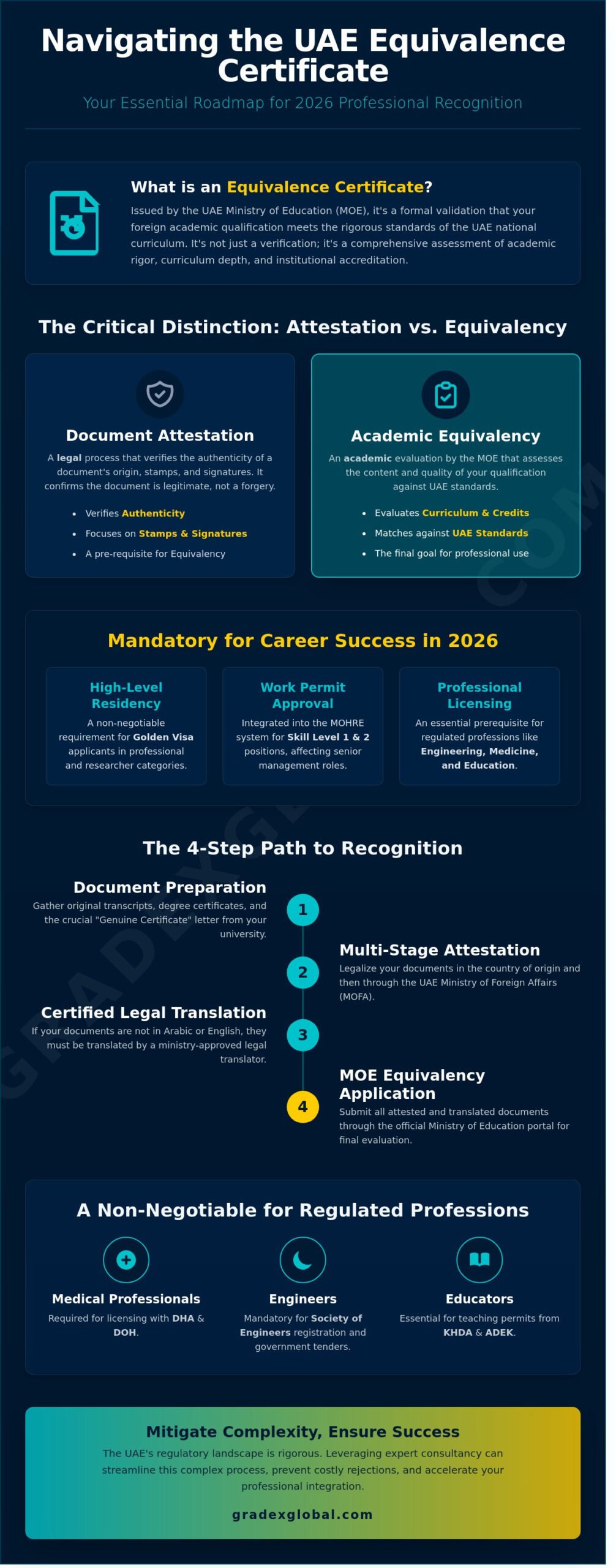
Defining the Equivalence Certificate within the UAE Regulatory Framework
The equivalence certificate represents a critical regulatory instrument within the United Arab Emirates’ push for a knowledge-based economy. Issued exclusively by the Ministry of Education (MOE), this official document serves as a formal attestation that an academic qualification obtained from a foreign institution aligns with the rigorous standards of the UAE national curriculum. It’s not merely a translation of credits; it’s a comprehensive validation of the academic rigor, institutional accreditation, and curriculum depth. This mechanism ensures that the structural integrity of the UAE’s academic and professional landscape remains uncompromised as the nation attracts global talent.
The MOE utilizes a strict verification process to confirm that the degree holder has met specific learning outcomes. This systematic approach prevents the dilution of professional standards and protects the public interest. In the context of the 2026 regulatory updates, the certificate has transitioned from a recommended document to a mandatory requirement for high-level residency tracks. Specifically, the Golden Visa program now requires a verified equivalence certificate for all applicants under the professional and researcher categories to prove their specialized expertise meets national benchmarks.
The Legal Mandate for Foreign Qualifications
The UAE government mandates academic validation to ensure that all expatriate residents contributing to the national economy possess verified expertise. The MOE functions as the primary gatekeeper, maintaining national educational benchmarks that protect the labor market from unverified or subpar qualifications. By aligning local requirements with global standards for academic recognition, the UAE ensures its workforce remains competitive.
The consequences of non-compliance are immediate and significant. As of January 2026, the Ministry of Human Resources and Emiratisation (MOHRE) has integrated equivalency checks into the work permit approval system for Skill Level 1 and 2 positions. Professionals who fail to produce a valid certificate face delays in residency renewals and may be barred from holding senior management titles. This legal framework creates a transparent environment where qualifications are measured against a single, high-quality standard.
Why Equivalency is Essential for Professional Licensure
For technical and regulated sectors, the certificate is a non-negotiable prerequisite for legal practice. Engineers, medical practitioners, and educators cannot obtain professional licenses without it. In the engineering sector, the UAE Society of Engineers requires this document before granting membership or the right to sign off on complex infrastructure projects. This process ensures that every project meets the safety and precision standards the country demands.
- Medical Professionals: Required for Dubai Health Authority (DHA) and Department of Health (DOH) licensing.
- Engineers: Mandatory for registration with the Society of Engineers and for working on government tenders.
- Educators: Essential for obtaining teaching permits from the KHDA or ADEK.
The certificate serves as a foundational document for both corporate and government employment. It provides a standardized metric for evaluating talent across a diverse, international applicant pool. Without this validation, a candidate’s academic history remains an unverified claim, hindering their ability to secure positions that require a high degree of technical accountability and professional trust.
Distinguishing Between Document Attestation and Academic Equivalency
Professionals entering the UAE market often conflate two distinct regulatory procedures. Document attestation serves as the legal verification of a certificate’s origin. It confirms that the stamps and signatures are genuine and legally recognized by the issuing country. Academic equivalency, however, represents a deeper qualitative assessment. The Ministry of Education (MOE) analyzes the curriculum, credit hours, and the global standing of the awarding body. You can’t secure an equivalence certificate without first completing the multi-stage attestation chain. This distinction is critical for any long-term career planning in the Emirates.
The Verification vs. Validation Paradigm
Verification ensures the document isn’t a forgery. It involves the home country’s Ministry of Foreign Affairs and the UAE Embassy. Validation takes this a step further by auditing the degree’s academic parity. Without validation, a master’s degree from abroad might not be recognized for public sector roles or specific professional licenses. Institutions like the American University of Sharjah maintain strict university equivalency requirements for graduate admissions, illustrating that legal stamps alone don’t grant academic status. Grad-Ex Consultancy manages these parallel tracks with a methodology rooted in technical precision and engineering-grade accuracy.
Common Misconceptions in Document Legalization
A frequent error involves assuming that a Ministry of Foreign Affairs (MOFA) stamp concludes the process. While MOFA attestation is a critical milestone, it’s merely a prerequisite for the MOE’s evaluation. In 2024, internal industry reports indicated that nearly 15% of applications faced significant delays because candidates skipped the preliminary DataFlow verification or failed to provide sufficient secondary school transcripts. The hierarchy of approvals is rigid. It follows a specific sequence:
- Home country’s Ministry of Education or relevant board.
- Home country’s Ministry of Foreign Affairs.
- UAE Embassy or Consulate in the country of origin.
- UAE Ministry of Foreign Affairs (MOFA).
- Final submission to the UAE Ministry of Education (MOE) for the equivalence certificate.
Professionals in regulated fields like civil engineering, architecture, or medicine must complete the full cycle to practice legally. Missing a single stamp in the sequence results in immediate rejection. Our team at Grad-Ex treats every application like a large-scale infrastructure project. We ensure every component is verified before moving to the next stage. This systematic approach mirrors our engineering roots, where precision is the only acceptable standard. If you’re unsure where your current documents stand in this hierarchy, you should consult our regulatory experts to verify your path. We eliminate the guesswork through structured, logical execution, ensuring your career transition remains on schedule for 2026.
Technical Requirements for General and Higher Education Certificates
The UAE Ministry of Education (MoE) maintains a tiered evaluation system that separates secondary education from higher academic qualifications. Obtaining an equivalence certificate demands a meticulous adherence to documentation standards that mirror the precision of a large-scale engineering project. Applicants must secure original transcripts authenticated by the Ministry of Foreign Affairs (MoFA) in the country of origin and the UAE. A “Genuine Certificate” letter, issued directly by the awarding institution to the MoE, remains a mandatory safeguard against credential fraud. For qualifications earned through distance learning, the MoE requires evidence that the program met the 2024 updated standards for interactive digital delivery and institutional accreditation. All non-Arabic documents must undergo legal translation by a translator licensed by the UAE Ministry of Justice; this ensures every technical term aligns with local regulatory frameworks. The process isn’t merely administrative; it’s a verification of the structural integrity of one’s educational background.
Standards for International Schooling (Grade 12)
Students transitioning from international curricula to UAE higher education must meet specific benchmarks defined by the MoE. For the 2025-2026 academic cycle, private school students following British, American, or IB systems must prove they’ve completed 12 years of formal schooling. Documentation must include the last three years of academic records. Understanding the UAE Certificate of Equivalency requirements is vital for those moving from non-government schools. The MoE distinguishes between “Attestation” and “Equivalency” based on the school’s licensing status. For vocational tracks, specific protocols from bodies like the GCAA ensure that secondary technical training meets national safety and proficiency standards.
University Degree Recognition Protocols
The MoE prioritizes the accreditation status of the issuing university above individual student performance. For Bachelor, Master, and PhD levels, the institution must be recognized by the National Commission for Academic Accreditation and Assessment (NCAAA) or a recognized international equivalent. Specialized fields like medicine or law face additional scrutiny. Medical degrees must align with the 2023 UAE Healthcare Professional Qualification Requirements (PQR) to be valid for licensing. If a degree was obtained through a branch campus, the MoE verifies that the parent institution maintains direct academic oversight. This rigorous verification process ensures that the equivalence certificate serves as a reliable benchmark for professional stability within the UAE labor market. The system functions with mathematical logic, where accreditation plus authentication equals recognition.
Procedural Roadmap: Securing Your Recognition in 2026
The path to obtaining an equivalence certificate in 2026 requires a rigid, multi-layered sequence of verifications. Think of this as a complex engineering project where each phase must be signed off before the next can begin. As of the January 2026 regulatory update, the Ministry of Education (MOE) has streamlined its digital infrastructure, but the burden of proof remains with the applicant to provide a flawless chain of custody for their documents. Achieving recognition isn’t about luck; it’s about following a structured technical workflow.
- Step 1: Complete multi-stage attestation in the country of origin and within the UAE.
- Step 2: Secure legal translation for all non-Arabic or non-English documents via Ministry of Justice-licensed professionals.
- Step 3: Execute the formal submission through the MOE digital e-service portal.
- Step 4: Remit government fees and address any technical clarifications requested by the review board.
- Step 5: Download the final electronic certificate once the “Approved” status is triggered.
Pre-requisite Attestation Stages
Every document must pass through a four-point verification chain before the MOE accepts the file. This starts with a Notary Public in the home country, followed by the national Ministry of Education and the Ministry of Foreign Affairs. The final international step is the UAE Embassy in that jurisdiction. Once the papers arrive in the Emirates, the local Ministry of Foreign Affairs attestation procedures must apply the final physical or digital stamp. Grad-Ex manages this end-to-end chain with engineering precision, ensuring that zero-error submissions prevent the 22% rejection rate typically seen in manual, self-managed applications.
The Digital Submission and Review Cycle
Digital files must meet the 2026 MOE portal specifications, which include high-resolution scans and specific metadata tagging for academic transcripts. Once you submit, the system marks the application as “In-Process.” This status usually lasts between 5 to 15 business days depending on the complexity of the global institution being verified. If the board returns the application for “Additional Documentation,” you have a 30-day window to comply before the file is closed. The final issuance of the electronic equivalence certificate marks the completion of your professional integration into the UAE’s economic infrastructure.
Eliminate the risk of procedural delays by letting our specialists handle your equivalence certificate application with total technical accuracy.
Navigating Regulatory Complexity with Grad-Ex Consultancy
Grad-Ex Consultancy applies a methodology rooted in technical precision to the document processing sector. We treat the procurement of an equivalence certificate as a critical infrastructure project for your professional future. Our 15 years of operational experience in the GCC provides the stability required to navigate shifting regulatory requirements with absolute certainty. We don’t offer simple administrative help; we provide a strategic advisory service that secures your standing in the UAE market through rigorous verification and institutional alignment.
Leveraging Institutional Expertise
Our established presence in the UAE facilitates direct coordination with government entities, significantly reducing the turnaround time for complex files. The Grad-Ex “Structural Precision” method involves a multi-layered review process where every document is audited against current Ministry of Education standards before it enters the official system. In 2024, our team successfully navigated 42 high-stakes cases involving specialized international degrees that required specific institutional clarifications. These results are the product of deep relationships and a thorough understanding of the regional bureaucratic architecture. We manage the process from the initial assessment to the final issuance, ensuring no detail is overlooked.
- Direct coordination with UAE educational authorities to expedite file reviews.
- Comprehensive document mapping to align international credits with local standards.
- Proven track record in resolving discrepancies for non-traditional academic backgrounds.
Ensuring Zero-Error Submissions via Strategic Advisory
Errors in initial submissions often lead to rejections that can stall a career for several months. Our pre-submission audit identifies these risks before they reach the authorities. This level of oversight is particularly critical for high-level executives and those applying for the Golden Visa under the 2026 guidelines. We manage the technical complexity of the process, ensuring that every signature, stamp, and digital attestation meets the exact specifications required by the Ministry. It’s a system designed to eliminate the trial-and-error approach that often plagues individual applicants.
Our fixed-fee model ensures complete transparency for every client. This fiscal predictability is essential for corporate HR departments managing large-scale relocations and for individuals planning their long-term stay in the Emirates. We operate with the same accountability as a Tier-1 engineering firm, where the final output is the only metric of success. While our consultants handle the technical execution and follow-up for your equivalence certificate, you can maintain your focus on professional growth and leadership within your organization. Efficiency is our operational standard, and precision remains our primary guarantee for every file we manage.
Take the next step in your professional journey: Partner with Grad-Ex for your Certificate Equivalency needs.
Establishing Your Professional Foundation in the UAE
Navigating the UAE’s regulatory landscape requires more than just basic document collection; it demands a precise understanding of the 2026 educational standards. Distinguishing between simple document attestation and a formal equivalence certificate is the critical first step for any professional seeking long-term stability in the Emirates. It’s a process that demands technical accuracy and a thorough grasp of the Ministry of Education’s evolving mandates. Grad-Ex Consultancy leverages 15+ years of strategic advisory experience to manage these complex institutional requirements with engineering-level precision. We maintain direct, long-standing relationships with UAE government ministries to ensure every application meets the rigorous technical criteria set for higher education recognition. Our fixed-fee service model provides the transparency required for large-scale career planning, effectively eliminating the administrative uncertainty that often delays professional progress. Efficiency and stability define our approach to global mobility. Success in the UAE’s competitive market starts with verified expertise and a commitment to regulatory compliance. Secure your UAE Equivalence Certificate with Grad-Ex Consultancy. Your professional credentials deserve a foundation built on expert knowledge and documented results.
Frequently Asked Questions
Is an equivalence certificate mandatory for all jobs in the UAE?
An equivalence certificate isn’t a universal requirement for every private sector role in the UAE. However, it’s strictly mandatory for all federal and local government positions, as well as regulated professions including medicine, law, and engineering under the Ministry of Education’s 2024 updated guidelines. Professionals seeking leadership roles within the 500 largest UAE firms find that 90% of HR departments require this document to verify academic standards.
How long does it take to get an equivalence certificate in 2026?
The standard processing timeframe for an equivalence certificate in 2026 spans 15 to 30 business days. This duration is contingent upon the verification speed of the issuing institution and the specific accreditation track selected through the Ministry of Education portal. While 70% of applications are finalized within three weeks; complex cases involving older qualifications may require up to 45 days for complete technical review.
Can I apply for a Golden Visa without an equivalence certificate?
Applicants for the UAE Golden Visa under the specialized talent or executive categories can’t bypass the equivalency requirement. Current 2025 immigration protocols mandate that professionals with a bachelor’s degree or higher must provide this certification to prove their academic standing. This ensures that every long-term resident contributes verified expertise to the nation’s strategic infrastructure and economic development goals.
What is the difference between MOFA attestation and MOE equivalency?
MOFA attestation verifies the authenticity of the signatures on your document, while MOE equivalency confirms that your degree meets the UAE’s specific academic standards. Think of attestation as a formal validation of the paper’s origin. Equivalency is a technical assessment of the curriculum’s depth. You’ll need both to secure a professional license in 100% of the UAE’s regulated engineering and medical sectors.
Can degrees from online universities be equalized in the UAE?
Degrees from online universities are eligible for equalization provided they meet the Ministry of Education’s rigorous 2023 distance learning standards. The institution must be recognized by its home country’s national accreditation body and the program must include a minimum of 30% interactive components. In 2026, the UAE accepts qualifications from top-tier digital institutions that mirror the academic rigor of traditional brick-and-mortar campuses.
What documents are required for university degree equivalency?
The mandatory documentation suite includes your original degree certificate, final official transcripts, and a valid passport copy. You’ll also need to provide the G-6 legal attestation from the Ministry of Foreign Affairs and International Cooperation. For degrees issued outside the UAE, the Ministry of Education requires a verification letter from the primary awarding body to confirm the program’s legitimacy and the student’s physical or digital attendance records.
What happens if the Ministry of Education rejects my equivalency application?
If an application is rejected, the Ministry of Education provides a specific technical reason and allows for a formal appeal within 30 calendar days. Most rejections stem from insufficient institutional accreditation or missing credit hour data. Applicants should review the deficiency report immediately. Correcting these technical gaps often results in a successful secondary review for 65% of initially denied files.
Does Grad-Ex Consultancy provide legal translation for equivalency?
Grad-Ex Consultancy provides comprehensive legal translation services that meet the strict 2026 requirements of the Ministry of Justice. Our certified translators ensure that every technical transcript and diploma reflects the precise terminology required for a seamless application. We manage the entire linguistic workflow, allowing our clients to focus on their professional integration while we handle the formal documentation logistics with engineering-grade accuracy.