
Recent reports indicate that administrative penalties for regulatory oversights in the Emirates can reach upwards of AED 100,000 for a single instance of non-compliance. As the Federal Tax Authority implements its rigorous 2026 mandates, the margin for error has effectively vanished. You’re likely concerned about the intricate web of multi-ministry requirements and how they impact your operational stability. Understanding how to ensure my business is compliant with uae law isn’t just a legal necessity; it’s a structural requirement for any enterprise aiming for long-term durability in this market. Stability in the UAE requires more than just awareness; it demands a precise, engineering-focused approach to corporate governance.
We’ve engineered this strategic guide to provide the exact technical roadmap you need to protect your assets from heavy administrative fines. You’ll gain a clear understanding of your fiscal obligations and the precise administrative procedures required to maintain document validity through official channels like the Ministry of Economy. We’ll examine the specific 2026 tax regulations and the hierarchical steps necessary to secure your company’s legal standing against future volatility, ensuring your infrastructure remains as robust as the projects you deliver.
Key Takeaways
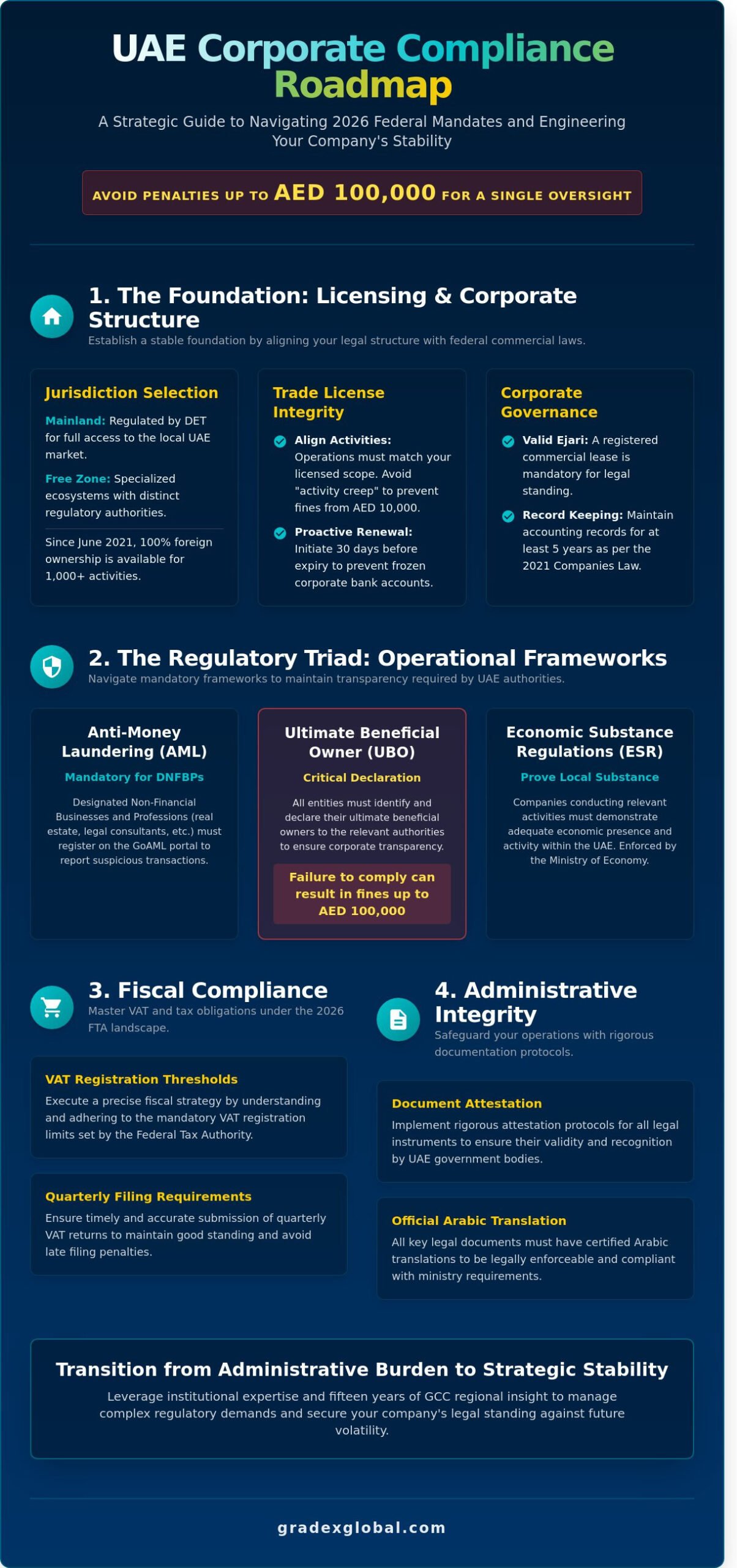
- Identify the critical alignment between trade license scopes and federal commercial laws to establish a stable foundation for your corporate structure.
- Navigate the mandatory frameworks of AML, UBO, and ESR reporting to maintain the transparency required by UAE regulatory authorities.
- Execute a precise fiscal strategy by mastering VAT registration thresholds and quarterly filing requirements under the 2026 Federal Tax Authority landscape.
- Understand how to ensure my business is compliant with uae law by implementing rigorous document attestation and Arabic translation protocols for all legal instruments.
- Transition from administrative burden to strategic stability by leveraging institutional expertise and fifteen years of GCC regional insight to manage complex regulatory demands.
The Foundation of UAE Corporate Compliance: Licensing and Structure
Corporate compliance in the United Arab Emirates represents a rigorous adherence to federal and local commercial mandates. It’s the structural integrity upon which every successful enterprise is built. To understand how to ensure my business is compliant with uae law, you must first master the legal framework established by Federal Decree-Law No. 32 of 2021. This legislation, often referred to as the United Arab Emirates corporate law, governs the formation, management, and dissolution of commercial entities. Structural stability begins with selecting the correct jurisdiction. Mainland companies, regulated by the Department of Economy and Tourism (DET), offer total access to the local market. Conversely, Free Zone entities provide specialized ecosystems but operate under distinct regulatory authorities. Since the landmark amendment in June 2021, 100% foreign ownership is now permitted for more than 1,000 commercial and industrial activities, eliminating the previous requirement for a local majority shareholder in most sectors.
Trade License Maintenance and Activity Alignment
Precision in licensing is non-negotiable. Every physical operation must align exactly with the activities listed on your commercial permit. “Activity creep,” the practice of engaging in services outside your licensed scope, carries heavy risks. In Dubai and Abu Dhabi, unauthorized activities can result in administrative fines starting from 10,000 د.إ. To maintain compliance, you should conduct quarterly audits of your operational output against your license parameters. If your business evolves, you must officially amend your license through the relevant licensing authority. Proactive renewal is equally vital. Most commercial banking facilities in the UAE freeze corporate accounts within 24 hours of a license expiration. You should initiate renewal protocols at least 30 days before the expiry date to ensure uninterrupted financial operations.
Corporate Governance and Legal Presence
A valid Ejari or commercial lease agreement is a prerequisite for legal standing in the UAE. By the start of 2026, the UAE Ministry of Economy aims to have all commercial licenses linked to a unified digital registry that requires real-time verification of physical office space. You can’t maintain a compliant status with a “virtual” presence that doesn’t meet the specific square footage requirements of your activity. Governance also demands meticulous documentation. While the role of the Local Service Agent (LSA) has shifted for many commercial activities, professional licenses still require an LSA to manage governmental relations. How to ensure my business is compliant with uae law involves more than just external filings; it requires internal discipline. You must maintain a robust corporate minute book and document all board resolutions. Under the 2021 Companies Law, failure to maintain proper accounting records for at least five years can lead to significant legal liabilities for directors and managers.
- Verify that your Ejari is registered in the “RERA” system to avoid renewal delays.
- Update the National Economic Register (NER) whenever there’s a change in management.
- Ensure all Ultimate Beneficial Owner (UBO) declarations are submitted to avoid fines of up to 100,000 د.إ.
Operational Regulatory Frameworks: AML, UBO, and ESR
The UAE regulatory environment demands a level of precision comparable to large scale engineering projects. Operating without a clear compliance framework risks the structural integrity of your enterprise. To understand how to ensure my business is compliant with uae law, you must first master the triad of Anti-Money Laundering (AML), Ultimate Beneficial Ownership (UBO), and Economic Substance Regulations (ESR). These aren’t mere suggestions; they’re rigid legal pillars enforced by the Ministry of Economy and various Free Zone authorities to maintain the nation’s financial reputation.
Anti-Money Laundering (AML) and GoAML Registration
Businesses within the UAE, particularly those classified as Designated Non-Financial Businesses and Professions (DNFBPs), face strict oversight. This category includes real estate agents, precious metal dealers, and legal consultants. Registration on the GoAML portal is a mandatory technical requirement for these sectors. You’re required to appoint a qualified Compliance Officer to oversee internal audits and report suspicious transactions. Implementing robust Know Your Customer (KYC) procedures for every business partner is the only way to mitigate risk. Failure to register or maintain these standards can result in administrative fines starting from AED 50,000 and reaching up to AED 1,000,000 for severe infractions.
UBO and ESR Reporting Requirements
Transparency serves as the cornerstone of the UAE’s modern economic infrastructure. Every entity must maintain a Real Beneficial Officer register and submit this data to their relevant licensing authority. This requirement works in tandem with the Federal Corporate Tax Law to ensure a transparent fiscal environment across all jurisdictions.
Economic Substance Regulations (ESR) apply if your business conducts “Relevant Activities” such as banking, insurance, shipping, or distribution and service centers. Entities must prepare for the 2026 reporting cycle by ensuring their annual notifications and substance reports are filed before the specific deadlines set by their regulatory body. Precise documentation of local management, full-time employees, and physical assets in the UAE is vital to proving your business has adequate “substance” here. How to ensure my business is compliant with uae law often comes down to the accuracy of these annual filings.
Non-compliance triggers a sequence of escalatory measures. It starts with financial penalties but can quickly progress to the suspension or even the full revocation of your commercial license. In a market where reputation and stability are your primary assets, maintaining a clean regulatory record is non-negotiable. For those managing complex industrial or infrastructure projects, specialized support ensures every technical detail meets local standards. You can explore how professional oversight secures your operations by visiting Gradex Global. This level of control is what separates established market leaders from temporary players.
Navigating UAE Fiscal Compliance: VAT and Corporate Tax
The Federal Tax Authority (FTA) has transformed the UAE’s fiscal landscape into a model of digital precision. By 2026, the integration of the EmaraTax platform and automated reporting systems means compliance isn’t just a legal duty; it’s a structural requirement for operational stability. For leaders determining how to ensure my business is compliant with uae law, the focus must shift from annual reviews to real-time data accuracy. The FTA landscape in 2026 demands a proactive approach to tax technology, where financial records mirror the precision of a large scale engineering project.
Maintaining fiscal integrity requires strict adherence to record-keeping standards. Article 78 of the VAT Law mandates that businesses retain all financial records, including invoices, credit notes, and customs documents, for a minimum of 5 years. For entities involved in real estate or long term infrastructure, this period extends to 15 years. Failure to produce these documents during an FTA audit can result in administrative penalties starting at AED 10,000 for a first offense, rising significantly for repeated non-compliance.
Value Added Tax (VAT) Management
Precision in VAT management begins with understanding the registration thresholds. Any business with taxable supplies and imports exceeding AED 375,000 in the previous 12 months must register. Growing firms with expenses or revenues above AED 187,500 should consider voluntary registration to reclaim input tax on capital investments and operational costs. Every invoice issued must contain the supplier’s Tax Registration Number (TRN), the applicable 5% rate, and the specific date of supply to meet FTA standards. When you’re importing services from abroad, the Reverse Charge Mechanism shifts the tax obligation to the recipient, ensuring local and international services are taxed equitably within the UAE market.
Corporate Tax Obligations for 2026
The introduction of Federal Decree-Law No. 47 of 2022 established a 9% Corporate Tax (CT) on taxable income exceeding AED 375,000. This fiscal layer requires a sophisticated calculation of taxable income after accounting for allowable deductions and exemptions. Small Business Relief (SBR) remains a vital provision for the 2026 fiscal year, allowing eligible resident entities with gross revenue below AED 3,000,000 to be treated as having no taxable income. However, this relief doesn’t exempt the business from registration or filing requirements. For businesses operating within Free Zones, the necessity of audited financial statements is paramount to maintaining “Qualifying Free Zone Person” status and benefiting from the 0% preferential rate on qualifying income. This level of documentation is the only way to demonstrate how to ensure my business is compliant with uae law during high level inspections.
Safeguarding Administrative Integrity: Attestation and Translation
Business owners often overlook administrative protocols, yet document attestation serves as the silent pillar of UAE corporate stability. Without Ministry of Foreign Affairs (MOFA) validation, foreign documents lack legal standing within the Emirates. This verification process confirms the authenticity of signatures and seals, ensuring that cross-border legal recognitions remain airtight. If you’re analyzing how to ensure my business is compliant with uae law, prioritizing the chain of legality for your foundational documents is a non-negotiable step. Failure to secure these stamps can lead to the immediate rejection of bank account applications or commercial license renewals.
Certificate Attestation for Corporate and Personal Use
Corporate governance depends on the absolute validity of Power of Attorney (POA) and board resolutions. These documents must undergo a rigorous multi-step verification process, starting from the country of origin’s notary public and culminating in MOFA attestation in Dubai or Abu Dhabi. For regulated professional roles, the Ministry of Education requires specific personnel to hold a UAE Equivalence Certificate to meet strict visa quota requirements. This ensures that the qualifications of your leadership team align with local standards. Looking ahead, the 2026 process for Indian passport assistance has been optimized to expedite document verification for the large expat workforce, allowing companies to onboard technical experts without the typical 30-day administrative delays.
Legal Translation and Notary Services
Arabic is the only official language recognized for legal proceedings and government filings in the Emirates. Consequently, the Ministry of Justice regulates legal translation as a specialized, licensed profession. Every foreign contract, birth certificate, or memorandum of association must be translated by an authorized professional to be admissible in court. To maintain operational momentum, companies now utilize online notary services provided by the Dubai Courts or Abu Dhabi Judicial Department (ADJD) to execute commercial contracts remotely. This digital shift has reduced contract execution times from several days to under 24 hours. Standardizing these official communications is vital for meeting Ministry of Human Resources (MOHRE) requirements, particularly during labor inspections where 100% documentation accuracy is expected to avoid administrative fines that can exceed AED 10,000 per violation.
- MOFA Validation: Required for all foreign-issued corporate documents to be recognized by UAE banks.
- Equivalence Certificates: Essential for engineers, doctors, and teachers to secure specialized work permits.
- Arabic Translation: Must be performed by Ministry of Justice licensed translators to hold legal weight.
- Digital Notarization: Use Botim or official court portals to verify signatures without physical presence.
Precision in administrative tasks prevents the costly friction of legal disputes. By establishing a robust system for document management, you protect your firm’s operational continuity and maintain a high standing with federal authorities.
Ensure your administrative framework is built on a foundation of engineering precision by partnering with Gradex Global for your complex corporate compliance needs.
Strategic Compliance Management with Grad-Ex Consultancy
Effective corporate governance in the Emirates requires a shift in perspective. Viewing regulatory adherence as a series of isolated administrative tasks often leads to oversight. At Grad-Ex Consultancy, we frame compliance as a managed service, integrating it into the core infrastructure of your operations. Our methodology leverages 15 years of established institutional relationships within the GCC to provide a shield against regulatory volatility. We replace the uncertainty of hourly billing with transparent fixed-fee models for document processing and strategic advisory subscriptions, allowing for precise budgetary forecasting.
Maintaining a competitive edge depends on your ability to anticipate shifts in the legal landscape. Our team provides proactive regulatory monitoring, ensuring that your entity adapts to changes before they become liabilities. You won’t have to wonder how to ensure my business is compliant with uae law when every legislative update is filtered through our analytical framework and applied to your specific corporate structure. This systematic approach ensures long-term stability and protects your capital in one of the world’s most dynamic markets.
Our Tiered Strategic Consultancy Plans
We provide three distinct service levels tailored to the complexity of your operations. Our Basic plan handles essential renewals and filings for SMEs. The Standard and Premium tiers introduce recurring financial analysis and market research, which are critical for businesses scaling across different Free Zones. These plans include dedicated expert email support, providing rapid responses to regulatory shifts. Having a structured support system means your leadership can focus on growth while we manage the intricate details of statutory requirements.
End-to-End Business Setup and Licensing Support
Precision is the hallmark of our setup services. We manage authority approvals and trademark filings with the same rigor found in engineering projects. Our network facilitates international operations through a global chain of translation and attestation services, ensuring your documents meet the strict standards of UAE ministries. For organizations seeking absolute certainty, we offer a comprehensive compliance audit of your UAE entity. This deep-dive assessment identifies potential gaps in your current framework. Contact our experts today to secure your operational integrity and discover how to ensure my business is compliant with uae law through professional oversight.
- Institutional relationship management spanning 15 years in the Middle East.
- Fixed-fee structures for predictable financial planning.
- Tiered consultancy models designed for scalability.
- Global attestation and translation networks for seamless cross-border operations.
Navigating the 2026 UAE Regulatory Landscape
Maintaining business continuity in the Emirates requires more than just a valid trade license. It demands a rigorous, ongoing adherence to evolving AML, ESR, and UBO reporting standards. As the regional fiscal environment matures, integrating Corporate Tax and VAT protocols into your daily operations is the only way to protect your capital from penalties that can impact your bottom line. Understanding how to ensure my business is compliant with uae law involves managing these complex requirements across both mainland and free zone jurisdictions with total precision.
Grad-Ex Consultancy brings over 15 years of strategic GCC advisory experience to your boardroom, acting as a stable partner for high-stakes projects. We provide total cost transparency through fixed-fee document processing, ensuring your administrative integrity remains unshakeable. Our expertise ensures that every technical and legal detail is handled with the care your investment deserves. Secure your business future with Grad-Ex Consultancy. Build your enterprise on a foundation of absolute regulatory certainty and long-term stability.
Frequently Asked Questions
What are the penalties for non-compliance with UAE AML laws in 2026?
Penalties for non-compliance with UAE Anti-Money Laundering (AML) laws in 2026 include administrative fines ranging from AED 50,000 to AED 5,000,000 per violation. These sanctions, established under Federal Decree-Law No. (20) of 2018, target failures in customer due diligence and suspicious activity reporting. Repeat offenders face license revocation or prison sentences. Maintaining a robust compliance framework is essential to avoid these severe financial and legal repercussions.
How often do I need to renew my UAE trade license?
You must renew your UAE trade license every 12 months to maintain legal operations and avoid administrative fines. The Department of Economic Development (DED) or the relevant Free Zone Authority issues these licenses for a one year term. Late renewals incur monthly penalties of AED 200 or more depending on the specific jurisdiction. Consistent renewal is a foundational step in how to ensure my business is compliant with uae law and operational without interruption.
Is corporate tax mandatory for all businesses in the UAE?
Corporate tax is mandatory for all businesses in the UAE, including those in free zones, for financial years beginning on or after June 1, 2023. While a 0% rate applies to taxable income up to AED 375,000, profits exceeding this threshold are taxed at 9%. Every taxable person must register with the Federal Tax Authority (FTA) regardless of their specific income level or residency status. Failure to register within the deadlines set by the FTA results in a fine of AED 10,000.
Do I need an equivalence certificate for my employees to be compliant?
An equivalence certificate is required for employees whose roles demand specific academic qualifications recognized by the UAE Ministry of Education. This process verifies that degrees obtained outside the UAE meet local educational standards. While not every administrative position requires it, engineering, medical, and teaching professionals must secure this document to obtain a valid professional license and work permit. It’s a critical component of the labor compliance process for technical industries.
What is the difference between MOFA attestation and legal translation?
MOFA attestation is the process of authenticating a document’s validity through the Ministry of Foreign Affairs, whereas legal translation is the official conversion of a document into Arabic. You must first attest your original documents in the country of origin and then by MOFA in the UAE. Following this, a translator licensed by the Ministry of Justice performs the legal translation to make the document legally binding for local government authorities.
Can a foreign business owner manage compliance without a local partner?
Foreign business owners can manage compliance without a local partner for most commercial and industrial activities under the 2021 amendments to the Commercial Companies Law. This legislation allows 100% foreign ownership in mainland companies, removing the previous requirement for a 51% local shareholder. Owners must still appoint a professional compliance officer or legal firm to navigate complex regulatory filings and maintain statutory records. This autonomy requires a deeper understanding of how to ensure my business is compliant with uae law through direct engagement with authorities.
What documents are required for UBO reporting in the UAE?
Required documents for Ultimate Beneficial Owner (UBO) reporting include the Register of Partners and the Register of Real Beneficial Owners as mandated by Cabinet Decision No. (109) of 2023. You must submit copies of valid passports, Emirates IDs, and proof of residential addresses for all individuals holding at least 25% of the company’s capital. Companies must update these records within 15 days of any change to avoid fines starting at AED 15,000.
How does the UAE Corporate Tax affect free zone companies?
UAE Corporate Tax affects free zone companies by requiring them to register and file returns, although “Qualifying Free Zone Persons” may benefit from a 0% tax rate on qualifying income. This incentive applies only if the entity maintains adequate substance and complies with all transfer pricing rules. Non-qualifying income or income derived from mainland sources is generally taxed at the standard 9% rate. Free zone entities must conduct a detailed audit to determine which income streams meet the qualifying criteria.