
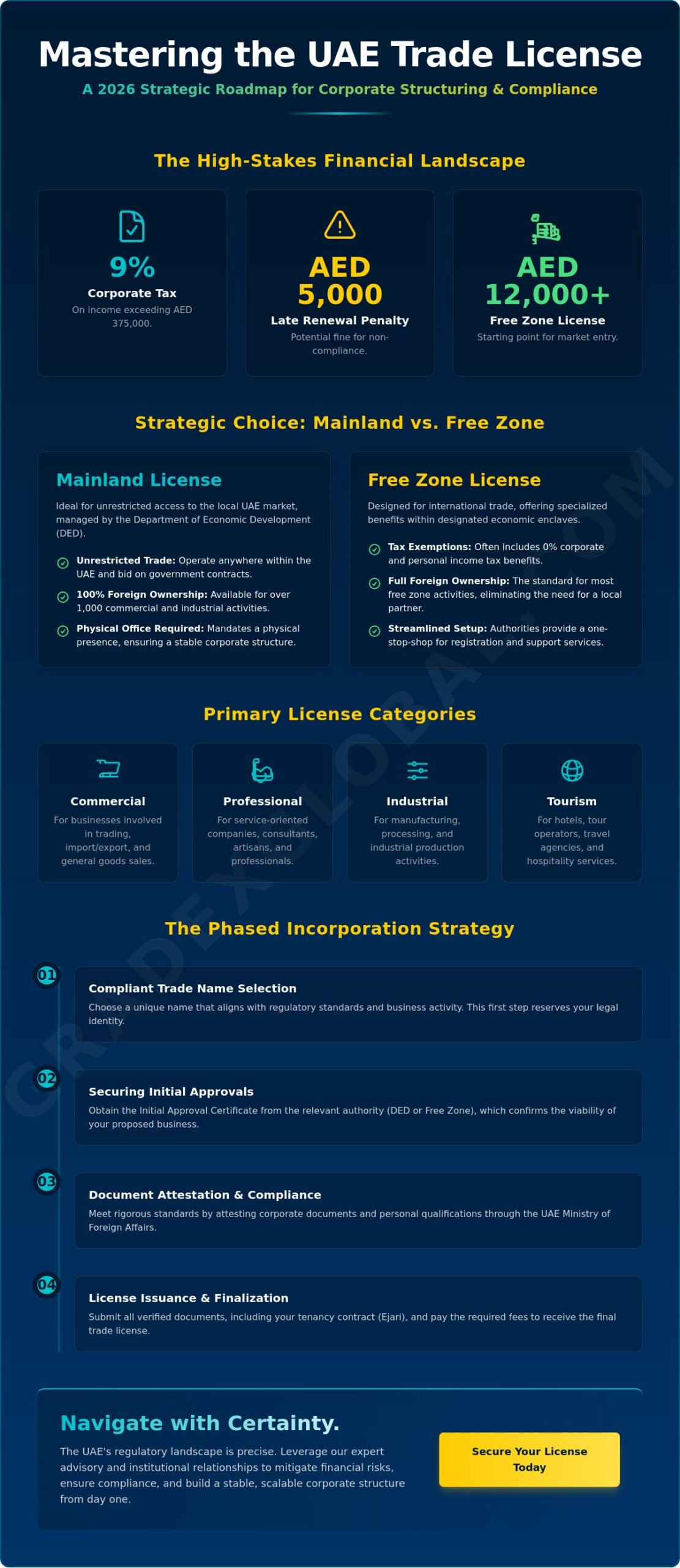
A trade license in the UAE isn’t just a regulatory permit; it’s a foundational structural asset that dictates the long-term stability and operational scope of your entire enterprise. Securing this asset requires the same engineering precision as a large-scale infrastructure project. You likely understand that the bureaucratic landscape often feels like a labyrinth of opaque processes, where a single misstep leads to non-compliance. With corporate tax now set at 9% for income exceeding AED 375,000 and late renewal penalties reaching up to AED 5,000, the margin for error has vanished.
We’ve designed this expert-led strategic roadmap to help you master these complexities with absolute certainty. You’ll gain a clear understanding of your legal obligations, from navigating 100% foreign ownership for over 1,000 commercial activities to selecting between mainland and free zone jurisdictions. This guide provides a detailed breakdown of current 2026 costs, such as the AED 12,000 starting point for free zone licenses, ensuring your market entry is both planned and executed with professional rigor. We’ll examine the technical requirements for physical office spaces and the specific criteria for Small Business Relief to ensure your corporate structure remains lean, stable, and compliant.
Key Takeaways
- Understand how a trade license functions as the sovereign authorization essential for establishing your company’s legal personality and structural foundation.
- Evaluate the four primary license categories to determine the optimal ownership structure and ensure your business activities align with 100% foreign ownership regulations.
- Execute a phased incorporation strategy that covers everything from compliant trade name selection to securing critical initial approvals with precision.
- Navigate the complexities of document attestation and educational equivalency to meet the rigorous compliance standards of the UAE Ministry of Foreign Affairs.
- Leverage professional advisory to mitigate financial risks through precise activity coding and long-standing institutional relationships within the UAE market.
Understanding the UAE Trade License: The Foundation of Corporate Legitimacy
A trade license represents far more than a simple permit; it is the sovereign authorization required to conduct commercial, professional, or industrial operations within the Emirates. Within the broader context of the UAE Economic Overview, this document serves as the structural foundation for corporate legitimacy. It effectively establishes a separate legal personality for your enterprise, which is a critical mechanism for insulating personal assets from corporate liabilities. This legal separation allows the company to enter into contracts, own assets, and assume obligations in its own name. As we move through 2026, the regulatory landscape demands higher transparency and deeper digital integration. This shift ensures every registered entity contributes to a data-driven ecosystem, aligning individual business goals with the UAE’s broader vision for a diversified, technology-first economy.
The 2026 regulatory framework emphasizes precision. Authorities have moved beyond simple record-keeping to a system where corporate data is synchronized across federal and local departments. This integration isn’t just about oversight; it’s a strategic move to enhance the nation’s global competitiveness. For the entrepreneur, this means the process of securing a trade license is now a sophisticated exercise in compliance and strategic planning. It requires a clear understanding of how your specific business activities fit into the nation’s long-term infrastructure goals, such as the “We the UAE 2031” vision.
The Legal Significance of a Valid License
Possessing a valid license provides a robust framework for the protection of intellectual property and trade names under federal law. It acts as the primary key to unlocking institutional resources. Without it, your firm cannot establish corporate banking relationships, secure employee visa quotas, or participate in high-value government contract bidding. A trade license is the primary legal instrument for fiscal and operational compliance. It guarantees that your business operates within the established parameters of the law, providing security to both partners and clients.
Regulatory Authorities and Jurisdiction
The Ministry of Economy sets national standards, but the execution of licensing falls under specific jurisdictions. The Department of Economic Development (DED) manages mainland licenses, which allow for unrestricted trade within the local market. Conversely, various Free Zone Authorities oversee their respective enclaves, offering specialized benefits for international trade. The introduction of the UAE Unified Licence (DUL) has streamlined national business data by assigning a unique identification number to every entity. This precision-driven system reduces administrative friction and enhances the speed of cross-border verification, making the UAE one of the most efficient business hubs in the world.
Categorising Your Business Activity: Strategic License Selection
Selecting the correct activity code is the most critical engineering decision in the incorporation process. It’s not just a label; it defines your legal capacity and tax obligations. Since the June 2021 amendments to the Commercial Companies Law, foreign investors can access 100% ownership for over 1,000 commercial and industrial activities on the mainland. This change effectively eliminated the 51% local shareholder requirement for most sectors. However, choosing the wrong code can lead to “activity creep,” where your operational scope exceeds your legal permit, resulting in significant fines or the inability to bid for specific contracts. Precision at this stage ensures your trade license supports future scalability rather than restricting it.
Every activity code you select carries specific implications for your visa quota and office space requirements. For instance, an industrial license might require a minimum square footage that a professional consultancy doesn’t. Precise definition of your scope prevents the administrative friction of adding activities later. Such amendments often require a full license revision and additional government fees. It’s often more efficient to consult with a strategic partner to map out your 3-year growth plan before finalizing your application.
Commercial vs. Professional Licenses
Commercial licenses cover tangible trade, such as retail, distribution, or general trading. These typically offer 100% foreign ownership on the mainland. Professional licenses are reserved for service-based firms, artisans, and consultancies. While professional entities also allow for 100% ownership, they often require a Local Service Agent (LSA) to manage administrative liaisons. The primary difference lies in liability; professional firms are often structured as civil companies, where liability may not be as strictly limited as in a Limited Liability Company (LLC). Following the official steps for a UAE trade license is essential to ensure your legal structure matches your risk profile.
Industrial and Tourism Licenses
Industrial licenses are mandatory for manufacturing, power generation, or any activity involving heavy machinery. These require physical premises and involve inspections from the Ministry of Industry and Advanced Technology. You’ll need external approvals from environmental departments and Civil Defence to ensure your facility meets safety standards. Tourism licenses follow a different logic, focusing on hospitality and travel agency operations. These are regulated by local tourism authorities, such as DTCM in Dubai. Each category demands specific documentation and often higher capital requirements, making the initial selection a high-stakes decision for any international firm.
The Phased Procedure for Obtaining a Trade License in 2026
Executing a business setup in the UAE is a process of interlocking dependencies. It requires a structured, multi-stage approach where each step serves as a prerequisite for the next. The 2026 regulatory environment has refined these phases to ensure maximum administrative efficiency. You must first determine the legal form of your entity, such as a Limited Liability Company (LLC) or a Branch of a Foreign Company, before selecting a unique trade name. This sequence ensures that your corporate identity is legally viable and technically sound from day one. Successfully securing a trade license depends on the precise execution of these five critical phases: name reservation, initial approval, documentation drafting, lease finalization, and final payment.
Trade Name Reservation and Initial Approval
Your trade name must adhere to strict linguistic and cultural criteria to gain approval. Prohibited terms include those with religious references, names of political groups, or words that imply government affiliation without explicit permission. Once the name is reserved, you must apply for Initial Approval from the Department of Economic Development (DED) or the relevant Free Zone Authority. This certificate signifies that the UAE government has no objection to your business presence. It allows you to proceed with secondary legal steps, such as signing a lease or drafting the Memorandum of Association. Typically, an Initial Approval certificate remains valid for six months, providing a specific window to finalize your remaining structural requirements.
Legal Documentation and Notarisation
The Memorandum of Association (MOA) serves as the legal blueprint of your enterprise. It outlines the shareholding structure, profit-sharing ratios, and management powers. Precision in drafting this document is non-negotiable to ensure long-term shareholder protection. To accelerate this phase, many firms now utilize online notary services to verify signatures and identities remotely. This digital integration has reduced the notarisation timeline from several days to just a few hours. All legal documents must be provided in both Arabic and English through a certified legal translator to satisfy federal requirements. This dual-language approach ensures your corporate governance remains transparent to both local authorities and international partners.
Following the notarisation of the MOA, you must finalize a physical or virtual office lease agreement. For Dubai Mainland entities, a physical office remains mandatory, and the lease must be registered through the Ejari system to verify the business’s physical substance. The final phase involves the submission of all verified documents and the payment of licensing fees. As of April 2026, the basic license cost for a Dubai Mainland Commercial entity ranges between AED 10,000 and AED 20,000. Once payment is processed, the authority issues the trade license, officially authorizing your firm to commence operations within the UAE’s high-growth economy.
Critical Compliance: Document Attestation and Educational Equivalency
Securing a trade license is contingent upon the verification of your corporate and personal credentials through a process known as attestation. This is not a mere formality; it’s a multi-stage validation that ensures every director and manager listed on the license possesses the requisite expertise. Any discrepancy in these documents, such as a missing stamp from the country of origin’s Ministry of Foreign Affairs or a signature mismatch, results in the immediate rejection of the application. For professional license categories, the requirements are even more stringent, necessitating a formal equivalence certificate to align international degrees with UAE educational standards. As of April 2026, this recognition process has become more integrated with digital government platforms, yet it still requires precise physical documentation from the issuing institution.
The attestation chain follows a rigid hierarchy. It must begin at the relevant government department in the document’s country of origin, proceed to that nation’s Ministry of Foreign Affairs, and then be verified by the UAE Embassy. The final step occurs within the UAE at the Ministry of Foreign Affairs (MOFA). For international firms opening a branch office, this process extends to commercial documents, including the parent company’s Articles of Association and a Board Resolution authorizing the expansion. To ensure your documentation meets these rigorous standards without delay, partner with our compliance experts for a managed attestation strategy.
The Role of Certificate Attestation
Authorities mandate attestation for managers and directors to verify their legal and professional standing before they’re officially registered on a company’s license. This requirement extends to branch offices of international firms, which must present attested certificates of incumbency to prove the parent entity’s active status. Attestation is the primary barrier to entry for many professional firms. Without these verified credentials, the licensing authority cannot approve the visa quotas or the corporate structure, effectively halting the incorporation process before it begins.
Ejari and Physical Office Requirements
A mainland trade license requires a verified physical address to establish operational substance. This is managed through Ejari, the mandatory registration system for all commercial tenancy contracts in Dubai. In 2026, a private office in the mainland typically starts from AED 15,000 and can exceed AED 50,000 annually depending on the location. For startups or smaller enterprises, shared or flexi-desk options are available, with annual costs ranging between AED 5,000 and AED 15,000. While some free zones offer virtual office packages, mainland entities must demonstrate a physical footprint to comply with federal regulations and secure a greater number of employee visas.
Strategic Advisory: Why Professional Consultancy is Essential
Executing a successful market entry in the UAE requires a level of precision that mirrors the engineering of the nation’s most ambitious infrastructure projects. While digital portals offer a facade of simplicity, the underlying legal and financial structures demand professional oversight to ensure long-term stability. Utilizing a consultancy with over 15 years of institutional relationships within the UAE market ensures that your trade license application isn’t just submitted, but strategically optimized for the current regulatory climate. Professional advisors mitigate financial risks by conducting rigorous activity coding and fee analysis, preventing the costly errors that often arise from a DIY approach. By streamlining the end-to-end process from legal translation to final authority approvals, we eliminate the administrative friction that typically delays corporate operations.
Efficiency in this landscape is born from a single point of accountability. When multiple vendors handle different stages of the setup, the risk of data misalignment increases. We manage the entire spectrum of incorporation, ensuring that your Memorandum of Association, office lease, and activity permits are perfectly synchronized. This integrated approach is particularly vital for international firms that require a seamless transition from their home jurisdiction to the UAE’s specialized economic zones. Our role is to act as the technical lead, ensuring every component of your corporate structure is built to last.
Beyond Incorporation: Ongoing Compliance
Stability in the UAE market is maintained through consistent, proactive compliance. Your initial setup is only the first phase of a long-term corporate lifecycle. Annual trade license renewals, which as of April 2026 typically cost between AED 10,000 and AED 25,000 for mainland entities, must be managed with punctuality to avoid late-renewal penalties that can reach AED 5,000. Beyond renewals, protecting your brand through trademark registration is a critical defensive measure that should be initiated alongside the licensing process. A strategic consultant manages these critical timelines, allowing your leadership to focus on market expansion while ensuring your legal foundation remains unassailable.
The Grad-Ex Advantage
We provide a sophisticated framework for business setup that prioritizes transparency and predictability. Our fixed-fee approach to document attestation and licensing provides the budgetary certainty required by large-scale international firms and institutional investors. We possess the deep technical expertise needed to handle complex authority approvals for regulated industries, such as heavy manufacturing or specialized financial services. This specialized knowledge ensures that even the most intricate corporate structures are executed with engineering-level accuracy. Contact Grad-Ex Consultancy for a comprehensive business setup evaluation tailored to your firm’s specific operational requirements.
Executing Your Strategic Market Entry with Precision
Securing a trade license in 2026 is a sophisticated operation that demands absolute technical accuracy. We’ve examined the critical phases of incorporation, from the precise selection of activity codes to the rigorous multi-stage attestation required by the Ministry of Foreign Affairs. These steps form the infrastructure of your business, ensuring every regulatory requirement is met with engineering-level detail. A successful setup isn’t merely about obtaining a permit; it’s about architecting a compliant, scalable entity that can withstand the evolving fiscal demands of the UAE market.
Navigating this complex landscape requires a partner who understands the structural nuances of the Emirates. Grad-Ex Consultancy brings 15+ years of strategic advisory experience and deep institutional relationships with UAE authorities to every project. We offer a fixed-fee approach to document attestation, providing the financial predictability your firm needs to scale with confidence. Secure your UAE Trade License with Grad-Ex Consultancy to ensure your enterprise is built on a foundation of stability and total compliance. We’re ready to help you establish a lasting corporate presence in this high-growth economy.
Frequently Asked Questions
How long does it take to get a trade license in the UAE in 2026?
Obtaining a license typically takes between 3 and 5 working days for standard mainland applications, provided all documentation is verified and initial approvals are secured. Instant licenses in jurisdictions like Abu Dhabi or Dubai can be issued within minutes for specific activities that don’t require external department approvals. Complex industrial setups requiring site inspections from environmental or safety authorities may extend this timeline to several weeks.
Can a foreigner own 100% of a company in the UAE?
Foreign investors can maintain 100% ownership of mainland companies for over 1,000 commercial and industrial activities as per the 2021 amendments to the Commercial Companies Law. This regulation effectively removed the requirement for a local 51% shareholder in most sectors. Free zones have always allowed full foreign ownership, providing a stable environment for international firms to operate without the need for a local partner.
What is the difference between a mainland and a free zone trade license?
The primary difference lies in the geographical and operational scope of the business. A mainland trade license allows a company to trade freely across the entire UAE and bid for government contracts without restrictions. In contrast, free zone entities are generally restricted to trading within their specific zone or internationally, though they benefit from specialized infrastructure and simplified customs procedures tailored to specific industries.
Is a physical office mandatory for all trade licenses?
A physical office is mandatory for all mainland licenses, requiring a registered tenancy contract through the Ejari system. This ensures the business has a verifiable physical substance within the local market. However, certain free zone jurisdictions and specialized permits, such as the Dubai E-Trader license, allow for virtual office or flexi-desk arrangements to accommodate startups and home-based digital enterprises during their initial growth phase.
What are the main reasons for trade license application rejection?
Rejections most frequently stem from documentation errors, such as non-attested educational certificates or mismatched signatures on the Memorandum of Association. Authorities also reject applications that propose prohibited trade names or activities that conflict with national security and public policy. Ensuring all documents are translated into Arabic by certified professionals and verified by the Ministry of Foreign Affairs is essential to prevent these administrative setbacks.
How much does a trade license cost in the UAE?
Basic license costs for a Dubai Mainland Commercial entity currently range between AED 10,000 and AED 20,000 as of April 2026. General trading licenses often require a higher investment, ranging from AED 18,000 to AED 30,000. It’s important to account for additional expenses, such as the AED 3,000 to AED 6,000 per-visa fee and mandatory office lease costs, which vary significantly by location and facility type.
Do I need a trade license to work as a freelancer?
You must possess a valid freelance permit or trade license to legally conduct professional services as an individual in the UAE. Many free zones offer dedicated freelance packages that provide a residency visa and the legal right to invoice clients. Operating without this authorization is a violation of federal labor laws and can result in significant fines or legal action for non-compliance.
What documents are required for trade license renewal?
Renewal requires a valid tenancy contract registered through Ejari, passport copies of shareholders, and the existing license document. Some jurisdictions and specific industrial activities may also demand a recent audit report or updated environmental clearance certificates. Completing this process before the expiry date is vital to avoid late renewal penalties, which can range from AED 200 to AED 5,000 depending on the duration of the delay.