
A single missing stamp from a local notary thousands of miles away can instantly nullify your entire UAE residency application. Many professionals mistakenly assume an Apostille is sufficient for international use, yet the United Arab Emirates remains a non-signatory to the Hague Convention, requiring a rigid, multi-step legalization chain. Identifying the common mistakes in document attestation for uae is the first step toward preventing the rejection of your credentials and the costly visa delays that often disrupt professional transitions. We recognize that navigating these multi-country legal requirements is often a source of significant frustration and financial loss for those unprepared for the technical precision the process demands.
This guide provides a definitive framework to ensure your MOFA attestation is successful on the first attempt. We’ll examine the 2026 digital attestation protocols, including the specific fee structures for personal and commercial documents, to provide you with absolute clarity. By following this structured approach, you’ll secure your documents against administrative denial and ensure your transition to the Emirates proceeds with the stability and efficiency your career requires. From understanding the hierarchy of home country stamps to mastering the new digital submission channels, we’ll provide the technical insight needed to manage your documentation with total control.
Key Takeaways
- Master the multi-step chain of legalization to ensure each home-country verification meets the precise standards required by the UAE Ministry of Foreign Affairs.
- Identify and rectify common mistakes in document attestation for uae, such as submitting photocopies for primary verification or failing to distinguish between educational and personal document protocols.
- Adapt to the 2026 transition toward E-Attestation and digital stamps to maintain procedural compliance within the increasingly automated UAE regulatory framework.
- Mitigate the risk of rejection by utilizing certified translation services and initiating the attestation process at least 30 days prior to critical visa deadlines.
- Leverage professional consultancy and fixed-fee structures to eliminate hidden costs and ensure the technical precision necessary for a successful first-time attestation.
Understanding the UAE Document Attestation Hierarchy
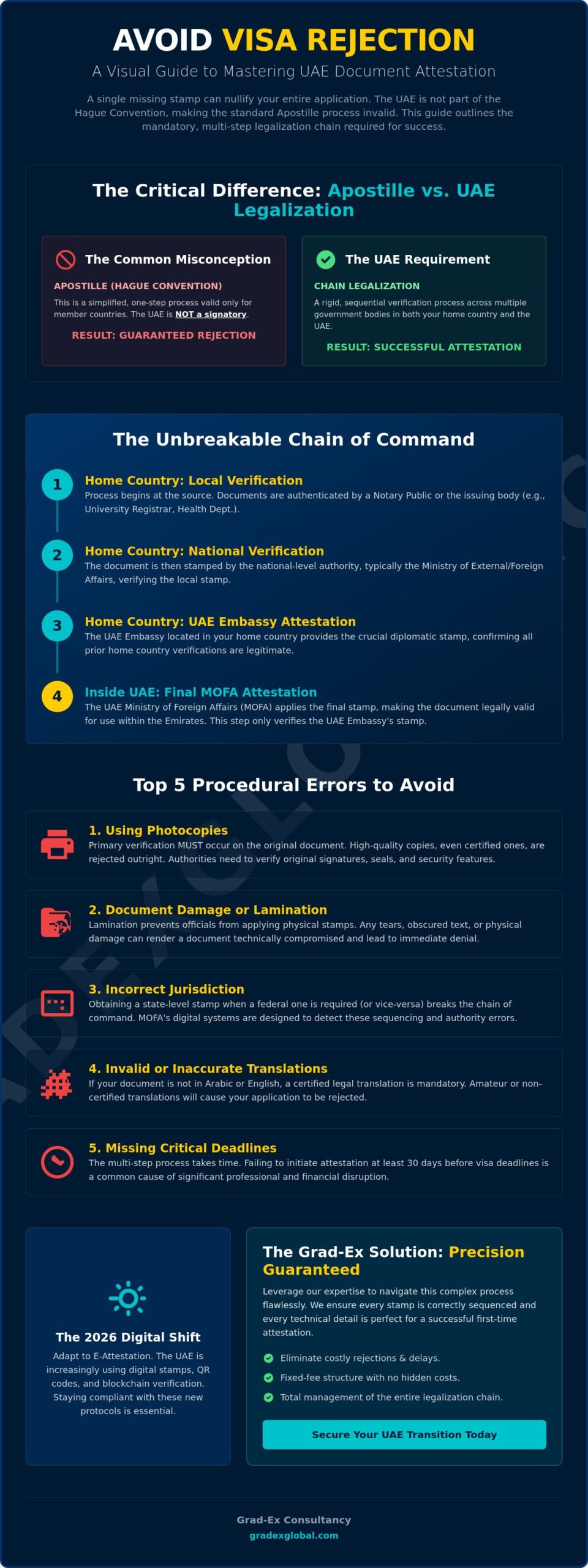
The document attestation process for the United Arab Emirates is a rigid, multi-layered legal verification framework designed to ensure that foreign-issued certificates possess the same legal standing as domestic documents. In 2026, the UAE Ministry of Foreign Affairs (MOFA) has significantly modernized this landscape by integrating advanced digital verification systems, yet the underlying requirement for a complete, unbroken chain of custody remains absolute. Professional success in the Emirates often hinges on this procedural precision. A foundational concept in Understanding Document Legalization is that each authority only validates the signature and seal of the preceding authority. If a single stamp from the issuing country is missing or improperly sequenced, the entire document becomes legally void for UAE use, regardless of its original authenticity.
MOFA acts as the final gatekeeper in this hierarchy. It doesn’t verify the facts of your graduation or marriage directly; instead, it confirms that the UAE Embassy in your home country has correctly verified the local government’s stamps. This system creates a secure bridge between different legal jurisdictions. In 2026, many of these steps have transitioned to digital formats, where QR codes and blockchain-backed signatures allow for near-instant verification. However, the logic of the hierarchy hasn’t changed. The process remains a bottom-up structure where the integrity of the final UAE stamp depends entirely on the stability of the foundational local stamps.
The Standard Attestation Chain of Command
The hierarchy begins with a Notary Public or the relevant local department in the issuing country, which performs the primary authentication of the document’s origin. Following this, the document must move to the central government level, typically the Home Department or the Ministry of External Affairs, for sovereign-level validation. The final international step is the UAE Embassy within that specific country. This diplomatic bridge serves as the essential prerequisite for the MOFA stamp within the Emirates. Each entity in this sequence acts as a technical guarantor for the one that follows, creating a verifiable trail of legitimacy that satisfies UAE authorities.
Why Rejections Occur at the Final Stage
Rejections at the MOFA level are frequently the result of technical oversights rather than intentional fraud. One of the common mistakes in document attestation for uae involves the assumption that an international Apostille bypasses the need for UAE Embassy involvement. Since the UAE isn’t a member of the Hague Convention, this shortcut is a guaranteed path to rejection. Additionally, filing documents in the wrong jurisdiction within the home country, such as obtaining a state-level stamp when a federal-level stamp is required, will trigger an immediate denial. MOFA’s 2026 digital systems are specifically tuned to identify these sequencing errors. They cross-reference digital signatures across the entire chain, ensuring that every stamp has been applied by a verified, authorized official in the correct order. Without this technical alignment, the document can’t be processed, leading to costly delays in visa issuance.
Frequent Procedural Errors in the Attestation Chain
The technical integrity of a document is the first point of failure in the legalization process. Many applicants encounter significant delays because they attempt to attest high-quality photocopies rather than original certificates. UAE authorities, as specified in the Official UAE Government Guidelines, mandate that the primary verification occur on the original document to ensure the authenticity of wet-ink signatures and security features. This is one of the most persistent common mistakes in document attestation for uae.
Another critical oversight involves the document’s physical state. A certificate that is laminated, torn, or contains obscured text is technically compromised. Lamination is particularly problematic because it prevents officials from applying the necessary physical stamps or verifying the paper’s texture. If your document is currently laminated, you’ll likely need to request a duplicate original from the issuing authority before starting the chain. Additionally, mistaking a “True Copy” notarization for a full government attestation is a frequent error. A notary’s “True Copy” stamp only confirms that a photocopy matches an original; it doesn’t satisfy the requirement for state-level or diplomatic validation.
Educational vs. Personal Document Nuances
Educational credentials require a distinct verification path compared to birth or marriage certificates. In 2026, degree certificates often require a prior verification step from the awarding university or a dedicated educational board before any ministry stamps are applied. Certain visa categories now also demand the submission of an original, attested transcript alongside the degree. For personal documents like marriage certificates, name discrepancies are a primary cause for rejection. Every character must align perfectly with the current passport. Even a minor spelling variation can halt the process, necessitating a formal name correction or an affidavit.
Commercial Document Pitfalls
Corporate attestation is significantly more complex and carries higher financial stakes, with MOFA fees for commercial documents set at AED 2,000 per document as of May 2026. A Power of Attorney (POA) often fails at the final stage because it lacks a Chamber of Commerce stamp from the country of origin. Board Resolutions present another challenge; each member’s signature must be individually notarized and verified to meet UAE standards for corporate bank account setup or branch registration. Ensuring these technicalities are managed correctly is essential for business continuity. For those seeking professional oversight to manage these complexities, utilizing a specialized Certificate Attestation service can prevent these technical failures. Articles of Association (AOA) also require full chain legalization to be recognized by UAE banks, a step often overlooked by new market entrants.
Technical Discrepancies: Translation and Validity Issues
Technical precision extends beyond the stamps themselves to the literal content and physical state of your paperwork. One of the primary common mistakes in document attestation for uae is the failure to reconcile name spellings across a candidate’s entire document portfolio. If a marriage certificate or degree uses a middle initial while the passport displays a full name, the digital verification systems utilized in 2026 will flag the record for a manual review. This often leads to an immediate rejection. Similarly, the “Lamination Trap” remains a significant hurdle for many. Authorities require access to the original paper’s security fibers and the ability to apply physical or digital overlays. A laminated document is technically inaccessible. Attempting to peel off the plastic often results in irreversible damage, rendering the certificate void for official use.
Understanding the temporal validity of documents is equally vital for procedural success. While educational degrees generally don’t expire, police clearance certificates and certain power of attorney documents have strict validity windows. These are often as short as three to six months. Submitting a document that has technically expired according to the UAE Ministry of Foreign Affairs Attestation Guidelines will result in a procedural failure at the final stage, necessitating a complete restart of the attestation chain.
Certified Legal Translation Requirements
The UAE government maintains a rigorous standard for linguistic accuracy in all official proceedings. Only translations performed by professionals authorized by the UAE Ministry of Justice (MOJ) are legally recognized. A common error is assuming any fluent speaker or standard translation agency can provide the necessary documentation. For a translation to be valid, it must be physically or digitally stapled to the original attested document and bear the official seal of the MOJ-licensed translator. In 2026, these translations are increasingly cross-referenced against technical databases to ensure terminology in specialized certificates is precise. Errors in translating professional titles or medical specializations can lead to significant licensing delays in the healthcare and engineering sectors.
Attestation vs. Equivalency: Know the Difference
It’s critical to distinguish between the verification of a document’s origin and the recognition of its academic value. Attestation confirms a certificate is genuine, but for many professional roles, the Ministry of Education requires an equivalence certificate. This secondary process evaluates whether your foreign degree meets the UAE’s specific academic standards and credit requirements. For 2026 residency and professional licensing, obtaining the MOFA stamp is merely the prerequisite. You must often complete the equivalency process to legally practice your profession or secure specific grade-level employment. Failing to account for this second stage is a frequent cause of employment start-date delays and contract complications.
Managing Deadlines and Regulatory Changes in 2026
The UAE Ministry of Foreign Affairs has completed its transition to a primarily digital attestation ecosystem. This shift has introduced a new layer of complexity for those accustomed to traditional physical stickers. A critical failure point among common mistakes in document attestation for uae is the underestimation of administrative lead times. While digital processing for MOFA within the UAE can occur within two hours during official working hours, the preceding international steps remain subject to physical logistics and varying government speeds. Professionals who initiate the process less than 30 days before a visa deadline often face significant financial penalties or mandatory travel.
Public holidays in either the UAE or the issuing country can halt the attestation chain for several days. These interruptions are rarely synchronized. This creates bottlenecks that can derail a planned relocation. Additionally, verifying the validity of older attestations is essential. While the UAE MOFA stamp itself doesn’t typically expire, the underlying home-country stamps or the document’s content, such as a Power of Attorney, may have specific validity periods. Reusing a document attested years ago for a new 2026 visa application without verifying current regulatory alignment is a high-risk strategy. It often leads to rejection at the final portal.
The 2026 Digital MOFA Transition
The centerpiece of the current system is the QR code verification system. Modern UAE stamps are now digitally rendered. This allows authorities to cross-reference the document’s metadata against central databases instantly. Applicants can verify their status via the official MOFA portal using UAE Pass. A frequent error during this digital transition involves improper document scanning. Uploading low-resolution files or documents where the QR code is partially obscured will trigger an automated system rejection. Precision in the digital submission phase is as important as the physical stamps themselves.
Strategic Planning for Expatriates and Businesses
Successful family sponsorship requires a synchronized timeline where birth and marriage certificates are ready simultaneously. Managing these logistics across multiple international borders requires a methodical approach to courier scheduling and fee payments. In 2026, the cost differential between ‘Urgent’ and standard processing is substantial. This makes early planning a financial necessity rather than a luxury. For precise management of these timelines and to ensure your documentation adheres to the latest digital standards, you should secure professional Certificate Attestation services. This proactive step eliminates the variables that lead to administrative delays and ensures your move to the Emirates remains on schedule.
The Grad-Ex Solution: Ensuring Procedural Precision
Navigating the 2026 UAE regulatory framework requires more than administrative effort; it demands a technical partnership capable of mastering the entire legalization chain from inception to completion. Grad-Ex provides this stability by centralizing the management of credentials and eliminating the procedural gaps that lead to administrative rejection. The value of a professional consultancy lies in its ability to provide a guarantee of quality that individual applicants cannot replicate. A core component of this service is the fixed-fee model. This approach ensures that professionals and businesses are protected from the financial loss associated with repeated government fees or courier errors. By leveraging established institutional relationships with ministries and embassies, Grad-Ex maintains a level of control over the document’s journey that ensures total procedural integrity.
End-to-end management is a necessity in a landscape where a single missing “middle-step” in the home country renders the final UAE MOFA stamp impossible. Grad-Ex oversees every phase of this hierarchy, ensuring that the transition from local notary to sovereign validation and finally to the UAE Ministry of Foreign Affairs is seamless. This systematic approach transforms a complex international requirement into a predictable administrative milestone, allowing expatriates and corporate entities to focus on their primary objectives within the Emirates.
Risk Mitigation and Document Security
Document security is the foundation of the Grad-Ex service model. High-value original certificates are handled through rigid protocols designed to prevent loss or damage. Before the process begins, a comprehensive pre-check service identifies common mistakes in document attestation for uae, such as lamination issues, name discrepancies, or incorrect jurisdictional filings. This technical audit ensures that no document enters the attestation chain unless it is guaranteed to succeed. Real-time tracking and status updates provide a transparent view of the document’s progress across international borders, offering the peace of mind that comes from professional oversight.
Comprehensive Corporate and Personal Support
The scope of support extends beyond simple certificate verification to encompass the entire relocation and business expansion ecosystem. Grad-Ex provides tailored solutions for complex business setup requirements and commercial licensing, where the precision of Board Resolutions and Articles of Association is non-negotiable. Specialized assistance for Indian passport renewal and other vital consular services ensures that all personal documentation remains current and compliant with 2026 standards. To secure your professional or corporate transition against administrative denial, the most effective path is to consult with a Grad-Ex specialist for a document audit. This proactive measure ensures your documentation is handled with the technical precision your career requires.
Securing Your Professional Compliance in the Emirates
Success in the UAE’s 2026 regulatory environment depends on an uncompromising commitment to procedural accuracy. The most frequent obstacles, ranging from the improper sequencing of home-country stamps to digital submission errors, are entirely preventable with structured oversight. Recognizing the common mistakes in document attestation for uae is the definitive step toward ensuring your visa processing remains on schedule. By prioritizing the technical integrity of your credentials and aligning with the latest Ministry of Foreign Affairs digital protocols, you eliminate the risk of administrative denial and financial loss.
With over 15 years of strategic GCC advisory experience, Grad-Ex offers the stability required to manage complex international document chains. Our end-to-end management ensures precise coordination between ministries and embassies, while our fixed-fee transparency protects you from unexpected costs. You don’t have to navigate these multi-country legal requirements alone. Secure Your Professional Document Attestation Quote Today and move forward with the confidence that your documentation is a permanent asset, not a liability. Your successful transition to the United Arab Emirates starts with a foundation of technical precision.
Frequently Asked Questions
Can I attest a photocopy of my degree certificate for a UAE visa?
You cannot attest a photocopy for a UAE visa. Authorities require original certificates to verify security features and wet-ink signatures during the primary authentication phase. Using copies is a frequent error that leads to immediate rejection at the initial verification stage.
What happens if my document is rejected by the Ministry of Foreign Affairs?
If your document is rejected, you’ll need to identify the broken link in the attestation chain and restart the process from that point. This often results in the loss of government fees and significant delays in your visa application. Identifying common mistakes in document attestation for uae early prevents these costly administrative setbacks and ensures your timeline remains intact.
How long is a UAE MOFA attestation valid for in 2026?
A UAE MOFA attestation generally remains valid indefinitely, provided the document’s content hasn’t changed. However, specific documents like police clearances or power of attorney certificates often have their own validity periods, typically ranging from three to six months. You should verify the status of the underlying home-country stamps before initiating a new residency application.
Do I need to translate my documents into Arabic before attestation?
You shouldn’t translate your documents until the original certificate has completed the full attestation chain. The correct procedure requires the original to be stamped by the UAE Embassy in your home country first. Once the original is fully validated, a Ministry of Justice authorized professional must perform the legal translation into Arabic.
Can I use an apostille instead of attestation for the UAE?
You cannot use an apostille for use in the UAE. The United Arab Emirates isn’t a member of the Hague Apostille Convention, so it requires a full multi-step legalization process. This includes verification by your home country’s foreign ministry and the UAE Embassy before the final MOFA stamp can be applied.
Why is my laminated certificate being rejected by the embassy?
Laminated certificates are rejected because the plastic coating prevents officials from verifying the paper’s security fibers and applying necessary physical or digital stamps. Lamination is considered a permanent alteration of a legal document. If your certificate is laminated, you’ll likely need to obtain a duplicate original from the issuing authority before starting the process.
How can I track the status of my UAE document attestation?
You can track your status through the official UAE MOFA portal or the MOFA smart application. In 2026, most attestations are digital and feature a QR code. This allows you to verify the document’s legitimacy and current processing stage instantaneously using your UAE Pass credentials for secure access.
Is it necessary to have my marriage certificate attested for family sponsorship?
Yes, a fully attested marriage certificate is mandatory for all family sponsorship applications in the UAE. The document must follow the complete legalization chain to prove the legal validity of the relationship to the Ministry of Interior. Without this verification, the residency visa for your dependents cannot be processed or issued.