
Did you know that a minor administrative oversight in validating your medical certificate could legally permit a 100% salary deduction for your period of absence? Under the Federal Decree-Law No. 33 of 2021, the burden of proof for a legitimate illness rests entirely on your ability to complete a formal sick leave attestation. It’s frustrating to manage recovery while trying to distinguish between the specific digital requirements of MOHAP, DHA, and the Department of Health. You shouldn’t have to risk your financial stability because of technical confusion or strict 48-hour submission deadlines.
This guide provides the technical precision required to ensure your medical documentation is beyond reproach and fully compliant with the latest Ministry of Human Resources and Emiratisation standards. We’ll outline the exact procedural steps and regulatory frameworks necessary to secure a legally recognized document that HR departments are obligated to process without friction. By following this 2026 update, you’ll gain a comprehensive understanding of digital portal navigation, current fee structures in AED, and the mandatory timelines to maintain full stability in your employment relationship.
Key Takeaways
- Identify the essential legal distinctions between standard medical certificates and government-validated documents to ensure your leave is fully recognized under national regulations.
- Navigate the jurisdictional requirements of MOHAP and regional health authorities with precision to maintain strict adherence to the UAE’s regulatory framework.
- Execute the multi-stage process for sick leave attestation by integrating licensed clinical reports with official digital health platforms for seamless validation.
- Master the strict timelines and compliance mandates set forth in Article 31 of the UAE Labour Law to safeguard your employment rights and entitlements.
- Utilize specialized consultancy workflows to manage complex documentation and mitigate the operational risks of administrative rejection in corporate environments.
Understanding Sick Leave Attestation in the UAE
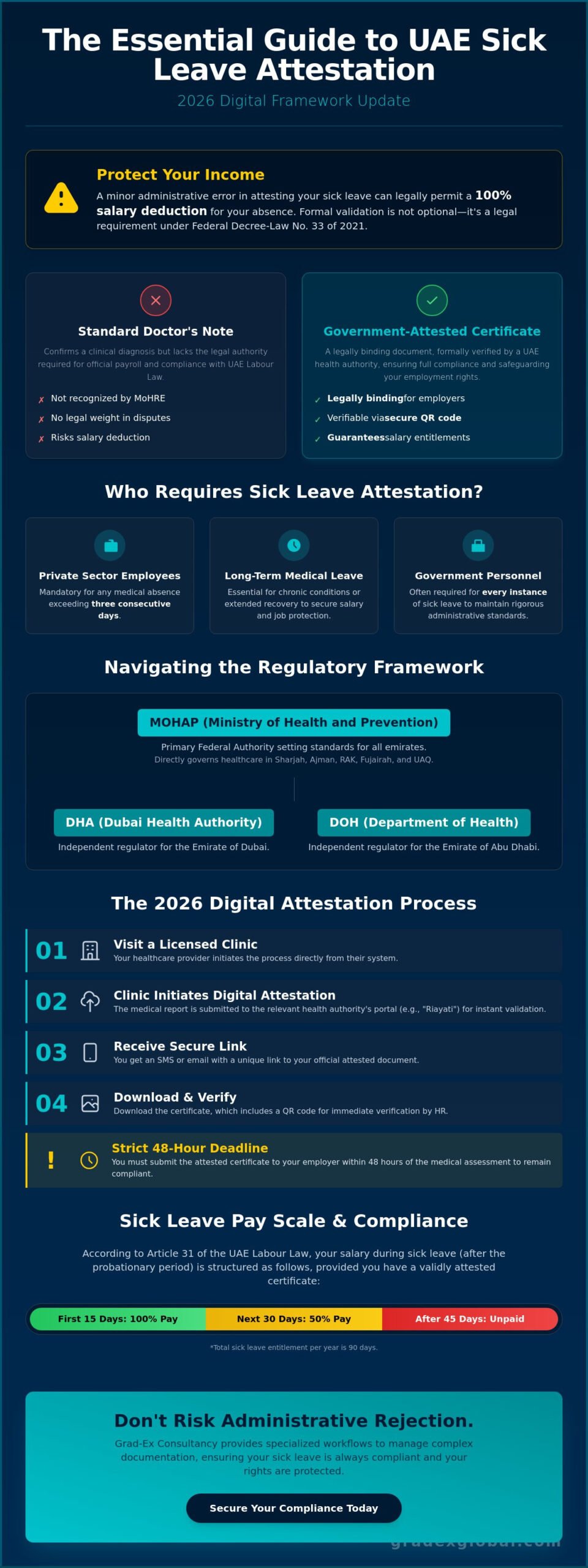
Sick leave attestation is the formal verification of a medical report by a UAE health authority. It’s a critical component of the national regulatory framework that ensures the integrity of medical documentation. While a standard doctor’s note confirms a clinical diagnosis, it lacks the legal weight required for official payroll processing and labour compliance. Attestation transforms a simple clinical document into a legally binding certificate recognized by the Ministry of Human Resources and Emiratisation (MoHRE). By 2026, the UAE has fully transitioned to a digital-first health ecosystem, where every medical certificate issued by licensed facilities undergoes automated validation through centralized platforms like the “Riayati” system.
The UAE government requires this third-party validation to maintain a high standard of administrative precision. It’s not merely a bureaucratic hurdle; it’s a verification protocol designed to eliminate the risks of document forgery. This system provides a secure, auditable trail that allows health authorities like the Ministry of Health and Prevention (MoHAP), the Dubai Health Authority (DHA), and the Department of Health (DoH) in Abu Dhabi to oversee the issuance of medical leave across the country. In the high-stakes environment of 2026, where digital integration is the norm, this process is now instantaneous, linking healthcare providers directly to government databases.
The Legal Necessity of Attestation
The requirement for formal validation serves as a structural safeguard within the UAE Labour Law Framework. It protects the employee’s right to paid leave while shielding the employer from the disruption caused by unverified absences. In the event of a labour dispute, the Ministry only recognizes sick leave attestation as valid evidence. Without this official stamp, a medical report carries no weight in a court of law or during a MoHRE mediation. This formalization ensures that medical absences are verified by a recognized health authority, creating a transparent record that protects the interests of all stakeholders involved in the employment contract.
Who Needs Sick Leave Attestation?
The necessity for attestation depends on the duration of the leave and the sector of employment. Federal regulations specify the following requirements:
- Private Sector Employees: Under current labour laws, any medical absence exceeding three consecutive days must be attested. For shorter durations, a standard medical report often suffices, though internal corporate policies may require attestation for even a single day to ensure full compliance.
- Long-term Medical Leave: For chronic conditions or recovery periods lasting more than three days, the sick leave attestation process is mandatory to secure the employee’s salary rights and job security.
- Government and Semi-government Personnel: These entities operate under rigorous administrative standards. They often mandate attestation for every instance of sick leave, regardless of the duration, to maintain precise attendance records.
Since the 2026 digital mandate, the process isn’t something employees typically handle manually. When a patient visits a licensed clinic, the facility initiates the attestation through the relevant digital portal. The employee then receives a secure link via SMS or email to download the attested certificate, which includes a QR code for immediate verification by the employer’s HR department. This seamless integration has significantly reduced the administrative burden on the workforce while increasing the reliability of the entire system.
The Regulatory Framework: MOHAP and Regional Authorities
The United Arab Emirates medical regulatory landscape operates through a tiered structure where federal oversight meets regional administration. The Ministry of Health and Prevention (MOHAP) functions as the primary federal authority, setting the standards for healthcare delivery and document validation across the seven emirates. While MOHAP maintains direct control over medical facilities in Sharjah, Ajman, Ras Al Khaimah, Fujairah, and Umm Al Quwain, the emirates of Dubai and Abu Dhabi manage their own independent health regulators. The Department of Health (DOH) governs Abu Dhabi, while the Dubai Health Authority (DHA) oversees Dubai’s clinical ecosystem.
Identifying the correct authority for sick leave attestation depends entirely on the location of the medical facility that issued the certificate. If a clinician in a Dubai-based private hospital issues a report, the DHA Sheryan system handles the validation. Conversely, a clinic in Sharjah falls under the MOHAP federal portal. By 2026, the Riayati platform has integrated these disparate systems, allowing for a unified national health record that simplifies cross-authority verification for employees moving between emirates. This integration ensures that a document issued in one emirate is recognized by government entities in another without redundant manual checks.
MOHAP vs. Regional Health Portals
The choice between portals is dictated by the facility’s license. Federal employees and those treated in the Northern Emirates utilize the MOHAP e-services portal, which charges a standard fee of AED 50 for attestation. In Abu Dhabi, the process is centralized through the TAMM platform, leveraging the Malaffi system to automate data sharing. Dubai utilizes the Sheryan portal, where digital certificates are generated instantly upon the doctor’s entry. This digital infrastructure eliminates manual paperwork, ensuring that a sick leave attestation is verifiable by employers via a QR code or reference number within seconds of issuance.
Types of Medical Documents Subject to Attestation
Regulatory requirements vary based on the duration and origin of the medical necessity. Short-term certificates, covering 1 to 5 days, typically require standard digital validation through the respective regional portal. For extended leave exceeding 5 days or complex surgical cases, a comprehensive medical report is mandatory. These detailed documents undergo a more rigorous review by a medical committee to ensure compliance with UAE labor laws. Certificates issued outside the UAE require a multi-step process: legalization by the UAE Embassy in the country of origin, followed by attestation from the Ministry of Foreign Affairs (MOFA) within the Emirates. Just as Gradex Global manages complex infrastructure projects with precise oversight, the UAE’s health authorities apply a structured framework to ensure every medical document meets national standards.
Step-by-Step Guide to Attesting Your Medical Certificate
The process of securing a valid sick leave attestation in the UAE requires strict adherence to a digital workflow managed by regional health authorities. This protocol ensures that medical records are verifiable and tamper-proof. The sequence begins at a licensed UAE clinic or hospital, where the attending physician must issue a digital medical report through the facility’s integrated system. For residents in Dubai, this involves the DHA (Dubai Health Authority) portal, while those in the Northern Emirates utilize the MOHAP (Ministry of Health and Prevention) system. Abu Dhabi residents process their records through the DoH (Department of Health) via the Malaffi platform.
Once the clinic uploads the report, you must log in to the respective health authority’s digital platform using your UAE PASS credentials. The system typically identifies pending certificates linked to your Emirates ID. You are required to select the specific record for attestation, upload any supporting diagnostic files if prompted, and settle the prescribed fees. As of early 2026, the standard fee for attesting a short-term medical certificate remains 50 AED, though this can vary based on the duration of the leave or the specific health district. Once payment is confirmed, the system generates a final certificate featuring a digital QR code. This code is the primary tool for verification, allowing employers to confirm the document’s authenticity instantly.
The final stage involves submitting this digital document to your employer’s HR department. Most UAE corporate entities now mandate submission through internal ERP systems rather than physical paper. It is standard practice to provide the PDF version containing the active QR code to ensure compliance with federal labor laws.
Required Documentation and Prerequisites
A successful application for sick leave attestation depends on the accuracy of your foundational data. You must possess a valid Emirates ID and ensure your contact details are updated within the National Health System. The original medical report must clearly state the diagnosis, the facility’s license number, and the specific duration of leave. In instances where medical leave impacts professional or academic progression, you might also require an equivalence certificate to align your health records with educational recognition standards. This is particularly relevant for residents pursuing specialized certifications alongside their professional roles.
Common Pitfalls in the Application Process
Errors in the attestation process often lead to administrative delays or rejection by HR departments. One frequent issue is the omission of the doctor’s digital signature or the facility’s electronic stamp. If the medical record is not synced correctly with your Emirates ID, the digital platform will fail to locate the file. Furthermore, the UAE health authorities enforce a strict window for attestation. You must complete the process within 5 working days of the certificate’s issuance. Attempting to attest a certificate after this 2026 deadline typically results in an expired record, requiring a new consultation and report. Always verify that the name on your medical record matches the exact spelling on your Emirates ID to prevent system mismatches.
Validity, Deadlines, and UAE Labour Law Compliance
Under Federal Decree-Law No. 33 of 2021, Article 31 establishes a rigid framework for medical absences within the private sector. Employees must notify their employer of any illness within a maximum of three working days. Failure to provide a verified sick leave attestation during this window can lead to the absence being classified as unauthorized, which often results in disciplinary action or loss of wages. For absences exceeding two consecutive days, the law empowers employers to demand a medical report officially validated by the Ministry of Health and Prevention (MOHAP) or the Dubai Health Authority (DHA).
Sick Leave Entitlements and Salary Calculation
The statutory 90-day sick leave allowance per year follows a tiered compensation structure that rewards long-term stability. The first 15 days are processed at 100% full pay. The subsequent 30 days are paid at 50%, while the final 45 days are unpaid. This financial protection only activates once a valid sick leave attestation is submitted through the company’s HR portal. If an employer rejects a certificate, the employee has the right to contest the decision through the Ministry of Human Resources and Emiratisation (MOHRE). In 2024, MOHRE reported a streamlined digital dispute process that typically resolves such technical documentation conflicts within 14 working days.
Employer Rights and Verification Duties
Employers possess the legal right to verify the authenticity of any medical note to maintain operational integrity. Modern certificates in the UAE feature integrated QR codes, allowing HR departments to instantly confirm validity via the MOHAP or DHA smart apps. This digital verification eliminates the risk of document tampering and ensures that only legitimate health claims are processed. For Indian expatriates, specific situations might require additional steps; you can consult the Consulate General of India for guidance on external document recognition and consular verification requirements.
Submitting a fraudulent certificate is a serious offense under Article 44 of the Labour Law. This provision permits summary dismissal without notice and may lead to criminal prosecution under the UAE Penal Code. Precision in documentation isn’t just a clerical requirement; it’s a legal safeguard that protects both the worker’s income and the company’s productivity standards. Companies that maintain strict adherence to these verification protocols ensure a transparent and compliant workplace environment.
How Grad-Ex Consultancy Streamlines Document Attestation
Grad-Ex Consultancy provides the technical infrastructure required for complex document verification. We treat administrative workflows with the same precision as a large-scale engineering project. Our team manages sick leave attestation for corporate entities that demand zero-error margins. We’ve spent 15 years building institutional relationships within the UAE’s regulatory framework. These connections allow us to navigate the Ministry of Health and Prevention (MOHAP) and Dubai Health Authority (DHA) systems with high efficiency. We don’t just process papers; we provide the stability large-scale enterprises require to maintain operational continuity.
Our approach integrates document management into a broader corporate service strategy. We don’t view attestation as a standalone task. It’s a critical component of business continuity. For companies managing thousands of work hours, a single rejected medical certificate can disrupt payroll and labor compliance. We eliminate this friction by auditing every document before submission. Our internal protocols ensure that every stamp, signature, and digital QR code meets the specific requirements of the 2026 UAE labor laws. This systematic oversight guarantees that our corporate clients avoid the delays typical of manual processing.
Why Professional Guidance Matters
The 2026 regulatory landscape has introduced sophisticated digital verification layers that require expert navigation. HR departments now face increased pressure to validate medical records for large workforces instantly. Professional guidance isn’t just a convenience; it’s a risk mitigation strategy. Grad-Ex identifies potential discrepancies in medical reports that could lead to legal complications or labor disputes. We provide a buffer between the employer and the bureaucracy, ensuring that every sick leave attestation aligns with the latest federal decrees. This precision protects the company’s reputation and financial stability in a competitive market.
Our Comprehensive Document Solutions
We handle more than just medical records. Our team manages educational, marriage, and commercial document attestation with the same rigorous standards. We provide clients with fixed-fee structures, allowing for transparent budgeting in AED without hidden costs. This predictability is essential for procurement departments and CFOs planning annual administrative expenses. Our solutions are designed for those who value stability and professional accountability over low-cost, high-risk alternatives. We control the process from initial collection to final delivery, maintaining a secure chain of custody for all sensitive documents.
Your corporate compliance requires a partner that understands the value of precision. Contact Grad-Ex Consultancy for expert attestation support to secure your workforce documentation.
Ensure Regulatory Compliance for Your 2026 Career Objectives
Navigating the complexities of UAE Labour Law requires more than just awareness; it demands precise execution of administrative protocols. Ensuring your medical certificates meet the rigorous standards set by MOHAP or regional health authorities is essential for maintaining employment stability. A valid sick leave attestation protects your legal rights and ensures your salary entitlements remain secure under the 2026 regulatory framework. Delays or errors in document processing lead to rejected claims and professional friction. It’s vital to treat these documents as critical infrastructure for your career.
Grad-Ex Consultancy brings 15+ years of strategic advisory experience to manage these technical workflows. Our team possesses deep expertise in MOHAP and regional health authority protocols, providing a structured approach to document verification. We operate with fixed-fee processing for total transparency, so you won’t face unexpected costs. By centralizing your requirements with a proven partner, you eliminate bottlenecks and ensure every submission meets high-level quality benchmarks.
Secure your employment compliance with Grad-Ex Attestation Services and benefit from a partnership built on stability and professional excellence.
Frequently Asked Questions
Is sick leave attestation mandatory for all employees in the UAE?
Sick leave attestation is mandatory for any medical leave exceeding two consecutive days to ensure legal compliance under Federal Decree-Law No. 33 of 2021. While shorter durations might only require a standard clinic note, most corporate entities in the UAE require an officially validated document for payroll processing. This systematic verification prevents administrative discrepancies and maintains the integrity of workforce management within the private and public sectors.
How long does it take to get a sick leave certificate attested in 2026?
The processing time for a sick leave attestation in 2026 typically spans 24 to 48 hours through integrated digital platforms like the MOHAP portal or DHA’s Sheryan system. Automated synchronization between healthcare providers and government databases has streamlined this timeline significantly. Electronic certificates are often issued instantly upon approval, allowing for immediate submission to HR departments without the delays associated with manual processing.
Can I attest a medical certificate issued by a private clinic?
You can attest medical certificates issued by licensed private clinics, provided the facility operates under the jurisdiction of the Ministry of Health and Prevention, Dubai Health Authority, or Department of Health. The clinic must register the leave through the official government portal at the time of the consultation. This digital link ensures that the private medical record meets the rigorous standards required for official recognition by UAE authorities.
What are the government fees for sick leave attestation?
Government fees for attestation generally start at AED 50 for certificates covering up to three days of leave. For extended periods, the Ministry of Health and Prevention or local health authorities may apply additional administrative charges. These costs are fixed by executive regulations and must be paid through official digital payment gateways to secure the final electronic stamp of authenticity for the document.
What happens if my employer refuses to accept an attested certificate?
An employer can’t legally reject a sick leave certificate that’s been successfully attested by the relevant UAE health authority. If a refusal occurs, the employee has the right to file a formal complaint through the Ministry of Human Resources and Emiratisation (MOHRE) online portal. Precise documentation and the digital attestation record serve as binding evidence of the employee’s medical status and legal entitlement to leave.
Can I attest a sick leave certificate retroactively?
Retroactive attestation is strictly limited and usually requires the medical record to be entered into the system within 48 to 72 hours of the patient’s visit. Most UAE health authorities don’t allow the validation of certificates issued several weeks after the illness occurred. Ensuring the clinic initiates the digital request during your initial consultation is critical for maintaining a precise and legally defensible timeline.
How do I verify the authenticity of an attested medical report?
Verifying the authenticity of an attested medical report is done by scanning the unique QR code printed on the document or entering the reference number into the official health authority website. This transparency allows employers to confirm the validity of the sick leave attestation instantly through a secure government database. This digital verification process eliminates the risk of fraudulent documentation and ensures every record adheres to national standards.
Is the process different for certificates issued outside the UAE?
The process for certificates issued outside the UAE involves a multi-stage validation including attestation by the Ministry of Foreign Affairs in the issuing country and the UAE Embassy. Once the document arrives in the UAE, it must be legalized by the Ministry of Foreign Affairs (MOFA) and often requires a certified legal translation into Arabic. This rigorous workflow ensures that foreign medical assessments meet the same structural requirements as domestic providers.