
The UAE Ministry of Economy recorded a 35% surge in new business licenses during 2023, yet the transition from mere registration to full operational capacity often remains stalled by technical inefficiencies. You likely understand that the promise of a 0% corporate tax environment is frequently complicated by the rigorous, often opaque demands of document attestation for foreign shareholders. Executing a successful company formation in uae requires a level of precision that mirrors complex infrastructure projects. It’s not merely about entry; it’s about building a corporate foundation that can withstand evolving regulatory shifts and maintain long-term structural integrity.
The persistent confusion between Mainland and Free Zone jurisdictions often leads to structural weaknesses that hinder scalability and institutional compliance. We promise to provide a strategic framework designed to minimize administrative friction and establish a legally robust corporate presence. This guide serves as your technical blueprint for 2026, offering a clear jurisdictional roadmap and a framework for sustainable growth. We will analyze the specific requirements for 100% foreign ownership and the exact procedures needed to secure a stable, high-performance business structure in the United Arab Emirates.
Key Takeaways
- Identify the optimal jurisdictional architecture for your business model by analyzing the structural differences between Mainland, Free Zone, and Offshore setups.
- Navigate the evolving regulatory landscape with a precision roadmap designed to streamline company formation in uae for the 2026 fiscal year.
- Eliminate operational bottlenecks by mastering the updated requirements for document integrity and attestation to ensure your incorporation proceeds without administrative delays.
- Align your corporate structure with sustainable growth objectives through strategic activity selection and rigorous trade name reservation protocols.
- Leverage institutional expertise and engineering-grade precision to secure a compliant, high-performance market entry into the competitive GCC landscape.
The Strategic Landscape of UAE Company Formation in 2026
Success in the Gulf Cooperation Council (GCC) market depends on the structural integrity of the initial setup. Sophisticated investors view company formation in uae as a high-precision engineering project where every administrative detail serves as a load-bearing element. By the 2026 fiscal year, the regulatory environment has transitioned into a mature, tax-integrated system. This evolution requires a shift from simple registration to complex institutional planning. Precision during this phase eliminates the 15% to 20% operational friction often caused by mismatched license activities or poor shareholding structures. Strategic advisory acts as the blueprint, ensuring that the corporate architecture supports the “We the UAE 2031” economic objectives.
Understanding the nuances of UAE Corporate Law is essential for maintaining compliance with the Federal Decree-Law No. 32 of 2021. This legal framework governs the 600,000+ active businesses in the country, ensuring that each entity adheres to global standards of governance. It provides the necessary stability for large-scale capital investments and cross-border trade operations. Failing to align with these mandates doesn’t just result in fines; it creates institutional risk that can compromise a company’s ability to secure banking facilities or government contracts.
The Shift Toward Institutional Transparency
The 2026 compliance landscape focuses on the UAE’s commitment to international financial standards. Incorporation now requires strict adherence to Ultimate Beneficial Owner (UBO) reporting and Economic Substance Regulations (ESR). These aren’t mere formalities. They’re the mechanisms that keep the UAE on the global “white list” of transparent jurisdictions. Aligning your business activity with national priorities, such as advanced manufacturing or digital economy sectors, ensures long-term stability and access to specialized free zone incentives. You’re not just building a business; you’re integrating into a planned economic ecosystem.
Why a “Fixed-Fee” Approach Matters
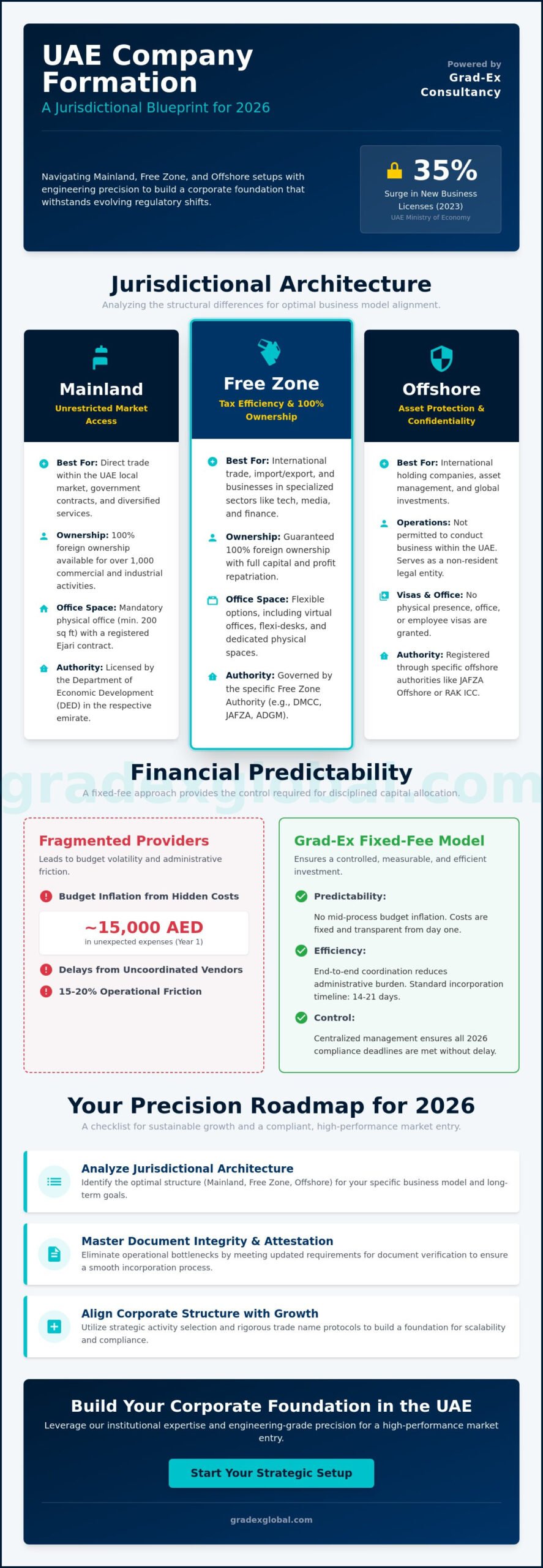
Fragmented service providers often lead to budget volatility. Hidden costs for renewals, attestations, or third-party approvals can reach up to 15,000 AED in unexpected expenses during the first year alone. A fixed-fee model provides the predictability required for disciplined capital allocation. It consolidates the process into a single point of accountability. Instead of managing multiple vendors for visas, office space, and licensing, a unified approach ensures all 14 to 21 days of the standard incorporation timeline are utilized efficiently. This methodology guarantees that company formation in uae remains a controlled, measurable investment rather than an open-ended financial liability.
- Predictability: Fixed costs eliminate the risk of mid-process budget inflation.
- Efficiency: End-to-end coordination reduces the administrative burden on your core team.
- Control: Centralized management ensures all 2026 compliance deadlines are met without delay.
Jurisdictional Architecture: Mainland vs. Free Zone vs. Offshore
Selecting a jurisdiction is a decision of engineering precision. It determines the entity’s operational radius and its long-term stability within the UAE’s economic framework. Successful company formation in uae requires a granular understanding of how these three pillars interact with regional regulations. Each structure offers distinct advantages in terms of market access, capital requirements, and regulatory oversight. Investors must align their choice with their specific commercial objectives to ensure the corporate architecture remains resilient as the business scales.
Mainland Incorporation: National Market Access
Mainland entities, licensed by the Department of Economic Development (DED), provide unrestricted access to the local UAE market. Since the landmark Decree Law No. 26 of 2020, 100% foreign ownership’s the standard for over 1,000 commercial and industrial activities. This eliminates the requirement for a local service agent or majority partner in most sectors. Operations require a physical office space of at least 200 square feet, verified through a registered Ejari contract. This structure’s essential for companies targeting government contracts or large-scale infrastructure projects that demand a physical presence in the heart of the national economy.
Free Zone Ecosystems: Specialized Industry Hubs
The UAE hosts more than 40 specialized Free Zones, each designed as a high-performance hub for specific sectors. These jurisdictions offer 100% import and export tax exemptions and simplified customs procedures. In 2026, Free Zone entities remain highly attractive for international trade, provided they adhere to the 9% corporate tax regulations on taxable income exceeding 375,000 AED. Industry clusters, such as Dubai Multi Commodities Centre (DMCC) or Abu Dhabi Global Market (ADGM), provide a concentrated infrastructure that supports rapid scalability. These zones allow for 100% capital repatriation, making them the preferred choice for tech-driven and export-oriented firms.
Offshore Structures: Asset Protection and Privacy
Offshore entities, primarily registered in Jebel Ali (JAFZA) or Ajman, function as non-resident vehicles. They’re built for global wealth management and holding assets rather than active local trading. These structures offer high levels of confidentiality and are exempt from the standard UAE audit requirements in many cases. While they can’t lease physical office space or conduct business within the UAE mainland, they serve as a secure foundation for international investment portfolios. Compliance standards have tightened since 2023, requiring rigorous Know Your Customer (KYC) documentation to maintain transparency. This model provides the necessary flexibility for holding companies managing diverse global interests.
Constructing a robust corporate foundation requires more than just administrative filing; it demands a strategic roadmap. Choosing the right partner for company formation in uae ensures that your business structure’s optimized for both current compliance and future expansion.
- Mainland: Best for local retail, construction, and government tenders.
- Free Zone: Ideal for logistics, technology, and international consultancy.
- Offshore: Optimized for real estate holdings and intellectual property protection.
The Critical Role of Document Integrity and Attestation
Document integrity represents the structural foundation of a successful company formation in uae. In 2026, the UAE Ministry of Economy reports that approximately 40% of delays in corporate licensing stem from incomplete or incorrectly verified documentation. This isn’t merely a bureaucratic hurdle; it’s a precision-based requirement designed to ensure the legal stability of the nation’s commercial infrastructure. For international investors, the attestation process acts as the “due diligence” layer that links foreign legal identities to local corporate registration.
The 2026 requirements for educational and commercial document verification have become more stringent to combat international fraud. Every document must follow a specific chain of legality to be recognized. If a single stamp is missing from the origin country’s Ministry of Foreign Affairs or the UAE Embassy, the entire application stops. Managing this process with professional oversight isn’t an option but a strategic necessity to avoid the high costs of operational downtime. For corporate shareholders, their personal document validity is directly tied to the company’s ability to open bank accounts and secure specialized trade permits.
Navigating the MOFA and Ministry of Justice Workflow
The attestation chain is a multi-government workflow that requires technical accuracy at every stage. It begins with notarization in the country of origin, followed by verification from that nation’s Ministry of Foreign Affairs. Once the UAE Embassy in the home country provides its stamp, the document must undergo final attestation by the UAE Ministry of Foreign Affairs (MOFA). For documents not originally in Arabic, a legal translation certified by the UAE Ministry of Justice is the final, non-negotiable step. Commercial Attestation is a mandatory prerequisite for 2026 that validates the legal existence and operational capacity of a foreign entity before it can hold shares in a UAE-registered company. This process ensures that every stakeholder in the UAE market is verified through a transparent, high-security protocol.
Educational Equivalency for Professional Licenses
For entrepreneurs seeking professional or consultancy licenses, degree attestation is the primary catalyst for approval. The relationship between academic credentials and trade licenses is rigid; you can’t manage a specialized engineering or medical firm without verified expertise. Integrating the UAE Equivalence Certificate into your corporate setup strategy is essential for 2026 compliance. This certificate proves that your international degree meets the specific standards set by the UAE Ministry of Education. Common rejections often occur because the applicant fails to account for the time required for this verification. By prioritizing educational equivalency at the start of the company formation in uae, you eliminate the risk of the Licensing Department blocking your trade license due to academic misalignment.
A Precision Roadmap for UAE Business Incorporation
Executing a successful company formation in uae requires a systematic approach that mirrors the technical rigor of a large-scale infrastructure project. The process isn’t merely administrative; it’s a strategic deployment of resources within a strictly regulated legal environment. By 2026, the integration of advanced digital governance has streamlined these phases, yet the requirement for absolute accuracy remains paramount to ensure long-term stability.
- Step 1: Activity Selection and Strategic Alignment. You must align your commercial activities with the updated 2026 ISIC 4 codes. This ensures your corporate architecture supports future expansions into regulated sectors and complies with the latest industrial mandates.
- Step 2: Trade Name Reservation and Initial Approval. Reservation occurs through the Department of Economy and Tourism (DET) or specific Free Zone portals. This stage validates your business blueprint against UAE public policy and intellectual property standards.
- Step 3: Drafting and Notarizing the MOA. The Memorandum of Association is the structural foundation of your entity. Drafting must be precise to define profit-sharing ratios, management powers, and dissolution protocols.
- Step 4: Securing Physical Premises and Ejari. Every mainland entity requires a physical footprint. You’ll need a verified lease agreement registered through the Ejari system in Dubai or Tawtheeq in Abu Dhabi to satisfy the mandatory workspace requirements.
- Step 5: Final License Issuance and Banking. Once the authorities issue the commercial license, the focus shifts to corporate bank account activation. This requires a comprehensive KYC audit to ensure the entity meets all AML (Anti-Money Laundering) standards.
Legal Translation and Notary Requirements
Precision in documentation is non-negotiable. All foundational corporate papers must undergo legal translation into Arabic by Ministry of Justice certified professionals. The UAE now utilizes an online notary system for 95% of business transactions. This digital infrastructure allows for the remote execution of documents while maintaining a secure, centralized repository of all notarized commercial records for audit readiness.
Post-Incorporation Compliance Checklist
The operational phase of company formation in uae begins with strict adherence to the nation’s fiscal framework. Entities with annual revenues exceeding 375,000 AED must register for the 9% Corporate Tax. VAT registration is mandatory once taxable supplies exceed 375,000 AED. You’re also required to maintain an updated Ultimate Beneficial Owner (UBO) register to avoid penalties that can reach 100,000 AED for non-compliance.
Build your corporate foundation with engineering precision and expert oversight. Consult with our specialists at Gradex Global to initiate your strategic setup today.
Grad-Ex Consultancy: Your Strategic Partner for UAE Market Entry
Grad-Ex Consultancy applies a rigorous engineering methodology to the corporate services sector. We view company formation in uae not merely as an administrative task, but as a critical infrastructure project for your business. Our team leverages 15 years of institutional relationships with government bodies to ensure every application moves through the system without delay. This stability is backed by a track record of managing complex setups for large-scale enterprises that require more than just a basic trade license.
Our operational model is built on transparency and predictability. While many consultants provide vague estimates, we utilize a fixed-fee model that eliminates the risk of hidden costs. This approach allows your finance department to allocate capital with 100% certainty. By integrating attestation services directly into the setup workflow, we’ve successfully reduced the time-to-market for our clients by an average of 22 days. We don’t leave anything to chance; every step is mapped out with the same precision we apply to civil engineering projects.
- Elimination of administrative friction through direct government channels.
- Predictable financial planning with a transparent fixed-fee structure.
- Accelerated market entry via integrated legal and attestation workflows.
- High-level consultancy rooted in 15 years of regional experience.
Comprehensive Support Beyond Incorporation
Our commitment to your stability extends far beyond the issuance of a license. We protect your brand’s integrity through comprehensive trademark registration across the GCC region, ensuring your intellectual property remains secure as you scale. Grad-Ex also provides data-driven market research subscriptions, giving you access to localized insights that are vital for the 2026 economic landscape. For firms relocating key personnel, we manage all expat documentation and Indian passport services, handling the logistics so your team can remain productive.
Begin Your UAE Expansion With Confidence
A successful launch depends on having a single point of contact who understands the totality of the UAE’s regulatory environment. Fragmented communication leads to errors and missed deadlines. Our senior advisors act as your primary liaison, coordinating with every relevant authority to secure your approvals. It’s time to build your corporate foundation on solid ground. You should Contact Grad-Ex Consultancy to initiate your UAE company formation and speak with a specialist who prioritizes precision over promises.
Establishing a Foundation for Enduring Success in the 2026 UAE Market
The evolution of the Emirates’ economy into 2026 demands a sophisticated approach to corporate structure. Success hinges on the precise selection of a jurisdictional architecture and the rigorous verification of every legal instrument required for official attestation. Navigating company formation in uae is no longer a mere administrative task; it’s a high-stakes engineering challenge that requires absolute technical accuracy. Businesses must balance the operational freedom of free zones with the market access of mainland licenses while maintaining total document integrity. This architectural precision ensures your enterprise remains resilient against shifting global regulations and remains fully compliant with the latest Ministry of Economy standards.
Grad-Ex Consultancy brings 15+ years of strategic GCC advisory expertise to your project. We provide a stable framework for market entry through fixed-fee transparency and comprehensive end-to-end ministry and embassy coordination. Our methodology ensures your corporate infrastructure is built on a foundation of professional excellence and regulatory compliance. Secure your UAE business future with Grad-Ex Consultancy. The path to regional leadership starts with a partner who values precision as much as you do. Your vision deserves a structure designed for longevity.
Frequently Asked Questions
How long does it take to complete company formation in the UAE in 2026?
The timeline for company formation in the UAE typically spans 3 to 7 working days for standard mainland or free zone registrations. Advanced digital portals like the “Invest in Dubai” platform now facilitate instant licenses within 24 hours for specific activities. If your project requires residency visas and corporate bank account opening, you should allocate a total of 4 to 6 weeks to finalize the entire operational infrastructure.
Can a foreigner own 100% of a mainland company in the UAE?
Foreign investors can maintain 100% ownership of a mainland company following the 2021 amendments to the Commercial Companies Law. This regulation applies to more than 1,000 commercial and industrial activities, removing the previous requirement for a local Emirati shareholder to hold 51% of the equity. Technical analysis confirms that strategic sectors like manufacturing and technology are fully eligible for this ownership structure without local interference.
What is the difference between a Trade License and a Business License?
A Trade License specifically authorizes the import, export, and distribution of physical goods within the market. While people often use the terms interchangeably, a Business License is a broader category that encompasses professional, industrial, and tourism permits. The Department of Economy and Tourism (DET) issues these documents to ensure every entity operates within the precise legal framework defined by UAE federal law and international standards.
Why is document attestation required for UAE company setup?
Document attestation serves as a mandatory verification process to ensure foreign legal papers are valid under UAE jurisdiction. The Ministry of Foreign Affairs (MOFA) requires this multi-stage authentication to prevent fraud and maintain the integrity of the corporate registry. Without these verified stamps, your articles of incorporation or educational certificates won’t be recognized by the licensing authorities during company formation in the UAE.
What are the minimum office space requirements for a new UAE business?
Mainland companies must secure a physical office space of at least 200 square feet to comply with Department of Economy and Tourism regulations. Free zone entities have more flexibility, often utilizing “flexi-desk” arrangements that provide a legal address without a dedicated private suite. This physical presence requirement is tied directly to the number of residency visas a company can apply for under its license, ensuring operational substance.
Do I need a local partner for company formation in the UAE?
You don’t need a local Emirati partner for the majority of commercial activities in the current regulatory environment. While the 51% local shareholding rule was standard before 2021, it’s now restricted to specific strategic sectors like oil and gas, defense, or utilities. For most investors, a Local Service Agent (LSA) is only required for professional licenses to manage administrative interactions with government departments without holding equity.
What are the estimated costs for business incorporation in 2026?
Total costs for business incorporation in 2026 generally range from AED 12,500 for basic free zone packages to over AED 45,000 for mainland setups with physical office space. These figures include government registration fees, initial trade license costs, and mandatory administrative charges. You must also factor in the 5% VAT on certain services and potential security deposits required by specific free zone authorities for utility connections.
How does the 2026 corporate tax environment affect new company setups?
The UAE applies a 9% federal corporate tax on annual business profits that exceed the AED 375,000 threshold. This fiscal policy, established in 2023, aims to align the nation with global transparency standards while maintaining a competitive edge. New setups in free zones can still qualify for a 0% tax rate on “qualifying income,” provided they maintain adequate substance and meet the specific technical criteria defined by the Ministry of Finance.