
An attestation rejection isn’t a final verdict on your professional credentials. Instead, it serves as a technical signal that a specific link in your document’s chain of trust has failed to meet the rigorous standards of the UAE Ministry of Foreign Affairs. You likely feel the pressure of mounting visa delays and the potential loss of government fees already paid. It’s a common concern to wonder exactly what happens if my certificate attestation is rejected and whether your career or business setup in the Emirates is now in jeopardy.
We recognize that technical precision in documentation is the cornerstone of a successful transition to the UAE. This guide provides a clear map of the resubmission process and explains how to identify the specific failure that led to the rejection. You’ll gain the knowledge required to rectify your authentication sequence and resume your residency timeline with total confidence. We examine the specific requirements for both personal and commercial documents to ensure your next submission meets every regulatory benchmark.
Key Takeaways
- Understand that a formal rejection results in the immediate invalidation of your submission and the forfeiture of all paid government processing fees.
- Identify the specific technical failure in your “Chain of Trust” to understand exactly what happens if my certificate attestation is rejected at the ministerial level.
- Learn the precise methodology for tracing authentication errors backward to rectify missing stamps from home country authorities or notary publics.
- Recognize how document failures directly stall residency timelines, family visa sponsorship, and the issuance of UAE trade licenses.
- Discover how an “Audit-First” consultancy approach prevents future procedural non-compliance through rigorous pre-verification and structured authentication workflows.
Immediate Consequences of an Attestation Rejection in the UAE
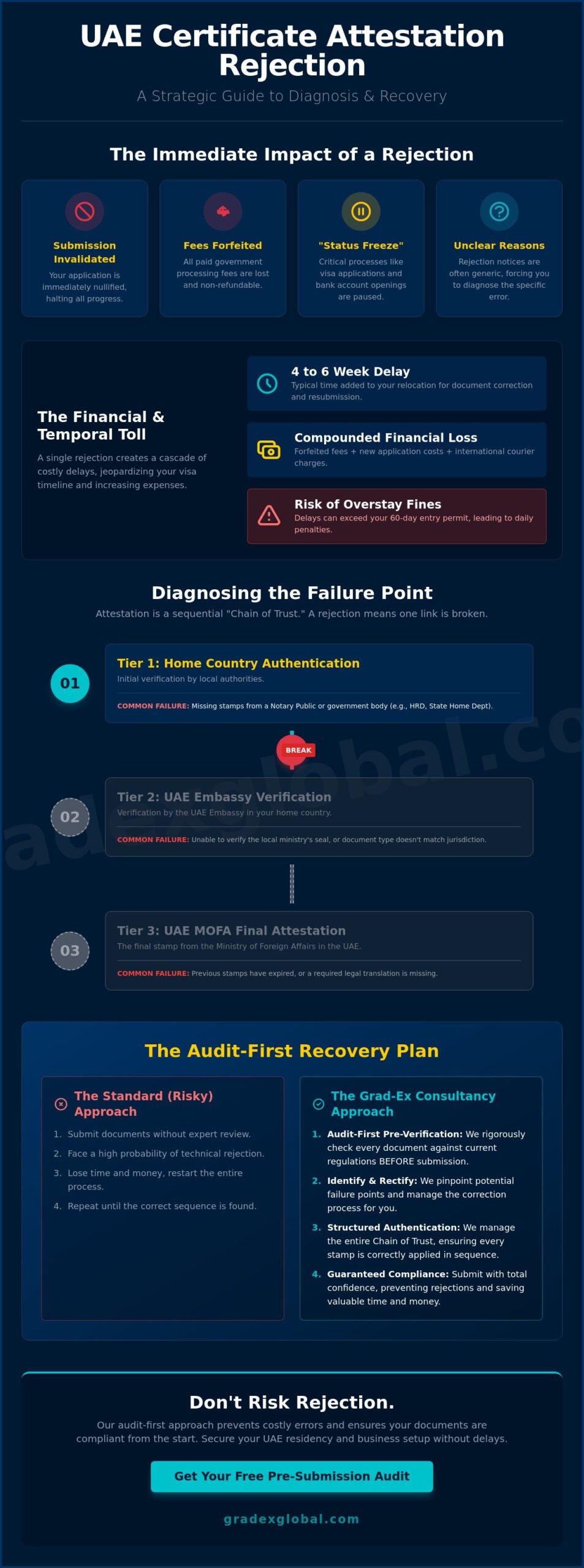
An attestation rejection is a formal refusal by a government body to verify the authenticity of a document. This usually occurs due to procedural non-compliance within the multi-tiered authentication chain. When an applicant encounters this, it’s not merely a minor administrative setback. It’s a definitive halt to your professional or corporate progress. If you’re wondering what happens if my certificate attestation is rejected, the most immediate consequence is the total invalidation of your current submission. You also face the forfeiture of government processing fees. These funds aren’t refunded, meaning any subsequent attempt requires a fresh payment and a new application cycle.
This rejection triggers a “Status Freeze” on critical legal processes. Pending residency visa applications or the opening of corporate bank accounts come to an abrupt standstill. Government entities and financial institutions in the UAE maintain a zero-tolerance policy regarding document verification. Without the final Ministry of Foreign Affairs (MOFA) stamp, your file remains inactive. Rejection notices often lack specific technical details. You might see a generic remark regarding “incomplete authentication,” which forces you to manually diagnose where the chain of trust broke without a clear roadmap from the authorities.
The Financial and Temporal Toll
A single procedural failure can add four to six weeks to an expat’s relocation timeline. This delay stems from the need to courier documents back to the country of origin to secure missing stamps from local ministries or embassies. Beyond the schedule, there’s the risk of “Document Fatigue.” Repeated shipping and handling across international borders can lead to physical wear, potentially making the certificate illegible or causing it to be rejected later for damage. Attempting a resubmission without a precise technical diagnosis often results in a second, more expensive rejection that compounds your financial loss.
Impact on Legal Residency Status
Timing is critical because most expatriates enter the UAE on a 60-day entry permit. A document rejection can consume the majority of this window, leaving very little time for rectification. If the attestation chain isn’t corrected quickly, you risk incurring daily overstay fines once the permit expires. This pressure is intensified for those with families, as dependent visas cannot be processed without a validly attested marriage or birth certificate. A rejected certificate halts the entire labor card issuance process. Without this card, you cannot legally commence work or be enrolled in a corporate health insurance plan, leaving you in a state of professional and legal vulnerability.
Diagnosing the Failure: Understanding the Multi-Tiered Authentication Chain
The structural integrity of the attestation process relies on a rigid “Chain of Trust.” This hierarchical system ensures that each government body only verifies the signature and seal of the preceding authority. Understanding what happens if my certificate attestation is rejected requires a deep dive into this sequence. If one link is missing or applied out of order, the entire document is deemed technically invalid for UAE use. Adhering to the official UAE attestation procedures is the only method to guarantee that each authority recognizes the legitimacy of the previous stamp.
Failures typically occur at one of three distinct tiers. Tier 1 failures involve the absence of primary home country authentication, such as the Human Resource Development (HRD) department or a Notary Public. Without these, the document cannot proceed. Tier 2 failures happen at the UAE Embassy in the issuing country. This often occurs if the embassy cannot verify the local ministry’s seal or if the document type doesn’t match the embassy’s specific jurisdiction requirements. Tier 3 failures are the final hurdle at the Ministry of Foreign Affairs (MOFA) within the Emirates. These rejections frequently stem from expired previous stamps or a failure to provide a required legal translation. Engaging with professional certificate attestation services ensures these technical nuances are identified and corrected before the final submission.
Technical Rejection vs. Authenticity Rejection
It’s vital to differentiate between a technicality and an authenticity issue. A technical rejection might involve the use of the wrong ink color, a blurred seal, or the use of digital stamps where physical ones are required by the 2026 regulatory framework. Conversely, an authenticity rejection is a far more serious matter. It suggests the document originates from an unrecognized or unaccredited institution. For professionals in regulated sectors, educational documents often require a specific equivalence certificate to be recognized by the Ministry of Education. This process is separate from attestation and must be handled with equal precision.
Document Condition and Formatting Pitfalls
Physical document condition is a common reason for rejection that many applicants overlook. Lamination is a frequent pitfall; UAE authorities often refuse to stamp laminated originals because lamination prevents the verification of the paper’s security features. Translation errors also present significant hurdles. If a document isn’t in Arabic or English, a legal translation is mandatory. Any discrepancy in name spelling between your certificate and your passport will result in a full stop. These formatting errors are entirely preventable through a rigorous pre-submission audit.
The Strategic Recovery Plan: Steps to Rectify and Resubmit
Recovery from a document rejection requires a methodical recalibration of the entire authentication sequence rather than a simple re-upload of existing files. Understanding what happens if my certificate attestation is rejected allows for a calculated response that addresses the specific technical deficit identified by the authorities. The process must follow a logical, five-step restoration plan to ensure the subsequent submission meets all compliance benchmarks.
- Step 1: Access the official government portal to obtain the specific rejection code or remark. This diagnostic data is essential for identifying whether the failure was a Tier 1, 2, or 3 error.
- Step 2: Trace the authentication chain backward from the point of rejection. You must find the last authority that validly recognized the document to determine where the “Chain of Trust” was severed.
- Step 3: Address the physical document status. If the rejection was due to lamination or physical damage, you must obtain a fresh original from the issuing institution.
- Step 4: Re-verify the document through the issuing country’s Ministry of Foreign Affairs and the UAE Embassy. These steps must be completed in the correct chronological order.
- Step 5: Perform the final resubmission to the UAE Ministry of Foreign Affairs (MOFA) once all prior stamps are verified as current and legible.
Navigating Home Country Recalibration
Coordinating with international authorities while remaining in the UAE requires technical precision and reliable logistics. If an original certificate is deemed too fragile for further stamping, you may need to utilize International Notary & True Copy Attestation services to create a legally recognized duplicate. Bridging linguistic gaps is also vital; utilizing Global Translation Services ensures that every stamp and remark is accurately interpreted by UAE officials, preventing a second rejection due to mistranslation.
2026 Resubmission Timelines
The total turnaround time for rectified documents in 2026 typically ranges from 7 to 20 working days for the international authentication leg. Once the document reaches the UAE, MOFA attestation is generally processed within 1 to 3 business days. You should avoid the “Fast-Track” myth, as skipping steps or using unverified channels often leads to permanent document blacklisting. The Resubmission Window is defined as the specific period before home country stamps expire or regulations change, necessitating a swift and accurate response to the initial rejection.
Assessing the Impact on Visa Processing and Business Continuity
A rejection of your documentation is not merely an isolated bureaucratic hurdle. It represents a critical failure in the regulatory compliance required for legal operations within the UAE. When considering what happens if my certificate attestation is rejected, one must look beyond the immediate document to the cascading legal consequences. For individuals, a rejected marriage certificate effectively freezes family visa sponsorship. This prevents dependents from obtaining residency and, by extension, blocks their enrollment in mandatory health insurance schemes. The legal vulnerability created by these delays can be significant, especially when medical coverage is a prerequisite for residency.
In the corporate sector, the ramifications are equally severe. Commercial attestation rejection is a primary cause for the suspension of trade license issuance. Without a verified certificate of incorporation or board resolution, the Department of Economy and Tourism cannot finalize the business registry. For high-level executive positions, a rejected educational degree halts the labor card approval process at the Ministry of Human Resources and Emiratisation. This professional delay often necessitates costly re-entry procedures or visa runs if the initial entry permit expires before the authentication chain is rectified. These financial risks often outweigh the cost of professional intervention.
The Dependency Loop: Visa, Ejari, and Banking
The UAE administrative system operates as an interconnected network where one failure disrupts multiple sectors. An attestation failure triggers a domino effect that reaches into your domestic stability. Without a valid residency visa, you cannot secure an Ejari certificate. This contract is the prerequisite for utility connections, internet setup, and housing contracts. Beyond these personal hurdles, specific professional visa designations are strictly linked to attested educational qualifications. If your degree is rejected, you may be forced to accept a lower-tier visa designation, which can impact your long-term benefits and banking eligibility. Our Business Setup & Ejari Services are designed to navigate these dependencies by ensuring every document meets the required standard before the process begins.
Mitigating Risk for Employers and Investors
HR departments must manage candidate expectations with technical precision when a rejection occurs. It’s advisable to maintain a buffer in the onboarding timeline to account for potential chain of trust failures. For investors, contingency planning is essential to protect capital. A trade license delay can result in missed market opportunities and contractual penalties with local vendors. Securing final UAE Authority Approvals requires a proactive approach to document verification. By auditing the authentication sequence early, business owners can ensure continuity and avoid the financial strain of a stalled incorporation process. This stable approach to document management is the only guarantee of long-term operational success in the Emirates.
Professional Resolution: How Strategic Consultancy Prevents Future Rejections
Navigating the aftermath of a document failure requires more than just a repetitive submission. It demands a professional recalibration of your entire documentation strategy. Understanding exactly what happens if my certificate attestation is rejected allows an applicant to transition from a reactive state to a proactive, structured recovery. Grad-Ex utilizes a methodical “Audit-First” approach. By conducting a rigorous pre-verification of every seal and signature before formal submission to the Ministry of Foreign Affairs, we eliminate the technical ambiguities that lead to procedural failure.
Our methodology is built upon 15 years of institutional relationships and technical expertise. We manage the end-to-end authentication sequence, from the initial home country verification to the final UAE MOFA approval. This comprehensive oversight ensures that every authority in the chain recognizes the legitimacy of the preceding stamp. We don’t merely move documents; we provide a guarantee of quality and technical precision that a standard typing center cannot replicate. This stability is essential for high-stakes business setups and residency applications where time is a non-renewable resource.
The Grad-Ex Advantage in 2026
The 2026 regulatory environment requires a centralized approach to document management. Our strategic consultancy handles Indian passport assistance and global translation services entirely in-house. This internal control prevents the data discrepancies that often occur when multiple third-party vendors are involved. We operate on a “Fixed-Fee” model for our certificate attestation services. This transparent structure provides peace of mind, as it covers the complexities of multi-country chains without hidden costs for resubmissions or courier logistics. Additionally, our online notary services play a critical role in expediting the recovery process, allowing for the swift legalization of supporting affidavits or true copies without unnecessary travel.
Next Steps for a Successful Resubmission
A successful recovery begins with a technical audit of the rejected file. Our expert consultants analyze the rejection remarks to identify the precise point of failure in the authentication sequence. We then prepare your file for a “Zero-Error” resubmission by securing any missing stamps or correcting formatting pitfalls such as lamination or translation errors. This disciplined approach ensures that your second attempt is your final attempt, allowing you to resume your residency or business setup timeline without further interruption.
Contact Grad-Ex Consultancy today for a professional audit of your rejected documents.
Restoring Procedural Integrity for UAE Compliance
A document rejection is not an insurmountable barrier. It’s a technical signal that your authentication sequence requires professional recalibration to meet the rigorous standards of the Ministry of Foreign Affairs. We’ve established that the chain of trust must be perfectly intact to support your residency or business setup goals. Understanding what happens if my certificate attestation is rejected serves as the critical turning point where you move from administrative confusion to a structured, successful resubmission.
Grad-Ex provides the stability and technical rigor necessary to navigate these complex ministry requirements with absolute precision. We leverage over 15 years of GCC market expertise and established strategic relationships with UAE authorities to secure your professional future. Our commitment to fixed-fee transparency ensures that your path to compliance remains predictable and efficient. You can regain control of your timeline by trusting a partner that prioritizes technical accuracy and institutional reliability above all else.
Secure Your Professional Document Audit Now
Frequently Asked Questions
Why was my MOFA attestation rejected without a clear explanation?
Rejections typically occur because of a technical procedural failure within the established chain of trust. Government portals often provide a generic rejection code rather than a detailed diagnostic of the error. This lack of specificity requires a manual audit of the preceding stamps from the home country or the UAE embassy to identify the exact missing link in the authentication sequence.
Do I have to pay the government fees again if my attestation is rejected?
Government processing fees are non-refundable and are forfeited immediately upon document rejection. Any subsequent attempt to attest the document is treated as a fresh application, which requires full payment of the applicable fees. This financial consequence underscores the necessity of ensuring total document compliance before the initial submission to avoid redundant expenditures.
Can I attest a laminated certificate for use in the UAE?
UAE authorities generally refuse to attest laminated original certificates. Lamination prevents officials from verifying the security features of the paper and applying the required physical stamps or seals. If your document is currently laminated, you’ll need to obtain a duplicate original from the issuing institution before you can proceed with the multi-tiered authentication process.
How long does it take to fix a rejected attestation chain?
Rectifying a rejected chain typically adds seven to 20 working days to your overall timeline. This duration accounts for the logistics of couriering the document back to the country of origin to secure missing stamps from local ministries. Once the international leg is corrected, the final MOFA attestation within the Emirates is generally processed within one to three business days.
What is the difference between attestation and an equivalence certificate?
Attestation verifies the authenticity of the seals and signatures on a document, whereas an equivalence certificate confirms that your qualification meets specific UAE educational standards. Attestation is a mandatory prerequisite for the equivalence process. Both procedures are essential for professionals entering regulated sectors such as healthcare, engineering, or education within the UAE.
Can a rejected document lead to my UAE visa being cancelled?
A rejection doesn’t trigger an immediate visa cancellation, but it effectively halts the issuance process. If you’re currently on a 60-day entry permit, a delay in understanding what happens if my certificate attestation is rejected can lead to your permit expiring. This results in daily overstay fines and potential legal complications if the authentication chain isn’t rectified swiftly.
Is a legal translation required after my document is rejected?
A legal translation is mandatory if the document was rejected because it was not issued in Arabic or English. This translation must be performed by a licensed professional and subsequently attested by the Ministry of Justice. Without this verified translation, the Ministry of Foreign Affairs won’t recognize the document, regardless of how many other stamps it possesses.
How can a professional consultancy speed up the resubmission process?
A consultancy provides a technical audit to identify the exact cause of failure before you resubmit your file. By leveraging institutional relationships and in-house resources like global translation and online notary services, they eliminate the risks of trial and error. This structured approach ensures a zero-error submission that protects your residency timeline and business continuity.