
While many attribute administrative setbacks to government latency, the actual bottleneck in 2026 is almost exclusively technical non-compliance within the multi-tier attestation chain. If you’re navigating the complexities of international document verification, you’ve likely encountered the opaque coordination between home-country ministries and UAE authorities. We’ll show you exactly how to avoid delays in uae visa document processing by aligning your documentation with the latest digital standards. You’ll gain a comprehensive understanding of the technical requirements and attestation workflows necessary to ensure your file moves through the system without friction. We’ll analyze the common pitfalls that lead to manual security screenings and provide a methodical roadmap for successful visa issuance. By following this structured approach, you’ll reduce lead times and eliminate the need for multiple resubmissions.
Key Takeaways
- Define the 2026 processing ecosystem as a multi-stakeholder environment where technical document precision dictates the speed of approval.
- Learn how to avoid delays in uae visa document processing by ensuring your certificate attestation aligns perfectly with specific visa category requirements.
- Recognize common technical pitfalls, such as nomenclature discrepancies and outdated legal translations, before they trigger administrative friction.
- Establish a pre-submission audit protocol to verify every document against the latest UAE Ministry of Foreign Affairs digital standards.
- Gain insights into strategic application timing to account for regional system updates and national holiday schedules that impact processing lead times.
The Landscape of UAE Visa Document Processing in 2026
The UAE visa document processing ecosystem in 2026 functions as a sophisticated, multi-stakeholder regulatory environment. It’s no longer a linear path but a synchronized network of digital platforms and government entities. While the infrastructure is designed for efficiency, documentation remains the primary variable affecting processing speed. Applicants often mistake the speed of digital portals for a relaxed standard of scrutiny. This is a critical error. Technical precision during the initial upload phase determines whether a file proceeds to approval or enters a cycle of administrative friction. Understanding the multi-tiered nature of these requirements is the first step in learning how to avoid delays in uae visa document processing.
Distinguishing between basic entry permits and complex residency or work visas is essential for proper planning. A standard tourist visa requires minimal documentation, often processed within 0 to 3 business days. However, residency visas involve a higher tier of verification, requiring coordination between the Federal Authority for Identity, Citizenship, Customs & Port Security (ICP) and the Ministry of Foreign Affairs (MOFA). For a foundational understanding of these categories, a UAE visa policy overview provides the necessary context for entry requirements and visa-free travel regulations. In 2026, the burden of proof has shifted entirely to the applicant to provide high-resolution, error-free digital assets from the outset.
The Evolution of Administrative Requirements in the UAE
The shift toward digital-first processing through E-channel systems has transformed the administrative landscape. In 2026, the UAE has fully integrated its MOFA attestation process into a digital workflow, utilizing electronic payments and courier-integrated handling. While these advancements facilitate speed, they’re accompanied by increased security protocols. These protocols involve automated background checks and manual reviews for data inconsistencies. The ICP serves as the central authority in this digital architecture; it oversees the issuance of residency permits and ensures that all applicants meet the stringent national security standards. This increased scrutiny means that even minor travel history gaps can trigger manual verification delays.
Why Documentation Accuracy is Non-Negotiable
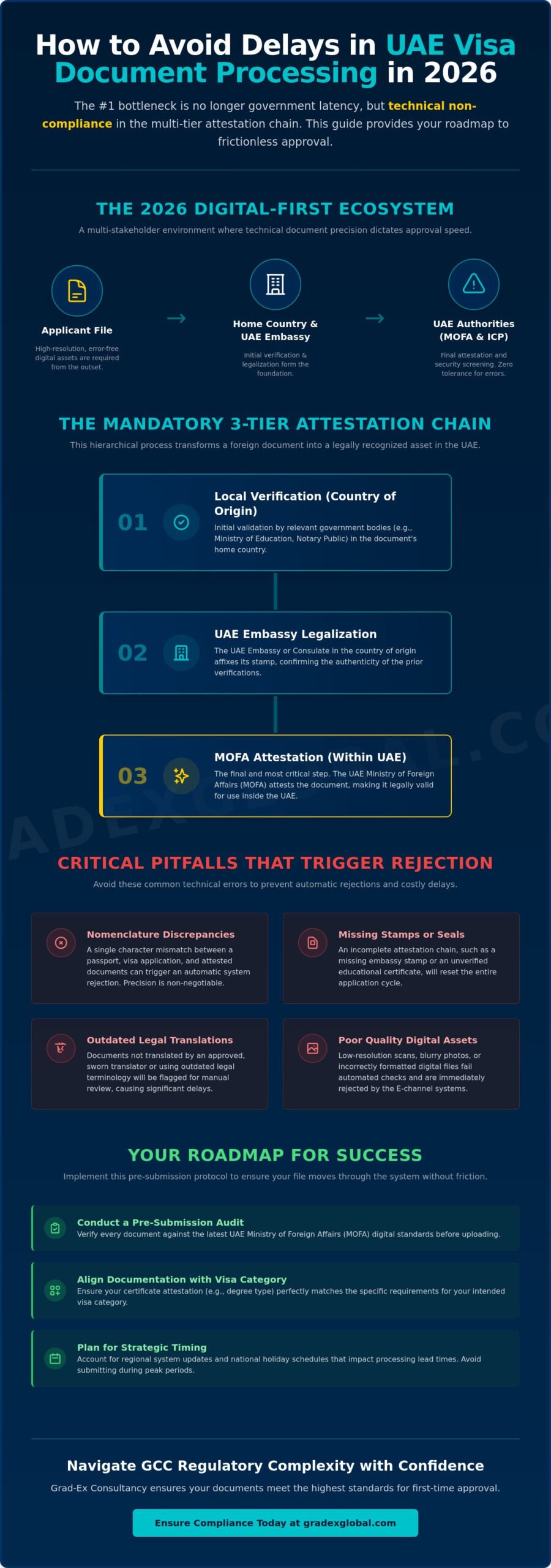
Mastering how to avoid delays in uae visa document processing requires an appreciation for the zero-tolerance policy regarding typographical errors. In a digital-first system, a single character mismatch between a passport and a legal translation can trigger an automatic rejection. Rejection isn’t just a minor setback. It carries significant costs in terms of forfeited government fees and extended timelines. A missing embassy stamp or an unverified educational certificate can reset the entire application cycle. Precision isn’t merely a preference; it’s the baseline requirement for navigating the UAE’s high-standard regulatory framework. You’re not just submitting papers; you’re providing data that must be perfectly congruent across multiple international databases.
The Critical Link: Certificate Attestation and Visa Approval
Certificate attestation serves as the mandatory verification chain that transforms a foreign document into a legally recognized asset within the Emirates. Without this chain, your residency or work permit application lacks the necessary validation to proceed through the ICP’s automated systems. The relationship between attestation status and visa category eligibility is direct. High-level professional visas require degree verification that meets specific criteria. To navigate this, one must adhere to the official document attestation process, which involves multiple sovereign entities and rigorous technical standards.
A standard attestation workflow follows a hierarchical three-tier structure. It begins with local verification in the document’s country of origin, followed by legalization at the UAE Embassy in that same country. The final step is the intervention of the Ministry of Foreign Affairs (MOFA) within the UAE. This multi-stage protocol ensures that every certificate is authentic and compliant with local standards. For professionals and investors, mastering this sequence is the primary way how to avoid delays in uae visa document processing. Technical accuracy is the only currency in this workflow.
Educational and Professional Document Verification
Degree attestation is a prerequisite for individuals seeking managerial or specialized professional roles. The process requires meticulous coordination with the issuing university and national education boards. In specific sectors like healthcare or engineering, obtaining an equivalence certificate is also necessary to confirm that foreign qualifications match UAE educational standards. Verification must be completed in the country of origin before any submission to UAE authorities. Retroactive corrections are often impossible once the visa process has begun.
Personal and Commercial Document Attestation
Family sponsorship visas depend entirely on the successful attestation of marriage and birth certificates. These documents must be verified to prove legal relationships, a step that often proves more time-consuming than the visa application itself. Commercial document attestation for business setup or investor visas involves even greater complexity. It often requires board resolutions or power of attorney documents to be legalized. How to avoid delays in uae visa document processing in these cases often hinges on the quality of legal translation. A single mistranslated term can invalidate a document, necessitating a full restart of the attestation chain. Utilizing professional Certificate Attestation services provides the technical oversight needed to ensure these documents meet every regulatory benchmark without fail.
Identifying Technical Bottlenecks and Common Pitfalls
Technical friction often originates in the Security Clearance phase, a stage where applications frequently transition to a “Pending” status. This status doesn’t signify a rejection. Instead, it indicates that the automated systems have flagged a data inconsistency that requires manual intervention by a government officer. In 2026, the primary cause for these flags is often poor digital upload quality. High-resolution scans are mandatory because the Federal Authority’s AI-driven verification tools must analyze the security fibers and holograms on your original certificates. If a scan is blurry or the edges are cropped, the system cannot validate the document’s authenticity, leading to indefinite holds. Understanding these granular requirements is essential for anyone seeking how to avoid delays in uae visa document processing.
Another significant bottleneck involves the use of outdated or non-compliant legal translations. The UAE has a rigorous standard for documents not issued in Arabic. A “general” translation from a standard agency is insufficient for residency or investor visa applications. Each translation must be performed by a translator licensed by the UAE Ministry of Justice to ensure legal equivalence. For those handling international paperwork, such as attestation for U.S. documents, the sequence of verification is unforgiving. Any error in the initial notary phase in the country of origin will cascade through the entire chain, resulting in a total loss of time and government fees.
Nomenclature and Data Alignment Issues
Data congruence is the cornerstone of a successful application. Names must match exactly across every submitted document, including passports, educational degrees, and marriage certificates. Discrepancies as minor as a missing middle initial or a hyphenation difference can trigger a security flag. This is particularly challenging for nationals from regions with complex naming conventions where surnames and patronymics are used interchangeably. Before initiating the attestation process, you must audit your documents for consistency. If your degree uses a shortened version of your name while your passport uses the full legal version, you’ll need to provide an official affidavit or name change certificate to bridge the gap.
Legal Translation and Notary Discrepancies
The role of Online Notary Services has become pivotal in accelerating the verification chain. However, these services must meet specific UAE digital standards to be accepted. When a document is notarized, it enters a legal workflow that eventually requires Global Translation Services to render it into the local administrative language. Identifying these technical bottlenecks early is the most effective way to learn how to avoid delays in uae visa document processing. You’re not just translating words; you’re ensuring that the legal standing of your document remains intact across different jurisdictions.
Strategic Strategies to Mitigate Processing Delays
Mitigation of administrative friction requires more than just punctuality. It demands a technical “Pre-Submission Audit” to identify non-compliance before the file enters the digital workflow. In 2026, the UAE’s digital-first infrastructure relies on automated data parsing; any discrepancy between your physical document and the digital application will trigger an immediate hold. Learning how to avoid delays in uae visa document processing involves shifting from a reactive to a proactive posture. This includes the strategic timing of submissions to avoid peak periods such as national holidays or scheduled system updates on the ICP portal. Maintaining a synchronized archive of both digital high-resolution scans and physical originals is also vital for rapid response if authorities request additional verification.
The utilization of specialized consultancy is another strategic pillar for managing institutional relationships. Professional intermediaries provide the technical oversight necessary to navigate the nuances of UAE Authority Approvals. These experts understand the internal logic of the verification chain and can often preemptively resolve issues that would otherwise lead to a “Pending” status. By leveraging established workflows, you ensure that your documentation is not just present, but compliant with the most recent regulatory shifts. For those seeking to secure their residency without technical setbacks, engaging with professional Certificate Attestation services provides a layer of stability and technical guarantee.
The 2026 Document Audit Framework
A methodical audit is the most effective tool in your arsenal. Every document must pass through a four-step validation process before it’s uploaded to the E-channel system. Precision at this stage is the only way to ensure the 0 to 3 business day processing window is met. Follow this technical checklist:
- Step 1: Cross-Document Data Validation. Confirm that names, dates of birth, and document numbers are identical across your passport, certificates, and translations.
- Step 2: Stamp Validity Check. Ensure that all existing stamps and seals from your home country’s ministries are legible and, where applicable, not older than 6 months.
- Step 3: Legal Translation Verification. Secure translations only from UAE-certified national providers to ensure they meet Ministry of Justice standards.
- Step 4: Category-Specific Alignment. Confirm that your attestation level matches the specific requirements of your visa category, such as the unique needs of an investor versus a specialized professional.
Managing the Timeline: Proactive Communication
Tracking your application status through the official ICP or MOFA portals is essential for visibility. If an application remains in “Pending” status for more than 48 hours, it’s often a sign of a technical flag rather than a high volume of work. At this stage, proactive communication through official channels is necessary to identify the bottleneck. Utilizing PRO services allows for direct coordination with authorities, providing a human interface to the digital system. This is particularly important when navigating how to avoid delays in uae visa document processing during the rollout of new regional initiatives, such as the GCC Unified Visa pilot phases. Direct institutional knowledge allows for the rapid escalation of stuck files, ensuring that your residency timeline remains on track.
Navigating GCC Regulatory Complexity with Grad-Ex Consultancy
Grad-Ex Consultancy serves as a strategic advisor for end-to-end document attestation, offering a level of technical oversight that transactional agencies cannot match. With a 15-year history of navigating complex GCC institutional requirements, the firm provides the stability needed for large-scale professional transitions. Our operational model integrates translation, notary, and attestation services under one umbrella. This structural synergy is exactly how to avoid delays in uae visa document processing. It eliminates the risk of data fragmentation that occurs when using multiple, disconnected vendors. Our transparent fixed-fee model ensures that applicants understand the financial landscape of their verification chain from the outset, removing the uncertainty often associated with international paperwork.
Institutional knowledge is the ultimate safeguard. While digital portals have increased the speed of submission, they have also heightened the penalty for technical errors. A single mismatched data point can lead to an immediate hold. By centralizing the management of your documentation, you ensure that every certificate is audited against the latest 2026 ICP and MOFA standards before it enters the verification queue. This comprehensive approach transforms a fragmented administrative task into a streamlined professional process.
The Value of Institutional Expertise
Institutional expertise is not merely about submitting documents; it’s about understanding the internal logic of the ministries involved. Deeply rooted relationships with UAE authorities allow for smoother processing and the rapid resolution of technical flags. Having a single point of contact for international document chains reduces administrative friction by ensuring that every stamp is verified before it ever reaches the ICP portal. Grad-Ex is uniquely positioned to handle complex cases, including Indian passport assistance and certificate equivalency, which often present the highest risk of delay for specialized professionals. We manage the entire lifecycle of the document, from the initial notary in the country of origin to the final MOFA stamp in the UAE.
Securing Your Future in the UAE
Technical precision during the attestation phase is a prerequisite for long-term legal stability in the Emirates. A single error today can lead to significant complications during future renewals or family sponsorship applications. In the 2026 regulatory environment, the authorities prioritize data congruence above all else. By conducting a strategic document review, you ensure that your file meets the rigorous standards of the digital landscape. This foresight prevents the need for costly resubmissions and protects your professional timeline. Ensure your documents are compliant—contact Grad-Ex Consultancy for expert attestation services.
Securing Your Residency Through Technical Precision
The transition to a fully digital administrative landscape in 2026 has redefined the standard for document verification. Success no longer depends on mere submission but on the absolute synchronization of data across sovereign borders. You’ve seen that the most effective method for how to avoid delays in uae visa document processing is the implementation of a rigorous pre-submission audit. By identifying nomenclature discrepancies and ensuring high-resolution digital compliance early, you bypass the manual security clearing bottlenecks that often hinder applicants. Consolidating your attestation and translation requirements under a single institutional partner ensures that your documentation remains a stable asset throughout the residency lifecycle.
Grad-Ex Consultancy brings 15+ years of strategic advisory experience to your international verification chains. Our comprehensive service model covers everything from global translation to business setup, ensuring that your transition to the Emirates is built on a foundation of technical excellence. Don’t leave your professional timeline to chance. Get a Quote for Fixed-Fee Document Attestation Services and secure your future with a partner who commands the intricacies of GCC regulation. Your path to the UAE should be defined by progress, not administrative friction.
Frequently Asked Questions
Why is my UAE visa processing taking longer than the estimated 72 hours?
Delays beyond the standard window often result from increased security screening protocols or high application volumes during peak travel periods. In 2026, the digital system may flag applications for manual review if data inconsistencies are detected between the E-channel submission and international databases. This manual intervention by government officers is a primary factor in understanding how to avoid delays in uae visa document processing for future applications.
What are the most common reasons for a UAE visa to show as “Pending”?
A “Pending” status indicates that the application has been diverted for manual security clearance or that the digital upload quality is insufficient for AI parsing. If the security fibers or holograms on a certificate scan are not clearly visible, the Federal Authority for Identity and Citizenship (ICP) will hold the file until the clarity is verified. Data mismatch between the passport and the attestation stamps also frequently triggers this status.
Can I attest my own documents for a UAE residency visa?
Individual applicants can initiate the process at home-country ministries, but the multi-tier coordination between foreign embassies and the UAE Ministry of Foreign Affairs (MOFA) is technically demanding. Most professionals utilize specialized consultancy to manage these sovereign verification chains to ensure compliance with the latest 2026 digital standards. Errors in the sequence of stamps often necessitate a complete restart of the entire process.
Does a delay in visa processing mean my application will be rejected?
A processing delay does not automatically signify a rejection; it typically indicates a requirement for additional scrutiny or manual background checks. Rejection usually occurs due to fundamental non-compliance, such as submitting expired documents or failing to meet the zero-tolerance policy for typographical errors. If your status is delayed, it’s often a request for patience while the authorities conduct their due diligence.
How long is a MOFA attestation valid for in the UAE?
MOFA attestation is generally considered valid indefinitely provided the original document has not been altered or reissued. However, specific UAE government bodies or employers may require that the attestation stamps are recent, often within the last 6 months, for certain residency or commercial categories. It’s a strategic best practice to verify the specific requirements of your sponsoring entity before initiating the submission.
What should I do if my name is spelled differently on my degree and my passport?
You must provide an official affidavit or a name change certificate to bridge any discrepancies in nomenclature across your documentation. The ICP’s digital systems require absolute congruence between all data points; any variation in spelling or hyphenation will lead to an administrative hold. This verification should be completed in your country of origin before the attestation chain begins to ensure a smooth workflow.
Is legal translation mandatory for all foreign documents in the UAE?
Legal translation is mandatory for all documents not issued in Arabic that are submitted to UAE government authorities. These translations must be performed by a translator licensed by the UAE Ministry of Justice to be legally recognized. A standard “general” translation from an unlicensed provider is insufficient and is a frequent cause of technical friction in the visa processing workflow.
How can a PRO service help in resolving visa document delays?
PRO services provide a direct institutional interface with government authorities, allowing for the rapid escalation of “Pending” or “Stuck” files. These professionals possess the technical expertise to identify the specific reason for a flag and can coordinate with ministries to provide the necessary clarifications. Utilizing such services is a proven method for how to avoid delays in uae visa document processing by leveraging established institutional relationships.