
Relying solely on an Apostille for your UAE visa application is a calculated risk that almost always results in a rejected document. It’s understandable to feel overwhelmed by the technicalities of international law, especially when your career or business expansion depends on meeting a tight deadline. You’ve likely heard that an Apostille is the global standard for document verification, yet the UAE remains a non-member of the Hague Convention, creating a unique set of requirements for newcomers. This apostille vs attestation for uae explained guide provides the technical precision you need to bridge that gap and ensure your paperwork meets federal standards.
By understanding the critical differences between these two processes, you’ll gain the confidence that your documents will be accepted by UAE Ministries without the risk of costly delays. We’ll provide a clear roadmap for the legalization process, from initial notarization to the final MOFA seal. This guide also details the current 2026 fee structures and digital processing times to help you plan your transition with absolute certainty. You’ll move from confusion to a state of total readiness, backed by the facts required for successful document recognition.
Key Takeaways
- Distinguish between simplified Hague certifications and the rigorous multi-step verification required by UAE authorities for legal document recognition.
- Understand the apostille vs attestation for uae explained framework to ensure your paperwork survives the scrutiny of federal ministries.
- Map out the necessary chain of custody, including the critical roles of home country departments and the UAE Ministry of Foreign Affairs.
- Identify physical document risks, such as lamination or outdated signatures, that frequently lead to immediate rejection by processing centers.
- Leverage professional Certificate Attestation strategies to navigate the complexities of international document transport and institutional requirements.
Defining the Terms: What is an Apostille vs. Attestation?
The technical requirements for document legalization in the United Arab Emirates are governed by strict federal protocols that distinguish between two primary methods of verification. For any professional or corporate entity, understanding the apostille vs attestation for uae explained framework is essential to ensure that educational, personal, or commercial documents hold legal weight within the country. While both processes serve to verify the authenticity of a document for international use, they operate under different legal jurisdictions and require varying levels of administrative oversight. In the context of 2026 regulations, failing to apply the correct method results in immediate document rejection by UAE authorities.
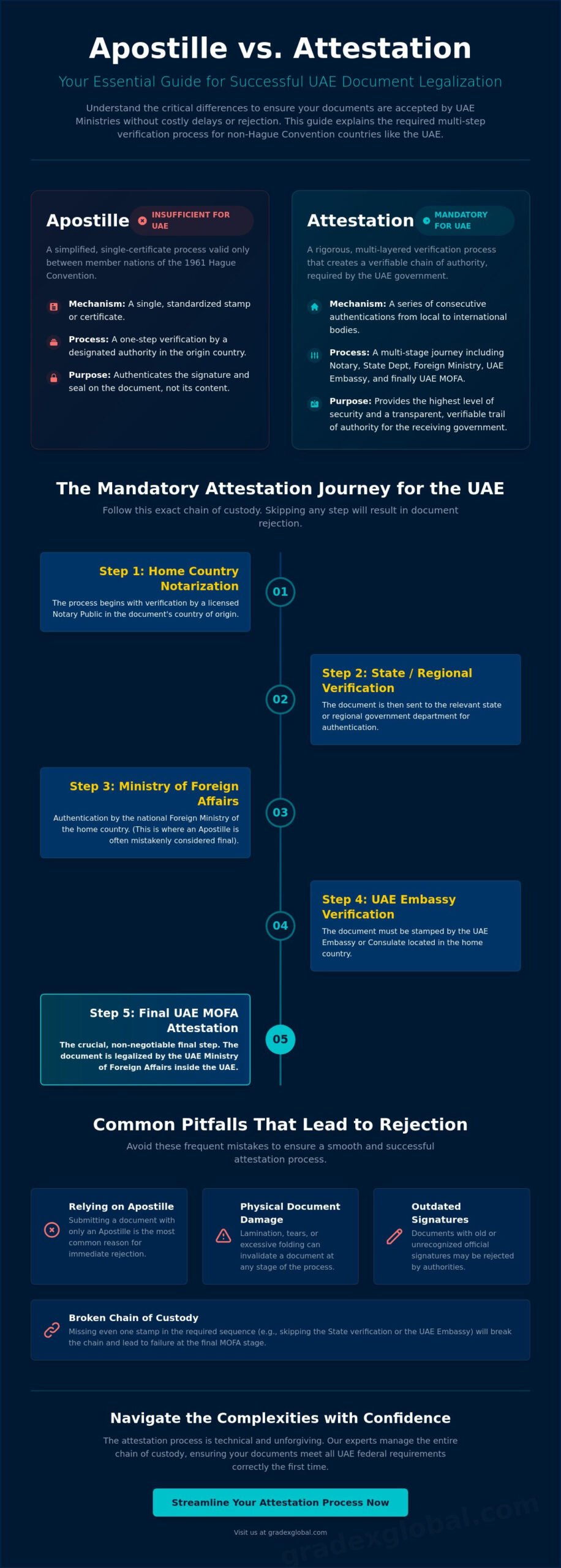
An Apostille is a simplified form of certificate issued under the terms of the 1961 Hague Convention. It’s designed to streamline the legalization process between member nations by providing a single, standardized stamp that confirms the legitimacy of the signatures and seals on a document. Conversely, Attestation is a more rigorous, multi-layered verification process required by countries that aren’t signatories to the Hague Convention. Because the UAE isn’t a member of this convention, a standard Apostille is never sufficient for final legal recognition. Instead, it serves only as a preliminary step in a longer chain of custody that must culminate in a seal from the UAE Ministry of Foreign Affairs (MOFA).
The Mechanism of an Apostille
The 1961 Apostille Convention established a framework to facilitate the international movement of public documents by replacing the traditional, cumbersome legalization process with a single certificate. This certificate is issued by a designated Competent Authority in the document’s country of origin, such as a Secretary of State or a Ministry of Foreign Affairs. It’s important to recognize that an Apostille doesn’t verify the truthfulness of the document’s content; it only authenticates the capacity of the person who signed the document and the identity of the seal or stamp it bears. While this simplifies movement between member states, it represents only the beginning of the journey for documents destined for the UAE.
The Multi-Stage Nature of Attestation
Attestation is defined by its hierarchical structure. Unlike the single-step Apostille, Attestation requires a series of consecutive signatures, each one verifying the one that came before it. This process typically begins with a local notary public and moves through regional or state departments before reaching the national Foreign Ministry. The chain isn’t complete until the UAE Embassy in the issuing country provides its seal, followed by the final mandatory attestation by MOFA within the UAE. This comprehensive approach ensures a transparent and verifiable trail of authority. It’s a mandatory requirement for all foreign documents used for employment, business setup, or residency in the Emirates, as it provides the highest level of security for the receiving government.
Choosing the correct path isn’t a matter of preference but a matter of federal compliance. As of May 2026, the UAE continues to enforce these multi-stage protocols to maintain the integrity of its administrative systems. Whether you’re presenting a university degree for a residency visa or a board resolution for a new branch office, the distinction between a simple stamp and a verified chain of custody is the difference between operational success and bureaucratic delay.
Why the UAE Requires Attestation Instead of Just an Apostille
The United Arab Emirates operates outside the legal framework of the Hague Convention, a deliberate choice that prioritizes institutional security and bilateral verification. For professionals and investors, the apostille vs attestation for uae explained logic is simple: a single stamp from a home country doesn’t provide the level of multi-jurisdictional scrutiny required by UAE federal law. The UAE government demands a complete, unbroken chain of custody. This means every document must be verified by both the issuing country’s authorities and the UAE’s own diplomatic representatives before it reaches the final desk at the UAE Ministry of Foreign Affairs.
It’s a common misconception that an Apostille is a “higher” form of certification. In reality, within the Emirates, an Apostille from a Hague-member nation is often treated as merely the first step in a much longer process. It serves to authenticate the document in its country of origin, but it lacks the final endorsement from the UAE Embassy, which is a mandatory prerequisite for local legal recognition. Without this embassy seal, the document remains legally invisible to UAE ministries, regardless of how many stamps it carries from its home territory.
The Sovereignty and Security Factor
The UAE ensures document integrity through a rigorous bilateral verification system. This methodical approach is designed to prevent the submission of fraudulent credentials in high-stakes environments like healthcare, engineering, or corporate governance. Authorities don’t accept “True Copy” stamps or standalone Apostilles because they lack the specific security features provided by the UAE Embassy seal in the country of origin. This seal acts as a bridge between two different legal systems. It confirms that the document has been vetted by officials who understand both the issuing country’s laws and the UAE’s strict administrative standards. This double-layer of protection is what maintains the stability and reliability of the UAE’s public records.
Commercial vs. Personal Requirements
The path to legalization varies significantly depending on the document’s intended use. Educational certificates, for instance, are subjected to high levels of scrutiny to ensure they meet the criteria for equivalence certificates, which are essential for specialized professional roles. Personal documents like marriage or birth certificates follow a different path, focusing on family residency and sponsorship eligibility.
Commercial documents, such as board resolutions or Power of Attorney filings, represent the most complex tier. These often require additional layers of verification from Chambers of Commerce before they can proceed to the embassy. Each step must be executed in a specific sequence; any deviation leads to document rejection and project delays. For those managing complex timelines, professional Certificate Attestation ensures that these technical requirements are met with precision from the very first step.
The 2026 Step-by-Step Process for Document Legalization
Executing a successful document verification strategy requires a methodical adherence to a five-stage protocol. While the apostille vs attestation for uae explained debate often focuses on the final result, the procedural integrity of the early stages determines whether a document will be accepted or rejected by federal authorities. In 2026, this sequence remains a mandatory requirement for all foreign instruments intended for use within the Emirates. The process follows a strict hierarchy where each step validates the preceding one, creating a secure chain of custody that satisfies UAE security standards.
- Step 1: Notarization: The document must first be certified by a licensed notary in the country of origin to verify the identity of the signatories.
- Step 2: Home Country Authentication: The document proceeds to the state department or foreign ministry in the issuing country for authentication of the notary’s credentials.
- Step 3: UAE Embassy Legalization: This is the critical bridge where the UAE Embassy or Consulate in the home country applies its seal, confirming the document meets bilateral standards.
- Step 4: UAE MOFA Attestation: Upon arrival in the Emirates, the document must receive the final seal from the UAE Ministry of Foreign Affairs (MOFA).
- Step 5: Legal Translation: If the document is not in Arabic, it must be processed by a certified translator to ensure its contents are legally accessible to local ministries.
Navigating the Home Country Phase
The initial requirements vary significantly between jurisdictions. For instance, documents from the UK or US often require specific state-level verification before they can reach the federal level, while Indian documents must typically pass through the Ministry of External Affairs (MEA). Western jurisdictions have increasingly shifted toward digital verification systems in 2026, allowing for faster authentication of electronic signatures. Rejections at the UAE Embassy stage often stem from technical errors, such as using an expired notary commission or failing to provide the original document. Ensuring your paperwork is free of lamination is also vital, as physical alterations can invalidate the entire chain of custody.
The Final UAE MOFA Milestone
Once the document reaches the UAE, the final validation occurs through the official MOFA portal. As of 2026, applicants within the UAE must use the UAE Pass digital identity for all attestation services to ensure maximum security. The fee structure is clearly defined: AED 150 for personal and academic documents, while commercial documents require a higher fee of AED 2,000. Digital attestation can now be completed within 2 hours during official working hours, provided the previous steps were executed correctly. For those requiring physical stamps, courier-based services typically conclude within 1 to 3 working days. Precision at this stage is non-negotiable; even a minor discrepancy in the digital application can lead to significant operational delays.
Common Pitfalls and How to Avoid Document Rejection
Administrative friction during document legalization often stems from minor technical oversights that escalate into significant delays. While the fundamental concept of apostille vs attestation for uae explained in earlier sections emphasizes the chain of custody, the technical execution often fails due to simple physical oversights. The most pervasive error is the “Apostille Trap,” where applicants assume a Hague stamp from their home country serves as a final endorsement. In the UAE, this stamp is merely a prerequisite for the embassy stage; without the subsequent UAE Embassy and MOFA seals, your document remains legally invalid for federal use.
Physical document integrity is equally critical. Lamination is a frequent cause of administrative failure. UAE authorities require direct contact with the paper to apply physical stamps and adhesive security labels. If a document is laminated, officials can’t verify the texture of the original seals or apply the mandatory MOFA stickers, leading to an immediate rejection. Additionally, sending documents to the incorrect regional consulate can result in weeks of lost time. Consular jurisdictions are strictly enforced; a document issued in one state or province must typically be processed by the specific consulate governing that territory.
Technical Standards for 2026
Precision in 2026 requires more than just correct signatures. All seals must be clear, and signatures must be legible without overlapping other text. For multi-page documents, authorities often demand ribbon-bound certifications or specific eyelet fixings to ensure pages haven’t been substituted. A significant development in 2026 is the UAE’s expanded acceptance of e-Apostilles from Western jurisdictions. While these digital certificates streamline the initial authentication phase, they don’t bypass the final MOFA milestone. The digital record must still be successfully mapped to the UAE’s internal verification systems during the final attestation step. For complex multi-jurisdictional filings, professional Certificate Attestation provides the necessary oversight to mitigate these technical risks.
The Role of Legal Translation
Legal translation into Arabic is a mandatory requirement for documents presented to most UAE government bodies, including the Ministry of Justice and various municipal authorities. The sequence of this step is vital. You shouldn’t translate the document until the primary attestation chain is complete. This is because the final translation must include the text of all the stamps and seals acquired during the legalization process. If you translate the document prematurely, the translation won’t reflect the final MOFA seal, rendering it incomplete. Furthermore, only translations performed by UAE-licensed professionals are recognized. Using an unlicensed translator, even if the work is accurate, will result in the document being dismissed by the receiving authority.
Strategic Solutions: How Grad-Ex Consultancy Streamlines the Process
Achieving administrative compliance in the Emirates requires more than just following a checklist; it demands a partner with deep institutional memory. Having analyzed the apostille vs attestation for uae explained requirements, it’s clear that the technical nuances of 2026 regulations leave little room for error. Grad-Ex Consultancy leverages over 15 years of established relationships with UAE ministries to navigate these complexities. Our methodology ensures that every document follows the correct legal trajectory, eliminating the risk of rejection at the final MOFA stage. We manage the entire lifecycle of document verification, providing a stable bridge between your home country’s authorities and the UAE’s federal requirements.
Our operational model is built on transparency and technical precision. We employ a fixed-fee structure that covers the entire process, including international document courier and administrative handling. This approach removes the uncertainty of hidden costs that often plague international document legalization. Whether you’re seeking residency visas or establishing a corporate entity, our team provides the comprehensive support necessary for a seamless transition. We handle everything from the initial notarization in your home country to the final UAE MOFA stamp. This allows you to focus on your core business objectives while we secure your legal standing through methodical execution.
Why a Strategic Advisor Outperforms a Standard Courier
A standard courier service merely transports paper; a strategic advisor secures the outcome. We provide rigorous pre-verification of all documents before they enter the attestation chain, identifying issues like lamination or improper notarization before they become expensive failures. Our experts coordinate across multiple time zones, providing real-time tracking and ensuring that each stage of the verification is completed with surgical accuracy. This level of oversight is particularly critical when integrated with our broader corporate services, where document recognition is the foundation of successful market entry.
Secure Your 2026 Global Success
The requirements for 2026 demand proactive compliance and a deep understanding of evolving digital protocols. Complex commercial filings and specialized educational requirements require a level of expertise that internal teams often lack. By starting your journey with a professional consultation, you ensure that your global expansion remains on schedule. Our commitment to stability and excellence makes us the preferred partner for high-stakes document legalization. To begin your process with technical certainty, Contact Grad-Ex Consultancy for expert UAE attestation services.
Securing Your Administrative Foundation in the UAE
Navigating the technicalities of the UAE’s document verification system requires a commitment to procedural accuracy and institutional knowledge. This apostille vs attestation for uae explained guide highlights that while an Apostille facilitates movement between Hague members, the UAE’s federal standards demand a more rigorous chain of custody. Success in 2026 depends on recognizing that each seal, from the initial notary to the final MOFA stamp, is a non-negotiable requirement for legal recognition. Failing to secure the correct sequence of verifications often leads to costly rejections and operational setbacks that can compromise your professional timeline.
Grad-Ex Consultancy brings over 15 years of GCC market expertise to every engagement, operating as a licensed UAE strategic advisory. We eliminate the unpredictability of international paperwork through our fixed-fee document processing model, ensuring total transparency from the outset. Secure Your Professional UAE Document Attestation Today and ensure your commercial or personal documents meet every federal benchmark without delay. Your transition to the Emirates should be defined by growth rather than administrative friction. With the right strategic partner, your documents will serve as a stable foundation for your future success in the region.
Frequently Asked Questions
Does the UAE accept an Apostille for a residency visa?
No, the UAE doesn’t accept an Apostille as a standalone method for document legalization. Since the Emirates isn’t a signatory to the Hague Convention, any document bearing an Apostille must still undergo the full attestation chain. This process includes verification by the UAE Embassy in the issuing country and a final seal from the Ministry of Foreign Affairs within the UAE.
How long does the full attestation process take for the UAE?
The final attestation stage within the UAE typically concludes within 1 to 3 working days for courier-based submissions. Digital attestation via the official portal can be finalized in approximately 2 hours during official working hours. However, the total duration depends on the processing speeds of home country departments and the UAE Embassy, which can add several weeks to the timeline.
Can I attest my documents while I am already inside the UAE?
You can only complete the final MOFA attestation while present in the UAE. The preceding stages, which include notarization and verification by your home country’s foreign ministry and the UAE Embassy, must be completed in the country where the document was issued. Many professionals use specialized consultancy services to manage these international phases while they focus on their local relocation.
What is the difference between MOFA and MOE attestation?
MOFA attestation verifies the legal authenticity of the signatures and seals on a document to ensure it’s a valid legal instrument. The Ministry of Education (MOE) process, or equivalency, evaluates the academic content of a degree to determine if it meets UAE educational standards. While MOFA is required for residency visas, MOE is specifically for professional licensing and further academic pursuits.
Do I need to attest my original documents or can I use copies?
Original documents are mandatory for the legalization process. UAE federal authorities and the Ministry of Foreign Affairs don’t accept photocopies or scanned versions for attestation. This strict requirement ensures that officials can verify the physical integrity of the document, including embossed seals and security features that are often lost in reproduction.
Is an Apostille required before I apply for UAE document attestation?
An Apostille is often the required preliminary step if your document originates from a Hague Convention member state. In these jurisdictions, the Apostille serves as the national-level authentication required before the UAE Embassy will apply its seal. Understanding the apostille vs attestation for uae explained framework is vital, as the Apostille acts as a bridge rather than a final solution.
What happens if my document is in a language other than English or Arabic?
Documents in languages other than English or Arabic require a legal translation to be recognized by UAE authorities. This translation should be performed after the primary attestation chain is complete in the country of origin. The final translated document must be certified by a UAE-licensed legal translator to ensure it meets the standards of the receiving government ministry.
Are digital or e-Apostilles recognized by the UAE Ministry of Foreign Affairs?
The UAE Ministry of Foreign Affairs increasingly recognizes e-Apostilles from Western jurisdictions as of 2026. While the digital format facilitates faster initial verification, the document must still be processed through the mandatory UAE Embassy and MOFA channels. The digital record is verified against international databases before the final UAE attestation is granted.