
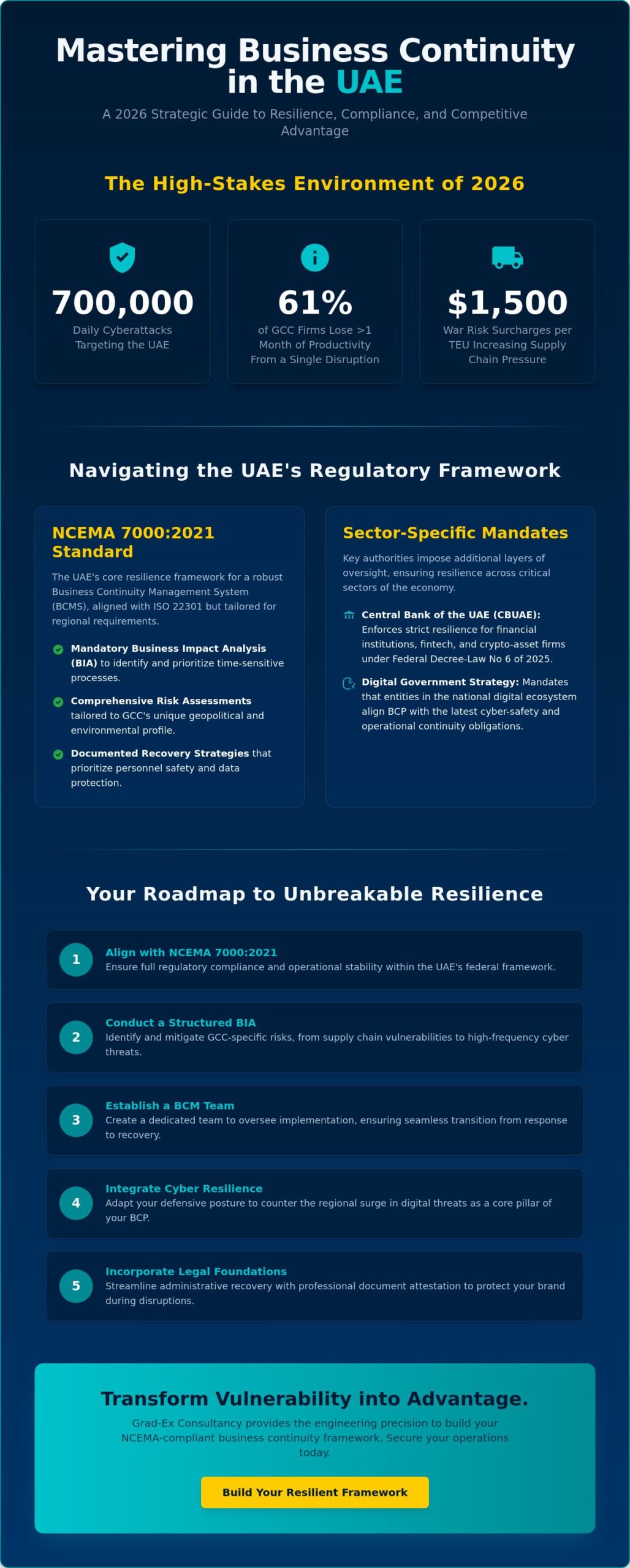
With the UAE Cyber Security Council reporting between 500,000 and 700,000 cyberattacks daily as of April 2026, the strategic necessity for business continuity planning in the uae has never been more critical. You’re likely aware that maintaining operational stability is difficult when 61% of GCC firms report that a single major disruption costs them more than a full month of productivity. The pressure to secure digital infrastructure while managing war risk surcharges of $1,500 per TEU on regional shipping makes the stakes higher than ever before.
This guide provides the engineering precision needed to master these complex requirements, ensuring you meet the rigorous NCEMA 7000:2021 standards while protecting your brand’s reputation. We’ll examine the latest federal decree-laws, including the 2025 updates to data protection and fintech supervision, to build a resilient framework that eliminates downtime and guarantees regulatory compliance. You’ll gain a structured roadmap to transform vulnerability into a stable, competitive advantage in the 2026 economic landscape. Our focus remains on providing the technical clarity and professional stability required to manage large-scale disruptions with confidence.
Key Takeaways
- Align your infrastructure with the mandatory NCEMA 7000:2021 standards to ensure full regulatory compliance and operational stability within the federal framework.
- Identify and mitigate GCC-specific risks through a structured Business Impact Analysis (BIA) that accounts for regional supply chain vulnerabilities and high-frequency cyber threats.
- Establish a dedicated Business Continuity Management (BCM) team to oversee the implementation of business continuity planning in the uae, ensuring a seamless transition from emergency response to long-term recovery.
- Adapt your defensive posture to counter the surge in regional digital threats by incorporating cyber resilience as a core pillar of your business continuity framework.
- Integrate professional document attestation and legal foundations into your resilience strategy to streamline administrative recovery and protect your brand’s reputation during disruptions.
The Regulatory Landscape of Business Continuity Planning in the UAE
Business continuity planning serves as the structural foundation for organizational endurance; in the Emirates, this discipline is defined by a rigorous alignment with national security and economic stability goals. Business continuity planning in the uae is not merely a defensive measure but a regulated engineering of resilience. The National Emergency Crisis and Disasters Management Authority (NCEMA) serves as the primary governing authority, ensuring that both public and private entities maintain operations during systemic shocks. By 2026, the mandate has evolved from basic disaster recovery to a philosophy of proactive resilience, where the ability to absorb and adapt to disruptions is quantified and audited. This shift is driven by the complexity of the regional economic landscape and the high reliance on digital infrastructure.
The NCEMA 7000 Standard Explained
NCEMA 7000 is the UAE’s primary resilience framework, establishing the technical specifications for a robust Business Continuity Management System (BCMS). The AE/SCNS/NCEMA 7000:2021 standard is closely synchronized with ISO 22301:2019, yet it incorporates specific regional requirements for resource management and crisis communication. While government entities and critical infrastructure providers face mandatory compliance, private sector firms increasingly adopt these standards to secure their position within the UAE market. The standard requires a systematic approach to identifying critical functions and the resources necessary to sustain them during a crisis. It emphasizes a cycle of continuous improvement through regular testing and exercising of response strategies.
- Mandatory Business Impact Analysis (BIA) to identify time-sensitive processes.
- Comprehensive risk assessments tailored to the GCC’s unique geopolitical and environmental profile.
- Documented recovery strategies that prioritize the safety of personnel and the protection of data.
Sector-Specific Regulations: CBUAE and Beyond
The regulatory landscape is increasingly granular, with specific authorities imposing additional layers of oversight. The Central Bank of the UAE (CBUAE), through Federal Decree-Law No 6 of 2025, enforces strict resilience mandates for financial institutions, extending this supervision to fintech and crypto-asset firms as of September 2025. This law necessitates the prompt reporting of security breaches and fraud to maintain the integrity of the national financial system. Similarly, the UAE’s “Digital Government” strategy dictates that any entity integrated into the national digital ecosystem must align its BCP with the latest cyber-safety obligations. With phishing attacks increasing by 21.2% in the second quarter of 2025, these regulations ensure that the nation’s smart-city infrastructure remains operational despite an escalating threat volume.
Core Pillars of an Effective UAE Business Continuity Plan
A resilient framework for business continuity planning in the uae rests on four structural pillars: impact analysis, risk assessment, resource allocation, and communication. Data from January 2026 indicates that 47% of GCC firms face annual disruption costs exceeding $1 million. This financial reality mandates a shift from theoretical planning to high-precision engineering of operational stability. We don’t view resilience as a luxury; it’s a mandatory component of the UAE’s complex economic infrastructure. Success requires a deep understanding of regional vulnerabilities, ranging from digital saturation to geopolitical supply chain shifts.
The Business Impact Analysis (BIA) Process
The BIA is the diagnostic phase where we identify critical business functions and establish Recovery Time Objectives (RTO). In the UAE’s high-speed market, an RTO of mere hours is often the difference between market leadership and total operational failure. You must assess the legal and financial impact of downtime with surgical accuracy. Prioritizing functions based on 2026 market demands ensures that essential services remain active, even when non-essential processes are paused. This logical hierarchy mirrors the precision of a large-scale engineering project, where every component has a defined role in the final structure.
Developing UAE-Specific Recovery Strategies
Recovery strategies must account for the specific geography and digital laws of the Emirates. Local cloud hosting and data sovereignty are non-negotiable requirements under the latest federal guidelines. When a crisis hits, the ability to pivot to alternate sites depends on more than just physical space; it requires administrative readiness. This includes ensuring your workforce has their equivalence certificate and other critical legal documents pre-attested for immediate verification. Without these foundational elements, even the most advanced technical recovery will stall at the bureaucratic level.
- Resource Management: Precise inventory of specialized personnel, backup technology, and physical assets like modern machinery or specialized vehicle fleets.
- Communication Protocols: Establishing clear, hierarchical lines of command for internal staff and external stakeholders, including regulatory bodies like NCEMA.
- Digital Redundancy: Implementing zero-trust architectures to protect the 500,000 to 700,000 digital assets targeted daily in the region.
Effective business continuity planning in the uae demands a partner who understands the intersection of technical precision and administrative compliance. For organizations seeking to fortify their local presence, Grad-Ex Consultancy provides the stable, professional foundation needed to navigate these complex requirements with confidence. We focus on the facts and the numbers to ensure your infrastructure remains standing, regardless of external disruptions.
Analyzing Regional Risks: Cyber Resilience and GCC Logistics
The evolution of the UAE’s smart-city ecosystem has expanded the attack surface for sophisticated digital disruptions. Business continuity planning in the uae must now account for a landscape where 500,000 to 700,000 cyberattacks occur daily, according to data released by the UAE Cyber Security Council in April 2026. These are not merely digital inconveniences; they are structural threats to the continuity of essential services. A robust plan must move beyond traditional firewalls, integrating deep-tier resilience that aligns with the UAE National Cyber Security Strategy (2025-2031). We view this as an engineering challenge where the goal is to maintain the integrity of the organizational structure under extreme pressure.
Cyber Security as a Continuity Foundation
Cyber resilience is the bedrock of modern operational stability in the Emirates. With DDoS attacks surging by 862% since 2019 and reaching over 373,429 incidents by the end of 2024, the technical requirements for defense have shifted. We’ve observed a 44% increase in underground recruitment efforts by ransomware affiliates targeting GCC countries throughout 2025. Organizations must implement AI-powered threat intelligence to counter the speed of modern attacks. AI is no longer optional; it’s a necessary tool for both threat generation by adversaries and real-time resilience monitoring by defenders. Protecting critical data against these state-sponsored or micro-affiliate threats requires a zero-trust architecture that guarantees function even during an active breach.
Supply Chain and Logistical Stability
The geopolitical position of the GCC introduces specific logistical vulnerabilities that demand precision in planning. Stress on the Strait of Hormuz and the Red Sea corridor has led to war risk surcharges of $1,500 per TEU, forcing a reassessment of global shipping reliance. To maintain stability, firms are diversifying suppliers across the GCC, moving away from single-source dependencies that are susceptible to regional disruptions. The UAE’s “Operation 300bn” strategy, which aims to double the industrial sector’s contribution to GDP by 2031, necessitates a rigorous approach to business continuity planning in the uae to protect the expanding manufacturing infrastructure. This industrial growth requires a stable flow of materials that only a diversified supply chain can provide.
Managing operations also requires a strategy for climate-related risks and manpower mobility. Extreme weather events can paralyze urban centers, while the mobility of an expatriate workforce depends on the continuity of visa processing and legal documentation. Ensuring that administrative foundations are as resilient as the physical machinery is the only way to guarantee long-term stability. A truly comprehensive plan addresses these human and environmental factors with the same level of detail as technical data recovery.
Step-by-Step Implementation: Developing and Testing Your Plan
Execution is where theoretical resilience transforms into structural integrity. Establishing a dedicated Business Continuity Management (BCM) team serves as the command structure for this process. This group shouldn’t simply be a collection of department heads; it must function as a high-precision engineering unit capable of making rapid decisions under pressure. Effective business continuity planning in the uae requires this team to oversee the entire lifecycle of the plan, from initial drafting to the final validation through rigorous testing cycles. Without a clear hierarchy and defined roles, the most sophisticated recovery strategy will fail during a real-world disruption.
Drafting the Continuity Documentation
The documentation phase requires the creation of two critical components: the Incident Response Plan (IRP) and the Disaster Recovery Plan (DRP). The IRP focuses on the immediate actions required to contain a crisis, while the DRP outlines the technical steps to restore infrastructure. In the UAE’s specific regulatory environment, ensuring all legal documents are professionally translated into Arabic and notarized is a mandatory step for emergency use. You must also establish a physical or virtual Crisis Management Command Centre. This hub serves as the single source of truth, ensuring that communication remains structured and that the administrative foundations mentioned in previous sections are accessible when digital systems are compromised.
Testing and Maintenance Strategies
A plan that hasn’t been tested is merely a set of assumptions. We distinguish between tabletop exercises, which are structured discussions of hypothetical scenarios, and full-scale simulations that involve the actual activation of backup systems. Given the 44% increase in ransomware efforts targeting the GCC in 2025, tabletop exercises should occur quarterly, while full-scale simulations are necessary at least once per year. You must update the BCP immediately following any UAE regulatory changes, such as the 2025 Central Bank decree-laws. Regular audits ensure that your recovery strategies keep pace with both evolving threats and the rapid modernization of the UAE’s digital government infrastructure.
- Training and Awareness: Embedding resilience into corporate culture ensures every employee understands their role in the continuity chain.
- Simulation Variety: Rotate testing scenarios between cyber breaches, supply chain failures, and extreme weather events to ensure comprehensive readiness.
- Post-Exercise Reports: Document every failure during testing to refine the plan; failures in practice are the only way to guarantee success in reality.
Building a resilient organization requires a commitment to precision and a deep understanding of local legal mandates. If you’re ready to secure your company’s future against regional disruptions, contact Grad-Ex Consultancy today to develop a robust, compliant business continuity framework. We provide the stability and expertise needed to protect your operations in the most challenging environments.
How Grad-Ex Consultancy Supports Business Resilience in the UAE
Operational resilience is built on more than technical redundancy; it requires a stable administrative and legal infrastructure. While many firms focus exclusively on digital recovery, business continuity planning in the uae remains incomplete without a focus on the foundational documentation required by local authorities. We provide the structural support necessary to ensure that your corporate framework remains intact during systemic shifts. Our approach mirrors large-scale engineering projects where every detail, from the ground up, is accounted for to prevent structural failure. We don’t offer vague promises; we deliver the precision required to navigate the UAE’s unique regulatory environment with confidence. This commitment to stability ensures that your organization is not just surviving disruptions but maintaining a position of market authority.
Foundational Legal Support
In a crisis, the speed of your response depends on the accessibility of pre-verified documentation. We ensure that all essential corporate documents are professionally attested and ready for immediate deployment. This is critical when communicating with UAE authorities, where accurate legal translation into Arabic is not just a preference but a mandatory requirement for official recognition. Leveraging over 15 years of deep-seated institutional relationships within the Emirates, we facilitate rapid response times that generic consultants cannot match. We handle the complex task of document verification so your leadership can focus on high-level decision-making. This proactive management of legal foundations eliminates the administrative bottlenecks that often stall recovery efforts during regional disruptions. Our expertise covers the full spectrum of administrative readiness, including:
- Cross-border document attestation and notarization for multi-national entities.
- Certified legal translation of Incident Response Plans for regulatory submission.
- Direct coordination with NCEMA and other federal bodies to ensure plan alignment.
- Maintenance of power of attorney and licensing continuity during operational shifts.
Strategic Advisory for Long-Term Growth
Resilience is a continuous process of optimization, not a one-time setup. Our tiered consultancy subscription plans are designed to integrate seamlessly with your internal BCM team, providing ongoing compliance monitoring and technical updates. We utilize rigorous market research and financial analysis to predict regional disruptions before they impact your operations. This allows for a planned modernization of your continuity framework rather than a reactive, costly overhaul. If your organization requires restructuring or new licensing during a period of growth, we streamline these processes to ensure no loss of momentum. To fortify your operational stability and ensure your infrastructure is prepared for the 2026 landscape, contact Grad-Ex Consultancy to discuss your business setup requirements today. We provide the stability your enterprise demands in a digital-first economy, ensuring that business continuity planning in the uae becomes a permanent asset rather than a temporary fix.
Building a Foundation for Uninterrupted Growth
The 2026 economic landscape demands more than reactive measures; it’s a structural commitment to resilience. Mastering business continuity planning in the uae involves aligning your operations with the NCEMA 7000:2021 standards while integrating the legal and administrative foundations we’ve analyzed. We’ve seen that technical recovery is only effective when supported by pre-verified documentation and a deep understanding of GCC-specific logistical risks. Success in this market isn’t accidental. It’s the result of precise engineering and authoritative oversight. By establishing a dedicated BCM team and maintaining a rigorous testing cycle, you transform vulnerability into a stable competitive advantage.
With over 15 years of GCC market expertise, our expert consultants provide the end-to-end document attestation and legal support necessary for full regulatory compliance. We don’t just help you survive; we ensure your infrastructure remains standing through every disruption. We invite you to partner with a firm that values precision as much as you do.
Secure Your UAE Business Future with Grad-Ex Strategic Advisory
A resilient future is within your reach when you build on a foundation of professional stability and engineering excellence.
Frequently Asked Questions
Is business continuity planning mandatory for private companies in the UAE?
Business continuity planning in the uae is mandatory for government entities and organizations within critical infrastructure sectors under the AE/SCNS/NCEMA 7000:2021 standard. Private firms in the financial sector must comply with Central Bank Federal Decree-Law No 6 of 2025, which became effective in September 2025. While not universally mandatory for every small business, it’s a prerequisite for securing government contracts and maintaining operational licenses in the 2026 economic landscape.
What is the difference between Disaster Recovery and Business Continuity in the UAE?
Business continuity encompasses the entire organizational strategy to maintain essential functions, including personnel, communication, and administrative foundations. Disaster recovery is a technical subset focused specifically on the restoration of IT infrastructure and data after a disruption. In the Emirates, a complete plan must integrate both to meet NCEMA requirements. We treat business continuity as the overarching structural framework, while disaster recovery provides the precision engineering for digital systems.
How does the NCEMA 7000 standard apply to international firms?
International firms operating in the Emirates must align their existing global frameworks with the specific local requirements of NCEMA 7000. While these firms often follow ISO 22301:2019, the UAE standard includes unique mandates for resource management and coordination with national emergency authorities. Compliance ensures that a foreign entity’s local branch can operate autonomously during regional disruptions without relying solely on international headquarters, which may be disconnected from local logistical realities.
What are the most common risks for businesses operating in the UAE in 2026?
Businesses in 2026 face an escalating volume of 500,000 to 700,000 daily cyberattacks, making digital resilience the primary concern. Logistical risks are equally significant, with war risk surcharges of $1,500 per TEU impacting the supply chains of 90% of GCC firms. Additionally, the 21.2% increase in phishing attacks during the second quarter of 2025 highlights the need for continuous monitoring. These data-driven threats require a proactive, engineered approach to risk management.
How much does it cost to implement a Business Continuity Plan in the UAE?
The cost of implementation varies based on organizational complexity and the scale of critical infrastructure. While we don’t provide fixed estimates, data from January 2026 shows that 47% of GCC firms lose over $1 million annually due to disruption costs. Investing in a robust plan is a strategic allocation of capital that prevents these high-volume losses. The focus should remain on the return on resilience and the protection of long-term brand reputation.
Can SMEs benefit from BCP, or is it only for large enterprises?
SMEs benefit significantly from business continuity planning in the uae because they often lack the capital reserves of larger corporations to absorb a month of lost productivity. Since 61% of GCC firms report disruptions lasting longer than 30 days, a structured plan provides the stability needed to survive. SMEs use these frameworks to build trust with larger partners and government entities, proving their reliability as part of a secure national supply chain.
How often should a UAE Business Continuity Plan be audited?
A comprehensive audit should be conducted at least once per year to ensure alignment with evolving UAE federal decree-laws. However, technical components and tabletop exercises should occur quarterly to address the rapid shift in cyber threats. Following any major organizational change or a surge in regional risks, such as those seen in 2025, a focused review is necessary. This logical cycle of maintenance guarantees that the plan remains a functional tool rather than a static document.
What role does the Ministry of Foreign Affairs (MOFA) play in business continuity?
The Ministry of Foreign Affairs (MOFA) is essential for the legal validity of the administrative foundations within your continuity plan. They oversee the attestation of corporate documents and powers of attorney, which are required to maintain operations if leadership is displaced. Without MOFA-verified documents, a firm cannot execute legal or financial recovery actions with UAE authorities. This administrative layer is a critical pillar that ensures the technical recovery strategies can actually be implemented.