
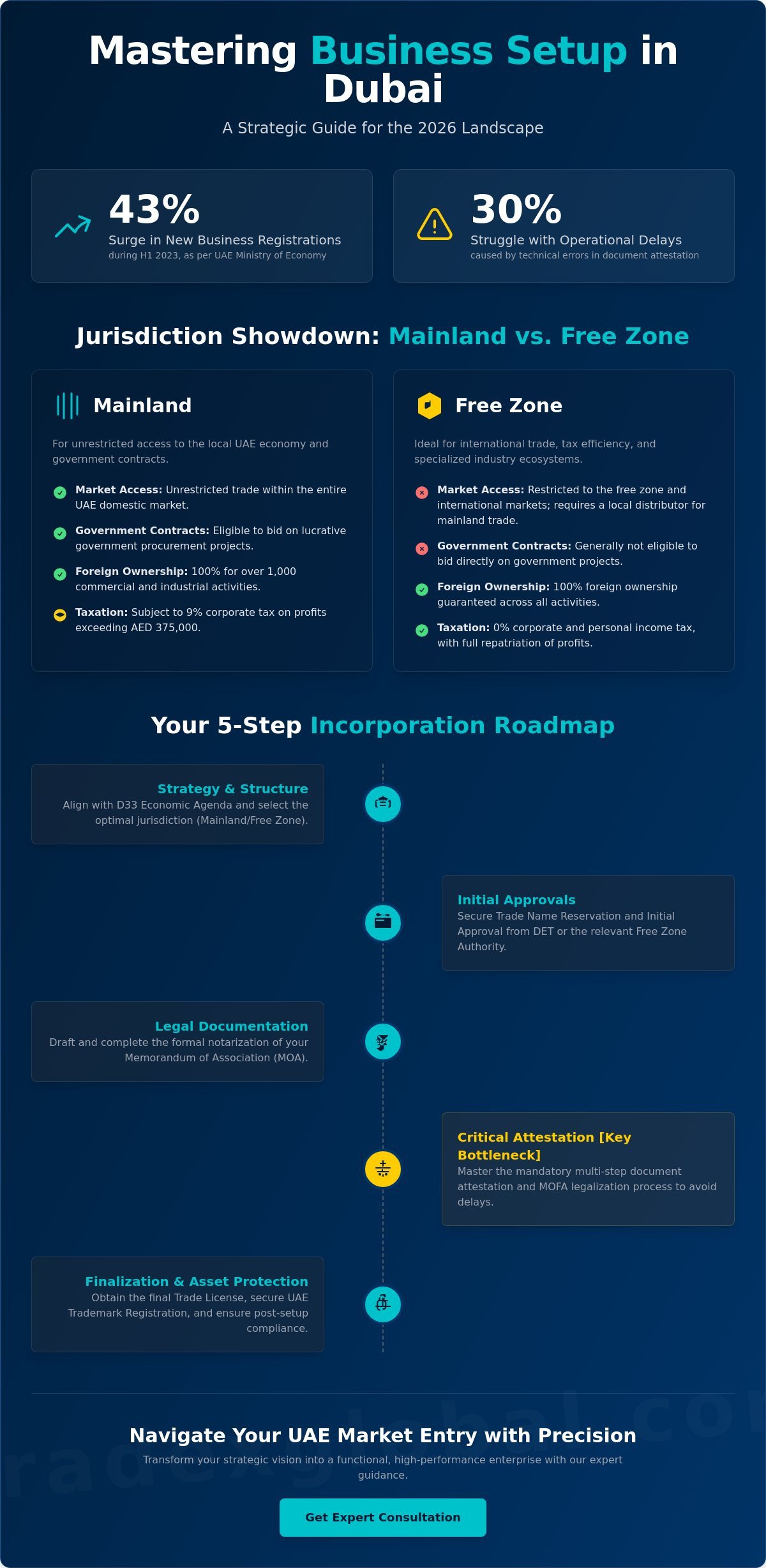
Data from the UAE Ministry of Economy reveals a 43% surge in new business registrations during the first half of 2023, yet approximately 30% of these entities struggle with operational delays caused by technical errors in document attestation. You’ve likely identified the Emirates as a critical hub for your next major investment, but the intricate bureaucratic requirements can obscure the path to a successful launch. This guide provides the engineering precision needed to master business setup dubai, ensuring your commercial foundation is legally sound and fully compliant with 2026 Ministry mandates. We’ll analyze the specific legal structures, jurisdictional differences between free zones, and the mandatory documentation required to transform your strategic vision into a functional, high performance enterprise.
Key Takeaways
- Align your market entry with the D33 Economic Agenda to ensure a precise and strategically sound integration into the UAE’s 2026 economic infrastructure.
- Discern the structural advantages of mainland versus free zone jurisdictions to balance geographic operational flexibility with tax-efficient asset ring-fencing.
- Streamline the primary bottleneck of business setup dubai by mastering the mandatory multi-step document attestation and MOFA legalization process.
- Execute a systematic incorporation roadmap that transitions from initial trade name reservation to the formal notarization of your Memorandum of Association.
- Protect your corporate assets and ensure long-term operational stability through rigorous post-setup compliance and UAE trademark registration.
Understanding the 2026 Business Setup Landscape in the UAE
Establishing a commercial entity in the United Arab Emirates represents a multi-stage integration into a sophisticated economic infrastructure. It’s a process that demands the same engineering precision as a large-scale construction project. A successful business setup dubai is no longer just about obtaining a trade license; it’s about aligning corporate governance with the Dubai Economic Agenda (D33). Launched in January 2023, the D33 agenda targets a total economic volume of AED 32 trillion by 2033. By 2026, the regulatory framework has evolved to prioritize high-value sectors and digital integration, making the initial application phase critical for long-term stability. Any technical discrepancy in the early documentation can lead to operational bottlenecks or compliance failures in subsequent years.
Precision in the initial filing determines the structural integrity of the corporation. Investors must treat the application as a blueprint. Selecting the correct activity codes and legal forms isn’t merely a clerical task but a strategic decision that affects tax liabilities and banking accessibility. The 2026 landscape rewards transparent, well-documented entities that contribute to Dubai’s diverse economic landscape, which has successfully transitioned from an oil-reliant model to a global center for trade, finance, and technology.
The Strategic Importance of the UAE Market
The UAE serves as a nexus for global trade, providing access to emerging markets across Africa, Asia, and the Middle East. By 2026, the regulatory environment has become even more favorable for international investors through the continued expansion of 100% foreign ownership. Following the implementation of Decree-Law No. 26 of 2020, the requirement for a local Emirati partner holding 51% of shares was abolished for over 1,000 commercial and industrial activities. This shift ensures that investors maintain full control over their operations and assets, reflecting the nation’s commitment to a pro-business, transparent ecosystem.
Key Regulatory Authorities and Their Roles
The regulatory framework is governed by several specialized bodies, each maintaining strict oversight to ensure market stability and compliance. Understanding these hierarchies is essential for a seamless business setup dubai:
- Department of Economy and Tourism (DET): This body is responsible for mainland licensing. It manages the issuance of commercial, professional, and industrial licenses within the emirate’s borders.
- Ministry of Economy: At the federal level, the Ministry oversees corporate laws, competition regulations, and intellectual property rights, ensuring that all businesses operate within the national legal framework.
- Free Zone Authorities: Entities like DMCC, IFZA, or JAFZA operate as independent regulatory ecosystems. They provide specialized infrastructure and 100% tax exemptions, governed by their own specific sets of internal regulations and compliance standards.
Each authority functions with a high degree of digital automation. In 2026, the integration of blockchain-based verification and AI-driven compliance checks means that documentation must be flawless. Professionalism and technical accuracy remain the only guarantees of a successful market entry.
Mainland vs. Free Zone: Selecting the Optimal Legal Structure
Choosing between a mainland and a free zone jurisdiction is the foundational engineering decision for any business setup dubai project. This choice dictates the company’s operational radius and its ability to engage with the local UAE economy. While free zones offer specialized infrastructure for specific industries, mainland entities provide unrestricted access to the domestic market and government procurement contracts. The strategic selection process requires a precise evaluation of where your primary revenue will be generated and how much physical presence your operations demand.
The introduction of the Dubai Unified License (DUL) in late 2023 significantly streamlined the identification process for companies across the emirate. This digital identity provides a standardized numbering system for all businesses, regardless of their zone. It enhances transparency and simplifies cross-border utility for international investors. Investors must follow certain key steps for setting up a business to ensure their legal structure aligns with their 2026 growth targets. The DUL acts as a bridge, though it doesn’t eliminate the underlying legal distinctions between jurisdictions.
Mainland Business Setup: Maximum Local Reach
A mainland license remains the gold standard for companies targeting the UAE’s internal consumer base. It allows for direct trade without intermediaries and provides the right to bid for massive infrastructure projects managed by government bodies. A physical office space is a mandatory requirement for mainland entities. This office must be registered through the Ejari system, which is a government-regulated tenancy contract system that ensures transparency in commercial real estate. Mainland setups are categorized primarily into two types:
- Commercial Licenses: These cover trading activities and now allow 100% foreign ownership for over 1,000 industrial and commercial activities.
- Professional Licenses: These are reserved for service providers and specialists, where the investor maintains full operational control over their intellectual and professional output.
Free Zone Options: Specialized Economic Hubs
Dubai’s 40 plus free zones function as industry-specific clusters. These include the Dubai International Financial Centre (DIFC) for finance or Dubai Internet City for technology. These zones provide 100% import and export tax exemptions, making them ideal for companies using Dubai as a global logistics or financial hub. However, free zone entities can’t trade directly with the local UAE market unless they work through a mainland distributor or establish a mainland branch office.
For firms focused on high-precision engineering or technical consulting, selecting a zone that mirrors their expertise is vital for networking and resource access. If your strategy requires a stable, long-term foundation in the region, consult with experts at Gradex Global to evaluate which jurisdiction supports your specific technical requirements. The decision hinges on whether your revenue will be generated from international exports or local service delivery.
The Critical Foundation: Document Attestation and Legalization
Establishing a corporate presence in the Emirates requires more than just capital; it demands meticulous administrative precision. For many investors, document attestation represents the most significant bottleneck in the business setup dubai timeline. This isn’t merely a formality. It’s a multi-layered verification process that ensures the authenticity of foreign documents within the UAE legal framework. Failure to account for the lead times associated with international ministries can delay operations by several weeks or even months.
The procedure follows a rigorous path that begins in the country of origin. You must first secure a local notary’s stamp, followed by legalization from your home country’s Ministry of Foreign Affairs and the UAE Embassy in that territory. The final step occurs locally at the UAE Ministry of Foreign Affairs (MOFA). This sequence ensures that every certificate or contract carries the weight of international law before it reaches the desk of a licensing officer. Precise coordination between these entities is vital for maintaining the project schedule.
Mandatory Attestation for Corporate and Personal Documents
Corporate entities expanding through branch offices must provide an attested Memorandum of Association (MOA) and Board Resolutions. Without these verified documents, the Department of Economy and Tourism (DET) cannot finalize the issuance of a trade license. Personal documentation is equally critical for the leadership team. To secure executive-level residency visas, the Ministry of Human Resources and Emiratisation (MOHRE) requires attested educational certificates to verify that the management possesses the necessary qualifications. The chain of legalization refers to the sequential verification process that begins with local notarization in the country of origin and concludes with final validation by the UAE Ministry of Foreign Affairs.
Integrating these steps into your business setup dubai strategy prevents administrative friction. Using the Official UAE Government Business Setup Guide helps identify which specific documents require attestation based on your chosen legal structure and activity. This level of preparation mirrors the planning required for large-scale infrastructure projects where every component must meet exact specifications before assembly begins.
Legal Translation and Notary Requirements
Once documents reach the UAE, they must undergo legal translation by a translator licensed by the UAE Ministry of Justice. All international contracts must meet these linguistic standards to be admissible in UAE courts or government departments. Modernization has introduced online notary services, which can reduce processing times by up to 40% compared to traditional physical appointments. This digital shift allows for faster execution of power of attorney and signature specimens.
For specialized professionals, the equivalence certificate process is a vital component of the setup, ensuring that foreign academic qualifications align with UAE standards for regulated sectors like engineering or healthcare. Managing these requirements with engineering-like accuracy ensures that your business foundation is stable and compliant. This systematic approach to documentation reflects the stability and professional standards expected in the Dubai market.
Operational Roadmap: A Step-by-Step Guide to Incorporation
Establishing a corporate entity in the UAE requires a methodical approach akin to a large-scale engineering project. The process isn’t merely administrative; it’s the construction of a legal and financial infrastructure that must withstand rigorous regulatory scrutiny. By 2026, the business setup dubai landscape has become more digitized, yet the fundamental requirement for structural integrity remains. Investors should view the following five phases as the critical path to operational readiness.
- Phase 1: Trade name reservation and securing the Initial Approval from the Department of Economy and Tourism (DET) or the relevant Free Zone authority.
- Phase 2: Drafting and notarizing the Memorandum of Association (MOA) to define the legal boundaries of the enterprise.
- Phase 3: Securing a physical location and registering the Ejari contract to validate the firm’s local presence.
- Phase 4: Final submission for the commercial license and commencement of the residency visa processing for shareholders and staff.
- Phase 5: Opening a corporate bank account and mandatory VAT registration for entities exceeding the AED 375,000 revenue threshold.
Trade Name and Initial Approval
The naming of a firm is the first technical milestone in the business setup dubai protocol. Regulations in 2026 continue to mandate that names don’t include references to divine attributes, political affiliations, or global brands without explicit authorization. Once the DET approves the trade name, you’ll receive the “Initial Approval.” This document acts as a temporary permit, valid for six months, allowing you to proceed with secondary requirements like leasing and legal drafting. Expect this phase to conclude within 48 to 72 hours if all documentation is precise.
Leasing and Infrastructure Compliance
Physical infrastructure is a mandatory pillar of UAE business law. Every license must be linked to a unique Ejari, which is a government-attested lease agreement. This document serves as the essential link between your commercial license and your ability to sponsor residency visas. In 2026, authorities require that the office space’s size and technical specifications directly match the license’s activity. For example, a logistics firm requires specific warehouse zoning, while a consultancy might utilize a 200-square-foot executive office. You can’t bypass this step; the Ejari is the digital proof of your company’s “substance” within the Emirates.
Finalizing the setup involves the issuance of the actual license and the activation of the establishment card. This allows for the processing of Emirates IDs, a prerequisite for the final operational step: the corporate bank account. Modern UAE banks require a high degree of transparency regarding the source of funds and business models, reflecting the nation’s 2026 commitment to global financial standards. Achieving this milestone transforms your strategic plan into a functional, revenue-generating asset.
Ensure your market entry is built on a foundation of professional precision and local expertise.
Strategic Growth: Post-Setup Compliance and Asset Protection
Successful business setup dubai requires more than a certificate of incorporation. It demands a transition into a phase where operational stability and legal compliance become the primary drivers of value. Transitioning from a newly formed entity to a sustainable market participant involves shifting focus from administrative tasks to rigorous financial analysis and market research. Maintaining this stability involves a rigorous schedule of recurring obligations that protect your legal standing.
Annual license renewals are non-negotiable. Missing a deadline results in penalties that compromise your standing with the Department of Economy and Tourism (DET) or relevant Free Zone authorities. Fines for late renewals often start at AED 200 per month, but the true cost is the potential suspension of your corporate bank account. Beyond renewals, companies must address Economic Substance Regulations (ESR) and Anti-Money Laundering (AML) frameworks. These regulations represent the structural integrity of your corporate presence. Failure to file an annual ESR notification can lead to a fine of AED 20,000, while non-compliance with AML reporting triggers much steeper financial consequences. Precision in these filings is mandatory to ensure long-term stability.
Trademark Registration and IP Protection
Brand equity is a primary corporate asset that requires legal fortification. Registering a trademark with the UAE Ministry of Economy provides legal exclusivity across the nation and serves as a strategic gateway for GCC-wide protection. It’s a technical process that requires a comprehensive search to avoid conflicts with existing registrations. Many firms fail by choosing the wrong classification under the Nice Agreement, which identifies 45 different classes of goods and services. This mistake delays protection and increases costs. A precise filing strategy ensures your corporate identity remains untouchable as you scale across regional markets.
Sustainable Growth with Grad-Ex Consultancy
Grad-Ex Consultancy brings 15 years of institutional relationships to the table to ensure smoother authority approvals. We don’t just facilitate introductions; we manage the complex engineering of your business growth. Our tiered strategic plans are designed to support businesses at every stage, from the initial startup phase to multinational status. We provide the financial analysis and market research necessary for data-driven decisions, ensuring your expansion is both stable and predictable. This structured approach allows you to focus on your core operations while we handle the technicalities of compliance and growth strategy.
Architecting Your Enterprise for the 2026 UAE Economy
Establishing a market presence in the Emirates requires more than just a license; it demands a foundation built on precision and technical accuracy. Selecting between Mainland and Free Zone structures isn’t just a legal choice. It’s a strategic maneuver that dictates your operational reach for the next decade. Your business setup dubai requires rigorous document attestation and a deep understanding of evolving compliance frameworks to protect your long-term assets. These pillars ensure your enterprise remains resilient against shifting global market conditions.
Grad-Ex Global brings 15 years of GCC strategic advisory experience to your project. We leverage deep institutional relationships to expedite authority approvals and provide fixed-fee document attestation and legal translation services. This engineering-led approach removes ambiguity from the incorporation process. Our team manages the complexity of the UAE regulatory environment so you can focus on scaling your operations. We don’t just facilitate entry; we build the infrastructure for your sustained growth.
Consult with Grad-Ex for your UAE Business Incorporation today to secure your commercial future in the Middle East.
Frequently Asked Questions
Can a foreigner own 100% of a business in Dubai in 2026?
Foreign investors can maintain 100% ownership of their companies in Dubai for over 1,000 commercial and industrial activities as of 2026. This regulation, initiated by Federal Decree-Law No. 26 of 2020, eliminated the previous requirement for a local Emirati shareholder to hold a 51% stake. It’s a strategic shift that ensures full operational control and capital repatriation for international entities entering the UAE market.
What is the difference between a mainland and a free zone license?
A mainland license allows a company to trade directly within the local UAE market and bid for government contracts without geographical restrictions. Conversely, a free zone license limits business operations to the specific zone’s boundaries or international markets. While free zones offer 100% import and export tax exemptions, mainland companies provide greater flexibility for large-scale infrastructure projects and retail operations across all seven emirates.
How long does the business setup process typically take?
The business setup dubai process typically requires 3 to 10 working days to finalize, depending on the complexity of the corporate structure and the specific activity. Instant licenses from the Department of Economy and Tourism (DET) can be issued within 5 minutes for certain activities. However, industrial licenses requiring technical approvals from external ministries often extend the timeline to 15 working days for comprehensive compliance.
Why is certificate attestation mandatory for starting a business?
Certificate attestation is mandatory to verify the legal authenticity of foreign documents, such as educational degrees or parent company incorporation papers, for UAE authorities. This multi-step process involves the Ministry of Foreign Affairs in the country of origin and the UAE Ministry of Foreign Affairs (MOFA). It ensures that all corporate entities operating within the jurisdiction adhere to the rigorous legal standards required for professional licensing and visa processing.
Do I need a local partner to set up a company on the mainland?
Most commercial and industrial activities no longer require a local Emirati partner to hold 51% of the shares following the 2020 regulatory amendments. Investors can now establish a Limited Liability Company (LLC) with full ownership in the majority of sectors. Certain strategic activities, specifically those related to oil and gas or security, still require a local service agent or specific Emirati involvement to ensure national regulatory alignment.
What are the mandatory office space requirements for a new license?
Mainland companies are required to lease a physical office space with a minimum area of 200 square feet to secure a trade license. This physical presence is verified through an Ejari contract, which is a registered tenancy agreement in Dubai. While some free zones allow virtual desks or flexi-desks for startups, mainland entities must maintain a verified physical location to facilitate labor inspections and corporate bank account openings.
What is the role of MOFA attestation in the setup process?
MOFA attestation serves as the final validation step for international legal documents before they are accepted by the Dubai Department of Economy and Tourism. The Ministry of Foreign Affairs confirms the validity of seals and signatures from foreign embassies. Without this certification, a company cannot complete its business setup dubai or finalize residency visas for its executive staff; it’s the primary safeguard against document fraud.
How much does it cost to get a trade license in the UAE?
A standard commercial trade license in Dubai typically costs between AED 10,000 and AED 30,000, depending on the chosen jurisdiction and business activity. This figure includes the initial approval, trade name registration, and administrative fees. Additional costs, such as the 5% market fee based on the annual office rent and mandatory Chamber of Commerce memberships, will influence the final total investment required for the first year of operation.