
A single structural tear or a layer of protective lamination can instantly halt a high-stakes residency application or a strategic corporate appointment. In the rigorous regulatory environment of the Emirates, physical document integrity is a mandatory requirement for procedural success, not a subjective preference. We recognize the professional anxiety that occurs when a vital certificate is flagged for wear, particularly when the threat of administrative rejection or the logistical complexity of obtaining duplicates from abroad creates significant delays.
This guide establishes the definitive 2026 protocol for handling damaged documents for attestation in uae, shifting the focus from high-risk repair attempts to a structured roadmap for replacement and validation. You’ll learn to identify specific UAE Ministry of Foreign Affairs (MOFA) rejection criteria, such as obscured text or blurred data, while understanding the latest fee structures like the AED 150 charge for personal document attestation. We provide a technical overview of the transition from physical rejection to successful attestation, incorporating the latest April 2026 digital pilot programs and streamlined international pathways designed to maintain your professional momentum.
Key Takeaways
- Identify the specific physical thresholds, such as lamination or blurred data, that constitute a damaged document and trigger immediate rejection by UAE authorities.
- Assess the administrative risks of submitting compromised originals, including potential flags in the Ministry of Interior system and delays in corporate licensing.
- Adopt the mandatory 2026 protocol for handling damaged documents for attestation in uae, which prioritizes official institutional replacement over prohibited manual repairs.
- Execute a structured roadmap for obtaining and authenticating duplicate certificates from international issuing boards and foreign ministries.
- Utilize professional pre-submission audits to verify document integrity, ensuring a precise and successful path to final UAE Ministry of Foreign Affairs attestation.
The Threshold of Acceptance: What Constitutes a Damaged Document?
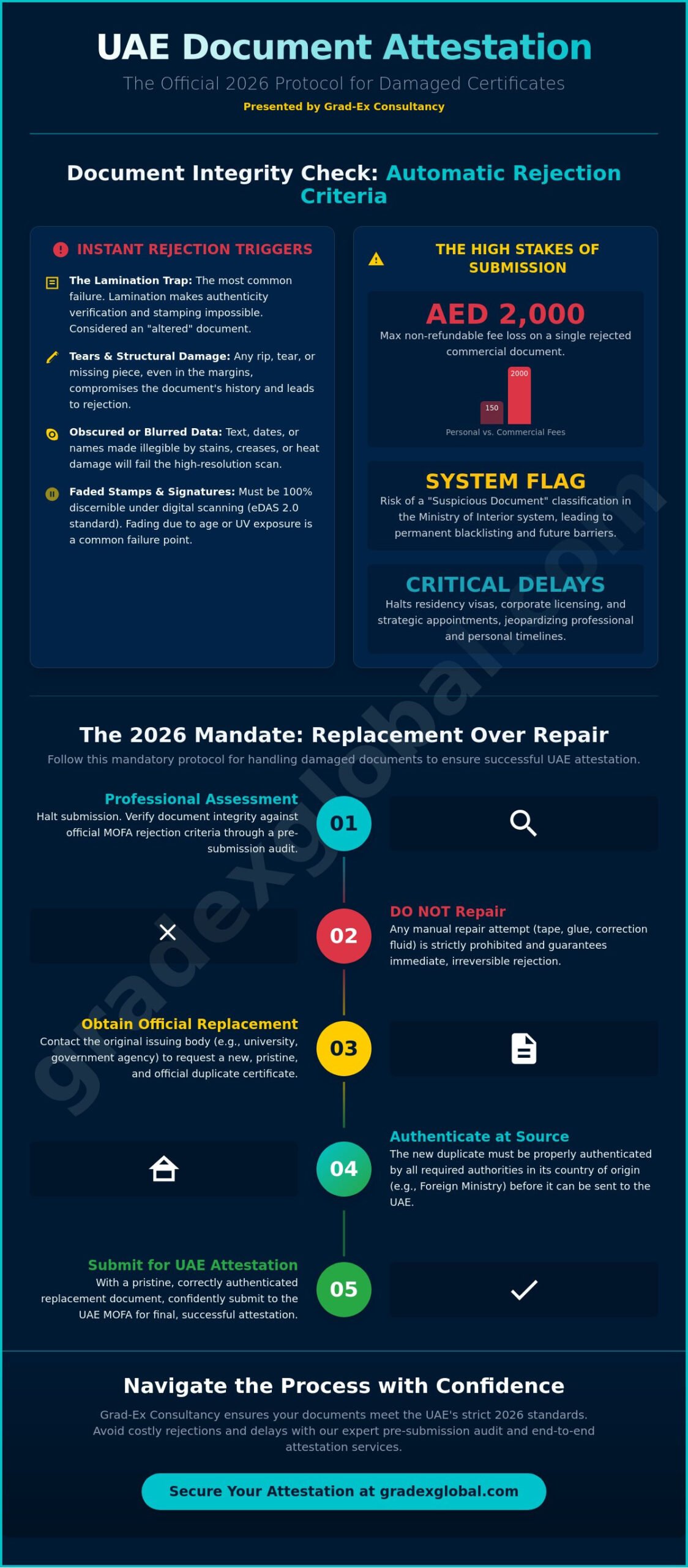
The success of any administrative procedure in the Emirates depends on the physical integrity of the evidence presented. Handling damaged documents for attestation in uae requires a technical understanding of the Ministry of Foreign Affairs (MOFA) inspection protocols. A document is officially classified as damaged and will face immediate rejection if it is laminated, torn, or contains obscured text. These standards exist because the process of document legalization relies on the ability of authorities to verify security features, embossed seals, and paper textures that are unique to original certificates. Even a minor tear in the margin can lead to major visa delays, as it suggests a compromise in the document’s structural history.
Critical failure points often include water stains that bleed ink, heat damage that discolors the substrate, and deep creases that bisect essential data. When a document reaches the MOFA counter, the officer must apply physical stamps and adhesive labels directly to the paper. If the surface is compromised, the legal validity of the attestation itself is called into question. This strictness ensures that every corporate license or labor contract processed in the UAE is backed by authentic, unaltered credentials.
The “Lamination Trap” in UAE Attestation
Lamination is perhaps the most common cause of procedural failure. UAE authorities cannot verify the authenticity of paper or the depth of an embossed seal through a plastic barrier. More importantly, the required attestation stamps must be applied directly to the original document fibers; lamination makes this impossible. Many applicants attempt to remove these plastic layers, but this often results in chemical burns or the lifting of original ink. The 2026 policy for educational certificates remains absolute. Any laminated original is considered “altered” and requires a full replacement from the issuing institution before the attestation process can begin.
Faded Stamps and Illegible Signatures
Older documents frequently suffer from UV exposure, which renders once-vibrant seals and signatures nearly invisible. In the high-precision environment of the UAE’s 2026 administrative framework, legibility is a binary state. With the introduction of the eDAS 2.0 digital pilot in April 2026, high-resolution scanning is now the standard for determining document viability. If the system cannot clearly capture the nuances of a signature, the document is flagged for replacement. The 2026 MOFA legibility standard dictates that every alphanumeric character, official seal, and handwritten signature must be clearly discernible under high-resolution digital scanning without the need for manual interpolation or digital enhancement.
The Legal Implications of Presenting Damaged Documents
Submitting a physically compromised original to UAE authorities carries risks that extend beyond simple administrative rejection. In the context of managing international legal documents, the integrity of the substrate is as vital as the data it carries. Handling damaged documents for attestation in uae requires a strategic approach because the Ministry of Interior (MOI) systems are designed to flag any irregularity as a potential security breach. If a document appears intentionally altered or is missing critical security fibers due to paper rot, it may be categorized as a “Suspicious Document.” This classification can lead to a formal investigation or a permanent blacklist of the file within the federal system, creating a significant barrier to future applications.
The financial repercussions are equally severe. Rejection at the MOFA counter does not typically result in a refund of the attestation fee, which remains AED 150 for personal documents and AED 2,000 for commercial ones as of 2026. Repeated attempts with a substandard original accumulate costs in courier fees and administrative surcharges. Additionally, if the source text is illegible, professional Global Translation Services cannot produce the certified Arabic versions required for legal validity. This creates a deadlock where the document is neither verifiable nor translatable, necessitating an immediate shift toward institutional replacement.
Rejection vs. Fraud Allegations
A critical distinction exists between a document that is merely “worn” and one that appears “tampered.” While a water-stained certificate might be rejected for illegibility, a document with missing edges or lifted ink can be interpreted as an attempt to hide or alter vital information. If an official questions the integrity of your document, the burden of proof lies with the applicant. Blacklisting occurs when authorities believe the damage was manufactured to circumvent verification protocols, a situation that can halt residency or business operations indefinitely. It’s essential to present a clean record to maintain your standing with UAE immigration and labor departments.
Impact on UAE Corporate and Personal Timelines
The procedural ripple effect of a rejected document is profound and often underestimated. Without a successfully attested degree or marriage certificate, the labor contract cannot be finalized. This delay prevents the issuance of an Emirates ID, which in turn blocks the opening of corporate bank accounts and the registration of Ejari contracts. For businesses, damaged commercial documents halt trademark filings and business setup procedures. It’s often more efficient to pause an application before a formal rejection is recorded, allowing for a professional audit of the document’s status to ensure all technical requirements are met before submission.
Replacement vs. Repair: Navigating the Recovery Process
When a professional credential is compromised, the instinctive reaction is often restoration. However, the administrative reality is that physical “repair” using adhesives, tape, or chemical cleaners is strictly prohibited. Such interventions are viewed as unauthorized alterations by regulatory bodies and typically trigger immediate rejection. To meet the UAE Ministry of Foreign Affairs attestation requirements, a document must be in its original, pristine state. Handling damaged documents for attestation in uae requires a decisive transition from a “repair” mindset to a “replacement” strategy. A second original, issued directly by the source authority, is the only guaranteed path to procedural success in the 2026 regulatory framework.
The timeline for recovery varies significantly based on the document’s origin. While a local notarization might be completed within 24 to 48 hours, obtaining a duplicate from an international university can take several weeks. It’s essential to evaluate the urgency of your visa or licensing requirements before choosing between a full replacement and a notarized alternative. In most cases involving residency or high-level corporate appointments, the replacement of the original is the only viable long-term solution to avoid recurring administrative hurdles.
Securing a Duplicate from the Issuing Authority
Obtaining a second original involves a formal application to the primary source, such as a university registrar or a government board. This process often necessitates a police report or First Information Report (FIR) to verify the destruction of the previous original. This step is crucial for maintaining a clean legal trail. Once the duplicate is issued, it must undergo the full cycle of home-country authentication before reaching the UAE. This is particularly relevant when pursuing The UAE Equivalence Certificate: A Strategic Guide to Educational Recognition (2026), as the Ministry of Education requires impeccable source documentation for their verification systems.
True Copy Attestation: A Secondary Solution
In specific scenarios, a notarized “True Copy” may serve as a viable legal alternative. Utilizing an online notary service allows for the verification of a document’s contents without submitting a fragile original to high-volume processing centers. This method involves a legally authorized notary certifying that the copy is an exact replica of the original. While efficient, this approach has limitations. High-security visa categories and certain government-mandated approvals still demand the physical original. You should verify with the specific UAE authority whether a “True Copy” meets their 2026 criteria before committing to this path.
Step-by-Step Protocol for Attesting Replacement Documents
The transition from a compromised original to a valid replacement requires methodical adherence to the 2026 administrative chain. Handling damaged documents for attestation in uae isn’t merely about physical acquisition; it’s about re-establishing the legal pedigree of the credential from its point of origin. This process begins with the issuing authority, such as a university registrar or a state board, where the replacement must be officially recorded and verified. Following this, the document must progress through the home country’s Ministry of Foreign Affairs and the UAE Embassy or Consulate in the country of origin. It’s a comprehensive cycle that ensures the new original carries the same weight as the predecessor it replaces.
For those managing complex international files, our Certificate Attestation services provide the technical oversight necessary to navigate these digital transitions without error. We ensure that every stamp is applied in the correct sequence, preventing the administrative friction that often arises when handling damaged documents for attestation in uae.
The Home Country Authentication Chain
A replacement document is a new legal entity. It must traverse the entire verification hierarchy from scratch, regardless of any prior attestations held by the damaged predecessor. In 2026, many issuing authorities have transitioned to advanced digital seals and QR-coded security fibers. It’s essential to ensure the replacement meets these modern standards, as older verification formats may no longer be accepted by UAE missions. While a “Duplicate” or “Re-issued” notation is a standard procedural mark, it must be supported by official institutional seals to pass the scrutiny of foreign ministry inspectors. Any ambiguity in the re-issuance date or the authority’s signature can trigger a secondary verification request, extending your timeline by several weeks.
UAE MOFA Finalization and Digital Registration
The final phase involves the UAE Ministry of Foreign Affairs (MOFA) and the eDAS 2.0 system. Following the April 2026 launch of the digital attestation pilot, electronic documents with integrated verification features can often be processed through a streamlined digital workflow. However, physical replacements still require a hybrid approach. You must upload the high-resolution scan of the replacement to the eDAS 2.0 portal before coordinating with approved courier services for physical delivery to the Ministry. This digital-first registration allows authorities to pre-verify the document’s authenticity against international databases. If a replacement is flagged during this stage, it’s usually due to a mismatch between the digital upload and the physical security features, highlighting the need for technical precision during the initial scan and submission process.
Strategic Document Management with Grad-Ex Consultancy
The complexity of the 2026 administrative environment demands a level of technical precision that exceeds standard clerical processing. Grad-Ex Consultancy functions as a strategic partner for individuals and corporate entities, ensuring that every credential meets the exacting standards of the UAE Ministry of Foreign Affairs. With over 15 years of institutional memory and established relationships with international issuing boards, we provide the stability required to manage high-stakes document recovery. Handling damaged documents for attestation in uae is a process fraught with potential delays; our role is to eliminate these variables through methodical oversight and strict adherence to the latest government circulars. We don’t merely process files; we manage the integrity of your professional and corporate identity within the Emirates.
Our presence in the market is defined by a commitment to technical precision and professional pride. We understand that a single rejected document can halt a large-scale project or a vital residency application. By leveraging our deep understanding of the 2026 protocol, we ensure that every replacement document is obtained, authenticated, and registered with the highest level of accuracy. This comprehensive approach allows our partners to focus on their core objectives while we maintain the procedural continuity of their legal documentation.
Proactive Document Auditing
Our methodology begins with a rigorous physical and digital audit of the source document. Experts trained in UAE regulatory compliance examine certificates for the critical failure points identified in previous sections, such as micro-tears, heat-induced discoloration, or compromised security fibers. By identifying these risks before the submission phase, we prevent the unnecessary forfeiture of government fees and protect the applicant’s record from being flagged in the federal system. This proactive approach allows us to develop customized recovery plans for commercial, educational, and personal files, leveraging our global network to coordinate replacements without the need for the applicant to travel to their home country. We manage the international coordination, ensuring that the new original meets the specific 2026 MOFA legibility standards before it ever reaches a government counter.
Fixed-Fee Peace of Mind
Navigating the recovery of lost or damaged credentials often involves unpredictable costs, from international courier surcharges to varying notary fees. Grad-Ex Consultancy operates on a fixed-fee model that provides absolute transparency and budgetary stability for our clients. This model covers the entire lifecycle of the file, including global coordination, legal translation, and final UAE MOFA verification through the eDAS 2.0 portal. By serving as a single point of technical contact, we ensure that the transition from a rejected original to a successfully attested replacement is seamless and efficient. Our commitment to professional excellence ensures that your administrative standing in the Emirates remains secure and compliant with all current protocols.
Secure your document attestation with Grad-Ex Consultancy today
Securing Your Administrative Future in the UAE
The 2026 administrative framework in the Emirates leaves no margin for error regarding the physical substrate of your credentials. As established, the transition from a compromised original to a verified replacement is a structured necessity, particularly given the strict MOFA rejection criteria for lamination and structural wear. Successfully handling damaged documents for attestation in uae depends on identifying these failure points early and initiating the institutional replacement chain before high-stakes deadlines are compromised. It’s no longer a matter of simple repair but a strategic navigation of the eDAS 2.0 digital verification landscape.
By integrating our 15 years of GCC market expertise with strategic relationships across UAE ministries, we ensure your documentation meets every regulatory standard. Our fixed-fee document processing provides the stability and predictability your professional or corporate timeline requires. We manage the technical complexity of international re-issuance, allowing you to maintain focus on your core objectives. Don’t allow a physical defect to become a permanent administrative barrier to your success.
Contact Grad-Ex Consultancy for an Expert Document Audit to verify your document’s status and secure a successful path to attestation. We are committed to maintaining the precision and continuity of your legal applications throughout the Emirates.
Frequently Asked Questions
Can I use a document that has a small water stain for UAE attestation?
Acceptance depends entirely on the legibility of the data and the integrity of the document’s security features. If a water stain obscures any alphanumeric text, official seals, or handwritten signatures, the document will be rejected during the digital scanning process. UAE authorities require a pristine surface to ensure that all security fibers and embossed elements remain verifiable under high-resolution inspection.
Will MOFA accept a certificate if the lamination is partially peeling?
No, any form of lamination is a disqualifying factor for the attestation process. Even if the plastic is peeling, the adhesive residue and the remaining barrier prevent the application of mandatory physical stamps and labels. Handling damaged documents for attestation in uae requires the removal of all artificial coatings; however, since manual removal often destroys the original ink, a full institutional replacement is the only stable solution.
What is the first step if my degree is rejected due to physical damage?
The immediate priority is to obtain a professional audit to determine if the damage is considered “unacceptable” under the 2026 protocol. Once a document is officially flagged for physical compromise, you must contact the original issuing authority to request a second original or a formal duplicate. It’s vital to pause all other administrative applications to prevent a “Suspicious Document” flag from being recorded in the federal system.
How do I get a duplicate certificate from my home country while in the UAE?
You must submit a formal application to the registrar of your issuing institution, which often requires a police report or an affidavit confirming the status of the original. Professional consultancy services manage this international coordination through global networks, allowing for the acquisition of new originals without the need for personal travel. This ensures the replacement meets the current 2026 security standards of the home country.
Does a replacement document need to be re-attested by all previous authorities?
Yes, a replacement document is viewed as a new legal entity by the Ministry of Foreign Affairs. It must traverse the entire authentication hierarchy again, starting from the source university or board and progressing through the home country’s foreign ministry. The 2026 protocol does not allow for the transfer of stamps from a damaged original to a new duplicate; the entire chain of custody must be re-established.
How much does it cost to replace and attest a damaged document in 2026?
The UAE MOFA attestation fee is AED 150 for personal documents and AED 2,000 for commercial files as of May 2026. Total project costs include the issuing institution’s duplicate fees, home country authentication charges, and international courier surcharges. Utilizing a fixed-fee model through a consultancy provides budgetary stability by consolidating these variables into a single, transparent processing cost.
Can Grad-Ex Consultancy help me if my university is no longer operational?
We utilize our 15 years of market expertise to identify the successor body or government department responsible for the defunct institution’s records. Our technical team facilitates verification through the appropriate regulatory archives or education boards to secure a valid replacement. This strategic oversight ensures that even complex files from closed institutions are successfully processed for handling damaged documents for attestation in uae.
Is a digital copy of a damaged document sufficient for UAE residency?
A digital copy is generally insufficient for residency applications, as the process requires the submission of physical originals for stamp application. While the April 2026 eDAS 2.0 pilot allows for the digital attestation of documents with integrated QR verification, most standard educational and personal certificates still demand a physically intact original. You should always prioritize obtaining a new physical original to ensure procedural continuity.