
Why does a standard AED 150 government fee frequently evolve into a total expenditure exceeding AED 1,200 for a single educational degree? It’s a common frustration for professionals who expect a linear administrative process, only to find themselves entangled in a multi-layered logistical chain. You likely understand that precision is non-negotiable in UAE compliance, yet the hidden costs of document attestation in uae often emerge from the complex requirements of home-country ministries and embassy surcharges. These secondary expenses, coupled with the risk of losing non-refundable government fees due to minor clerical errors, can disrupt even the most disciplined corporate or personal budget.
This guide provides a transparent, technical breakdown of the secondary expenses and logistical fees that define the 2026 attestation landscape. You’ll gain a clear understanding of the fiscal requirements, from legal translation rates to the nuances of international courier logistics, allowing you to avoid costly re-applications. We’ll examine the structural requirements of the process to ensure your residency or business setup proceeds with absolute predictability and professional stability.
Key Takeaways
- Distinguish between standardized federal levies and the comprehensive end-to-end expenses that constitute your actual fiscal commitment for document legalization.
- Identify how origin-country verification protocols and Apostille status significantly influence the final budgetary requirements for your specific international certificates.
- Evaluate the logistical surcharges associated with secure cross-border transit to accurately calculate the hidden costs of document attestation in uae.
- Quantify the financial risks of non-refundable government fee forfeiture and the subsequent operational delays caused by minor administrative or clerical discrepancies.
- Learn how institutional relationship management and fixed-fee structures provide the technical control necessary for predictable residency and business setup timelines.
Beyond Government Fees: Defining the Total Cost of Attestation
Professional documentation in the UAE operates on a foundation of technical precision. While most expatriates and business entities identify the Ministry of Foreign Affairs (MOFA) fee as their primary benchmark, this figure represents only the final verification in a much larger sequence. It’s a common oversight to equate the final stamp with the total project budget. This misconception often leads to the hidden costs of document attestation in uae surfacing mid-process, where logistical requirements and administrative surcharges can double or triple the initial estimate. Precision at the start is the only way to ensure stability at the finish.
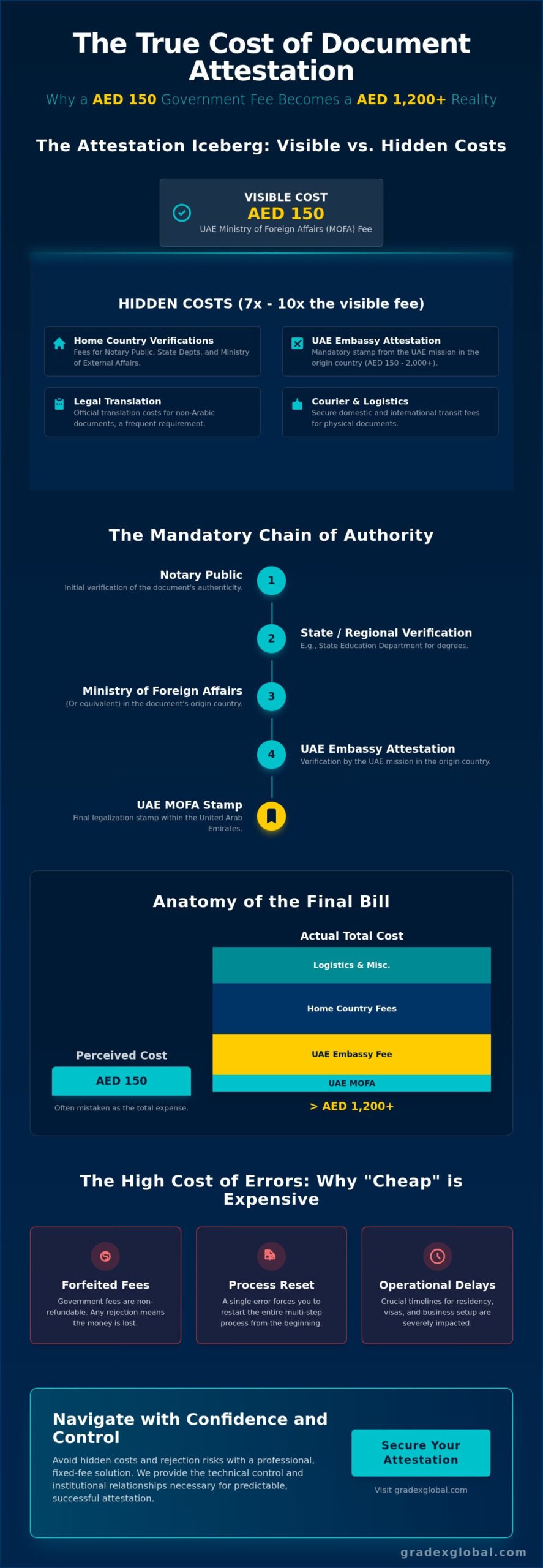
The “Iceberg Effect” is particularly relevant here. The visible portion of the process, the UAE MOFA stamp, rests upon a submerged structure of international verifications. Each layer requires separate fee structures and specific procedural compliance. Relying on institutional relationships and established workflows is the only way to maintain control over these variables. Without this technical oversight, applicants frequently face secondary charges for incorrect document formatting or missed state-level stamps. These errors aren’t just frustrating; they’re expensive.
The Baseline: Current UAE Ministry Fees
As of June 2026, the federal fee structure remains standardized for the final stage of attestation within the Emirates. Personal and educational documents, including birth certificates and university degrees, carry a Ministry of Foreign Affairs fee of AED 150 per document. Commercial documents require a significantly higher investment. The standard fee is set at AED 2,000, although specific instruments like board resolutions or powers of attorney can reach AED 2,048. Digital attestation channels have streamlined the submission process, yet they don’t eliminate the need for physical verification of original stamps from the country of origin. Miscalculating these baseline figures is often the first step toward a budget overrun.
The Invisible Chain of Authority
The true complexity of the process lies in the origin-country requirements. Before a document reaches UAE soil, it must navigate a hierarchy defined by international law, document legalization protocols. This chain typically begins with a Notary Public, followed by state-level or regional department verifications. For example, a degree from India requires a stamp from the relevant State Education Department before the Ministry of External Affairs (MEA) provides its verification. Each of these entities charges its own processing fees. These are separate from the UAE embassy’s attestation levy in that country, which ranges from AED 150 to AED 600 for personal documents and can reach AED 2,000 for commercial filings. Missing any link in this chain results in immediate rejection at the MOFA stage, leading to forfeited fees and the necessity of starting the entire sequence again.
The Hidden Layers: Home Country Verification and Translation
The geographical origin of a document dictates the technical roadmap for its legalization. Jurisdictional differences are a primary driver of the hidden costs of document attestation in uae, as each country maintains unique administrative protocols. For instance, documents from the United Kingdom often follow an Apostille route, which simplifies certain domestic steps. In contrast, non-Apostille jurisdictions like India or the United States require a more rigorous, multi-departmental sequence. These regional variations mean that a budget successful for one nationality may be entirely insufficient for another. Precision in identifying these requirements early prevents the structural delays that often derail residency or business licensing.
Origin Country Logistics
Institutional stability in the attestation process requires acknowledging that documents don’t move themselves. Domestic courier fees within the home country and international transit costs are frequently omitted from initial estimates. Furthermore, UAE missions abroad charge specific embassy fees that must be paid in local currency at the point of origin. For personal documents, these fees typically range between AED 150 and AED 400. Commercial instruments face a steeper requirement, often reaching AED 2,000. Certain educational credentials also trigger “verification at source” costs, where universities charge a separate administrative fee to confirm the degree’s authenticity to government authorities.
Legal Translation and Technical Accuracy
Once a document reaches the Emirates, the UAE Ministry of Foreign Affairs (MOFA) requires that any non-Arabic certificate undergo legal translation. This process isn’t a mere linguistic conversion; it’s a technical certification that must be performed by authorized professionals. Standard documents typically cost between AED 50 and AED 120 per page. However, technical commercial contracts or complex legal deeds can command rates up to AED 300 per page. An error in this stage isn’t just a minor typo. It’s a grounds for immediate rejection. If the MOFA rejects a document due to translation inaccuracies, all non-refundable government fees are forfeited, initiating an expensive re-attestation cycle.
Document age and physical format also impact the final budget. Older certificates may require “true copy” attestation or even re-issuance if the original seals have faded or the paper quality has degraded over time. These technical nuances underscore why a managed approach to global translation services and certificate verification is essential for maintaining project timelines. Maintaining control over these variables ensures that your professional or personal setup in the UAE remains on a predictable, secure path.
Logistics and Urgency: The Price of Speed and Security
Institutional precision dictates that logistical expenses should never be an afterthought in a professional budget. While the Official UAE Government Attestation Fees provide a clear baseline for the final stage of verification, the actual expenditure is driven by the necessity of secure, rapid transit. Original certificates are essentially irreplaceable; their loss doesn’t just represent a financial setback but a complete halt to residency or corporate licensing. Consequently, the hidden costs of document attestation in uae often include high-grade international courier services and dedicated tracking protocols that ensure the document’s integrity throughout its journey.
Time is a finite resource in the Emirates. Delays in the attestation chain carry heavy opportunity costs that many expatriates fail to quantify. A pending visa due to a missing stamp can lead to missed employment start dates, residency fines, or delays in opening corporate bank accounts. This “waiting time” is an invisible tax on those who don’t account for the full logistical cycle. Investing in speed is often a strategic decision to protect larger professional interests.
Normal vs. Express Processing
A standard international attestation cycle typically requires 15 business days, whereas premium express services can compress this timeline to approximately 5 days. Specific jurisdictions, such as India, offer “Tatkal” or priority processing at their consulates for an additional surcharge, which is essential for meeting urgent employment requirements. Utilizing “E-Channel” registration for digital submissions can further accelerate the process, though it requires specific technical setup and initial registration fees that must be factored into your 2026 budgeting guide.
Secure Handling and Risk Mitigation
The financial risk of document loss in standard postal systems far outweighs the cost of professional handling. If an original degree or marriage certificate is lost, the cost of re-issuance at the source university, combined with the subsequent re-attestation, creates a massive budgetary deficit. Grad-Ex’s methodology focuses on a rigid document chain-of-custody, ensuring that every transition between ministries and couriers is logged and verified. A technical cost-benefit analysis usually reveals that professional handling is more efficient than personal travel. When you factor in airfare, accommodation, and the time spent navigating foreign government offices, the surcharge for a managed service is a logical investment in professional stability.
The Financial Impact of Rejection: Why “Cheap” Often Costs More
Administrative precision is the only safeguard against the financial penalties inherent in the UAE’s regulatory framework. A critical, often overlooked aspect of the hidden costs of document attestation in uae is the non-refundable nature of government processing fees. If a document is rejected due to a minor clerical error, such as a name mismatch between a passport and a degree or an outdated seal from a home-country ministry, the initial fee is forfeited. You don’t just lose time; you lose the capital invested in that specific stage of the sequence. For commercial entities, where fees reach AED 2,000 per document, these errors represent a significant budgetary leak that compounds with every failed attempt.
The “Cascade Effect” of a single rejection can be devastating to professional timelines. Attestation is rarely an isolated task; it’s a prerequisite for residency visas, corporate bank account openings, and labor permits. A rejected stamp at the final MOFA stage triggers a total halt in these secondary processes. The opportunity cost of such a delay often manifests as lost wages for professionals or stalled revenue for new business setups. In a market as fast-paced as the Emirates, the price of a three-week delay frequently exceeds the cost of the attestation itself.
Common Administrative Pitfalls
Technical errors in 2026 often stem from a misunderstanding of the equivalence certificate requirement. Many applicants assume that attestation is the final step for educational recognition, yet certain professional roles require this additional layer of verification from the Ministry of Education. Furthermore, an incorrect sequence of stamps remains the most frequent cause of rejection. If a state-level verification is bypassed in favor of a central ministry stamp, the UAE authorities will not recognize the document’s validity. Commercial documents also face “expired verification windows,” where certain home-country stamps are only valid for a fixed period before they’re considered obsolete by UAE standards.
The Price of Self-Processing
Attempting to manage the attestation chain independently often results in a false economy. Quantifying the hours spent navigating various ministry portals, coupled with the physical costs of transport and parking at government service centers, reveals a high operational burden. Self-processing lacks the institutional oversight needed to identify potential rejection triggers before fees are paid. A professional approach ensures “first-time” success, transforming a volatile administrative task into a predictable line item. To secure your professional standing and avoid the financial pitfalls of rejection, it’s essential to partner with experts in certificate attestation services who maintain direct control over the verification chain.
Strategic Budgeting: Grad-Ex’s Fixed-Fee Solution
Institutional stability in the Emirates relies on the predictable execution of administrative mandates. When managing the hidden costs of document attestation in uae, a fragmented approach where each ministry and courier is handled in isolation inevitably leads to budget overruns. Grad-Ex addresses this volatility through a consolidated, end-to-end model that integrates home-country verifications with local UAE requirements. Our 15 years of institutional relationship management provide the technical foundation necessary to navigate complex global jurisdictions with absolute precision. This longevity isn’t merely a metric; it’s a guarantee that the structural integrity of your documentation is maintained from the point of origin to the final Ministry of Foreign Affairs stamp.
Our fixed-fee solution is designed to eliminate the service surcharges that frequently emerge mid-process. By providing a transparent fiscal roadmap at the outset, we ensure that expatriates and corporate entities can allocate resources with total confidence. This model accounts for the invisible chain of authority, including notary fees, state-level stamps, and embassy levies, without the risk of unexpected price hikes. Our strategic advisory identifies the most cost-effective path for your specific document type, whether it involves an Apostille convention or a more complex non-Apostille sequence. This technical oversight is essential for mitigating the hidden costs of document attestation in uae that typically derail self-processed applications.
Predictable Pricing for Global Success
A Grad-Ex fixed-fee quote is an all-inclusive technical instrument. It encompasses the entire logistical sequence, from initial domestic verification in the country of issuance to the final delivery of the attested document in the UAE. We coordinate directly with international embassies and consulates, ensuring that all mission-specific fees are handled without hidden markups. Our 15-year track record in GCC market entry allows us to anticipate regulatory shifts before they impact your budget. This depth of experience ensures that our Basic, Standard, and Premium plans are structured to meet the specific urgency and security requirements of your professional or personal profile.
Next Steps for Your Attestation
Securing your professional standing in the UAE requires a partner who understands the intersection of international law and local compliance. To receive a comprehensive, no-obligation fee breakdown tailored to your specific documentation, you can engage with our consultancy team today. We offer specialized solutions for high-volume commercial document batches, ensuring that corporate setups remain on schedule and within budget. Contact our Dubai-based experts to access professional certificate attestation and certificate equivalency services. By centralizing your requirements with a stable, institutional partner, you ensure that your transition to the UAE is defined by technical precision rather than administrative uncertainty.
Securing Your Professional Future with Technical Precision
Success in the UAE market is built on the foundation of administrative stability. Achieving this stability requires a meticulous approach to documentation that accounts for every link in the international legalization chain. The hidden costs of document attestation in uae aren’t inevitable obstacles; they’re manageable variables for those who prioritize technical precision over shortcuts. By consolidating home-country verifications, translation requirements, and secure transit into a single strategic plan, you protect your capital and your timeline from the risks of administrative rejection.
Grad-Ex offers the institutional control needed to navigate these complexities with confidence. Our 15+ Years of GCC Strategic Expertise and Zero-Hidden-Fee Guarantee provide the fiscal predictability your professional or corporate setup demands. We provide comprehensive end-to-end logistical management, ensuring your original certificates are handled with the highest standards of security. It’s a strategic investment in first-time success that allows you to focus on your larger objectives in the region. Get a Transparent, Fixed-Fee Quote for Your Attestation Today and take the first step toward a seamless, secure transition.
Frequently Asked Questions
Are UAE attestation fees refundable if my document is rejected?
Government processing fees for document legalization are strictly non-refundable. If an application is rejected due to a missing seal, incorrect sequence of stamps, or lamination, the applicant forfeits the paid amount. This policy necessitates technical precision during the initial submission to avoid the financial burden and administrative delay of a complete re-application.
How much does it cost to attest a degree certificate for a UAE visa in 2026?
The total expenditure for attesting a degree certificate typically ranges from AED 700 to AED 1,400 depending on the country of issuance. While the final UAE MOFA fee is AED 150, the total budget must account for home-country notary fees, state-level verification, and UAE embassy charges abroad. These cumulative expenses represent the actual hidden costs of document attestation in uae for expatriates.
Do commercial documents like MOAs cost more to attest than personal ones?
Commercial documents carry significantly higher attestation fees compared to personal or educational certificates. The Ministry of Foreign Affairs charges AED 2,000 for standard commercial documents, including Memorandums of Association and Board Resolutions. Specific instruments may reach AED 2,048. This distinction reflects the complex nature of corporate verification compared to the AED 150 rate for personal instruments.
Is there a difference in cost between digital and physical MOFA attestation?
The core government fee remains standardized at AED 150 for personal documents across both digital and physical channels. However, digital paths may incur minor service fees for e-channel registration or typing center assistance, typically ranging from AED 20 to AED 100. Choosing a digital route prioritizes administrative efficiency and speed rather than a direct reduction in the federal fee.
What are the additional costs for legal translation in the UAE?
Legal translation for non-Arabic documents costs between AED 50 and AED 120 per page for standard certificates. Technical or legal documents, such as commercial contracts, require a higher level of linguistic precision and are priced between AED 150 and AED 300 per page. These rates apply to all documents requiring official submission to UAE government authorities.
Can I save money by using an Apostille instead of full attestation?
An Apostille stamp doesn’t replace the full attestation requirement for use within the Emirates. Since the UAE isn’t a member of the Apostille Convention for inbound documents, an Apostille from a home country still requires subsequent UAE Embassy verification and a final MOFA stamp. Attempting to bypass these steps will result in immediate document rejection at the point of use.
How much extra should I budget for international courier services?
Applicants should budget for secure international transit to protect original certificates from loss or damage. While standard courier rates vary by region, the cost of professional, tracked handling is a necessary protection against the much higher expense of re-issuing a lost original document. This logistical safeguard is a critical component of the hidden costs of document attestation in uae.
Does the UAE Ministry of Education charge separate fees for equivalency?
The Ministry of Education (MOE) charges separate administrative fees for the issuance of an equivalency certificate. This process is distinct from the MOFA attestation and is often a mandatory requirement for specific professional roles or further education. It’s essential to verify the current MOE fee structure for your specific academic qualification to ensure full budgetary compliance.