
A single administrative oversight in the document legalization chain can stall a multi-million dirham infrastructure project for over 21 days, creating a bottleneck that no precision-engineered schedule can easily absorb. You recognize that the integrity of your corporate and personal documentation is the bedrock of your operational stability in the United Arab Emirates. This guide serves as an authoritative manual to mastering the ministry of foreign affairs attestation procedures, ensuring your legal framework remains as robust as your physical assets throughout 2026. You’ll gain a clear, sequential understanding of the entire legalization process, moving from initial notarization to final government endorsement with absolute certainty. We examine the technical shift from eDAS 1.0 to the 2.0 digital portal, providing the specific knowledge required to secure successful attestation without the risk of rejection or unforeseen costs. It’s time to treat your administrative workflows with the same engineering rigor you apply to your most complex projects, ensuring every document is a verified asset rather than a liability.
Key Takeaways
- Understand why the ministry of foreign affairs attestation is a non-negotiable prerequisite for securing residency, employment, and commercial licensing within the UAE’s regulatory framework.
- Navigate the transition to a paperless environment by mastering the eDAS 1.0 and eDAS 2.0 systems, ensuring your commercial trade documents meet the latest digital validation standards.
- Gain a precise, technical understanding of the multi-stage attestation process, beginning with essential notarisation and verification in the document’s country of origin.
- Identify and mitigate common procedural errors that lead to document rejection, allowing for a streamlined and predictable approval cycle for complex corporate requirements.
The Strategic Role of the Ministry of Foreign Affairs in Document Legalisation
The Ministry of Foreign Affairs (MoFA) functions as the supreme regulatory body for the authentication of both domestic and international instruments within the United Arab Emirates. It acts as the final verification layer in a rigorous multi-stage security protocol. This process ensures that every certificate, contract, or legal brief presented to UAE authorities possesses absolute legal integrity. Without this final stamp, a document remains a mere piece of paper with no standing in the eyes of the state. The Ministry’s oversight provides the necessary guarantee for government departments to accept foreign-issued paperwork.
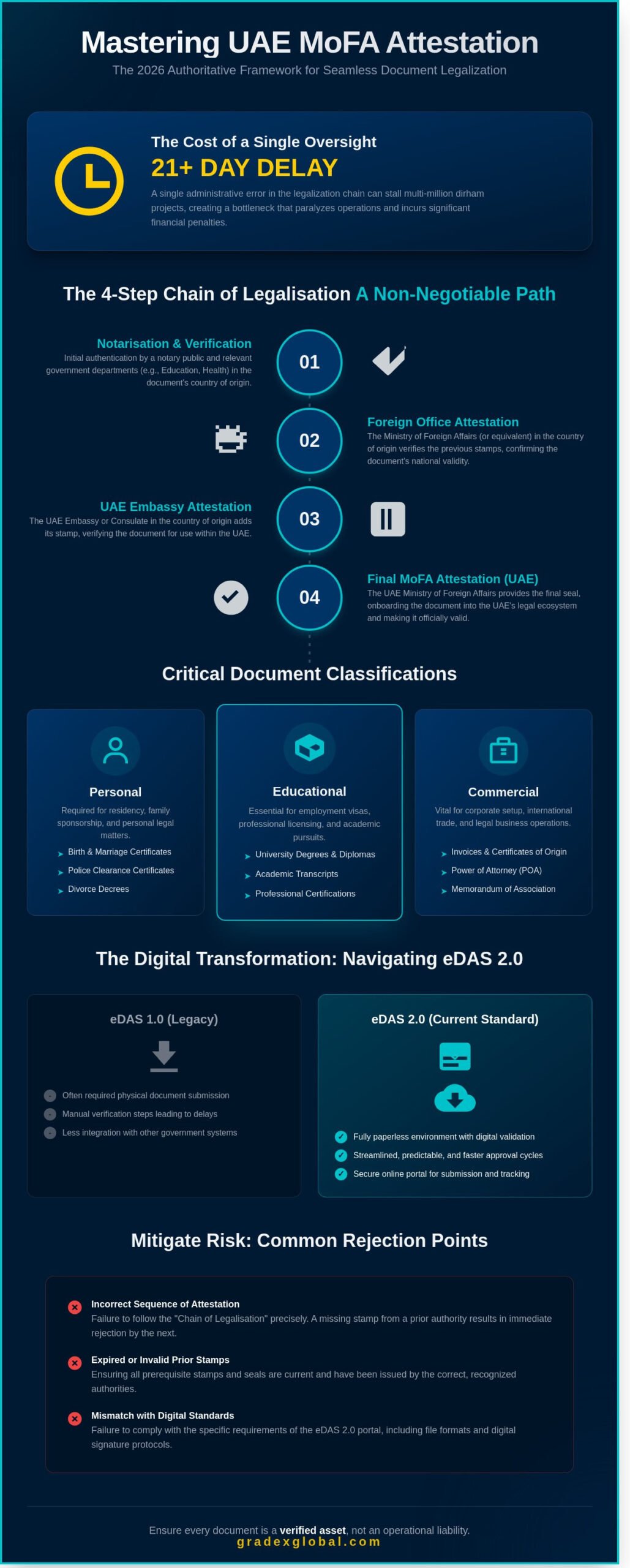
The ‘Chain of Legalisation’ represents a sequential, non-negotiable path. It begins with verification in the document’s country of origin, moves through that nation’s foreign office, and culminates at the UAE Embassy. The ministry of foreign affairs provides the final endorsement, effectively “onboarding” the document into the UAE’s legal ecosystem. It’s essential to distinguish this from an equivalence certificate. While attestation confirms the document’s authenticity and the validity of the signatures, equivalence evaluates the academic standard against UAE educational benchmarks. Both are critical but serve different legal functions.
Why MOFA Attestation is Essential for National Compliance
Legal validity is the cornerstone of national security and economic stability. The Ministry’s verification process prevents document fraud, protecting the integrity of the national labor market and the broader business environment. Missing attestation stops visa processing immediately. It also prevents the opening of corporate bank accounts. For businesses, this delay can result in operational paralysis and significant financial penalties. Compliance isn’t optional; it’s a structural requirement for any entity or individual operating within the Emirates. The system ensures that every professional entering the market holds genuine credentials verified by the ministry of foreign affairs.
Personal vs. Commercial Document Classifications
Documents fall into distinct categories based on their intended application, and the Ministry applies specific protocols to each to maintain precision. These include:
- Educational certificates: Degrees, diplomas, and transcripts required for professional licensing and specialized labor contracts.
- Personal status documents: Marriage, birth, and police clearance certificates necessary for family sponsorship and residency permits.
- Commercial documentation: Invoices, certificates of origin, and power of attorney vital for corporate setup and international trade operations.
Each classification requires a specific set of prior stamps before the Ministry will grant the final legalisation. Precision in this sequence is vital. Errors at any stage of the chain can lead to document rejection, forcing applicants to restart the entire process from the beginning.
Core Services Offered by the Ministry of Foreign Affairs
The ministry of foreign affairs serves as the definitive authority for the legal validation of international and domestic instruments. This institutional framework ensures that every document, whether for individual or corporate use, adheres to the rigorous standards required by the UAE’s legal and economic systems. By 2026, the Ministry’s service portfolio has transitioned into a highly efficient, digitally integrated ecosystem designed to support the nation’s rapid infrastructure and economic growth.
Document attestation remains the primary service for validating certificates. This process confirms the authenticity of signatures and seals, making foreign documents legally binding within the Emirates. For those engaged in global commerce, commercial invoice attestation is a non-negotiable requirement. It facilitates seamless customs clearance and ensures that trade data aligns with federal regulations. Specialized tracks now exist for Golden Visa holders and foreign diplomatic missions, reflecting the UAE’s commitment to attracting high-value talent and maintaining robust international relations.
Services for Individual Expatriates
Individual professionals require precise document handling to secure their legal status. The Ministry provides comprehensive attestation for educational credentials, which is a mandatory precursor for equivalence certificate applications. This ensures that academic qualifications meet local labor market benchmarks. Beyond education, the Ministry validates personal documents, such as birth and marriage certificates, necessary for residency sponsorship and legal proceedings. Users can access the official MoFA attestation portal to utilize real-time inquiry and tracking services. These digital tools provide transparency throughout the application lifecycle, reducing administrative delays for expatriates.
Services for National and International Businesses
Corporate entities operating in the UAE rely on the ministry of foreign affairs for operational continuity. The eDAS (Electronic Document Attestation System) has become the standard for commercial invoice attestation, allowing businesses to process trade documents with technical precision. For companies establishing a local presence, the legalisation of board resolutions and articles of association is essential for corporate branch setup. This procedural accuracy prevents delays in licensing and banking integration. Additionally, the Ministry handles customs-related attestation for import and export operations, ensuring that all cargo documentation satisfies federal security and economic protocols. Organizations seeking to streamline these complex administrative requirements often benefit from expert attestation support to ensure total compliance with 2026 regulations.
The Digital Transformation: Navigating eDAS 1.0 and eDAS 2.0
The ministry of foreign affairs finalized its transition to a 100% paperless service model at the start of 2026. This evolution marks the end of physical administrative bottlenecks. The Electronic Document Attestation System (eDAS) now functions as the primary engine for all legalization requirements. While the legacy eDAS 1.0 focused on digitizing the application process, eDAS 2.0 introduces a comprehensive technological overhaul designed for high-volume corporate and individual processing.
The most significant technical shift in 2026 involves the total replacement of physical ink stamps with digital verification codes. These encrypted QR codes provide a secure, tamper-proof method for international authorities to validate UAE documents. You can access the specific technical requirements and submission guidelines through the official MOFA attestation procedures portal. This digital-first approach ensures that document integrity is maintained across global jurisdictions with zero margin for error.
The Shift to eDAS 2.0 for Commercial Entities
Commercial entities now operate within a highly structured digital environment that prioritizes security and logistics speed. The eDAS 2.0 interface provides real-time tracking for every document in the pipeline, allowing businesses to forecast project timelines with engineering precision. Key features of the current commercial framework include:
- Customs Integration: Direct synchronization with national trade portals ensures that commercial invoices and certificates of origin are verified instantly for customs clearance.
- Advanced Security: Multi-factor authentication and blockchain-backed logging prevent unauthorized document alterations.
- Corporate Registration: Companies must link their Trade License to the ministry of foreign affairs digital platform using UAE PASS for high-level authorization.
This integration has reduced the average processing time for commercial attestations from three business days to less than six hours in 2026.
Navigating the Ministry’s Mobile Application
The Procedural Framework: How to Execute Ministry of Foreign Affairs Attestation
Achieving successful document validation requires a disciplined adherence to a multi-stage technical protocol. The process is not a singular event but a sequence of verifications where each step serves as a foundational requirement for the next. Failure to maintain this chain of custody results in immediate systemic rejection. For professionals and entities operating within the UAE, understanding this logistical flow is mandatory for operational continuity.
- Step 1: Origin Verification. Documents must first be notarized and then attested by the ministry of foreign affairs or the equivalent competent authority in the country where the document was issued.
- Step 2: Diplomatic Validation. The document requires a stamp from the UAE Embassy or Consulate located within the country of origin. This confirms the legitimacy of the local government’s seal for the UAE authorities.
- Step 3: Digital Application. Users must register on the official MoFA digital portal or mobile application. This phase involves uploading high-resolution scans and selecting the specific attestation type required for the transaction.
- Step 4: Physical Logistics. Once the digital application is approved and fees are processed, the physical document is handled via an integrated courier service. In the UAE, this typically involves a secure collection and delivery cycle managed by Emirates Post or designated private partners.
Pre-requisites: The Chain of Legalisation
The ministry of foreign affairs operates on a strict “chain of legalisation” principle. If a document arrives at the final stage without the prerequisite UAE Embassy stamp from the origin country, the system will trigger an automatic rejection. Precision is also required for non-Arabic or non-English documents. These must be translated by legal translators licensed by the UAE Ministry of Justice. Technical audits show that approximately 12 percent of delays in 2024 were caused by using unauthorized translation services or submitting expired “true copies” that lacked recent notarization dates.
Fee Structures and Payment Protocols
Financial planning for attestation must account for the tiered pricing model implemented by the authorities. Personal documents, such as birth certificates or marriage licenses, generally incur a fee of 150 AED to 300 AED per document. In contrast, commercial documents, including board resolutions or power of attorney for businesses, carry a standard fee of 2,000 AED. Payments are executed through the MoFA digital wallet, national identity-linked cards, or corporate credit accounts. Errors in the initial filing often necessitate a complete re-application, effectively doubling the cost; therefore, accuracy in the initial data entry is a financial imperative.
For organizations requiring the highest level of administrative stability and precision in their documentation workflows, securing professional guidance ensures every technical requirement is met without deviation. Consult with our specialists to streamline your corporate attestation protocols today.
Ensuring Compliance: Strategic Advisory for National Attestation
Precision defines the final stage of any regulatory process in the UAE. While the digital transformation of the ministry of foreign affairs has improved accessibility, it hasn’t lowered the standards for technical accuracy. Document rejection remains a significant bottleneck for corporate entities and high-net-worth individuals. These delays often stem from a lack of understanding regarding the rigid hierarchy of international legalization. Grad-Ex Consultancy approaches document management with the same engineering mindset applied to large-scale infrastructure projects. We ensure every link in the chain is secure before submission.
Common Pitfalls and How to Avoid Them
- Incomplete legalisation chains: This is the primary reason for rejection. A document must follow a specific sequence: Notary Public, followed by the home country’s foreign office, then the UAE Embassy abroad. Only after these steps can the ministry of foreign affairs apply the final attestation.
- Incorrect translation formats: The UAE authorities require translations from Ministry of Justice (MoJ) licensed professionals. Standard legal translations from outside the UAE often fail to meet these specific formatting and certification standards.
- Data discrepancies: Minor variations in name spellings or date formats across a portfolio of documents will trigger a system rejection. Every character must align across educational, professional, and personal records to maintain the integrity of the application.
The Grad-Ex Advantage in National Document Processing
Grad-Ex Consultancy leverages 15 years of operational history to navigate the complexities of the UAE regulatory environment. We don’t just process paperwork; we build the administrative infrastructure required for corporate stability. Our team manages the entire attestation lifecycle, providing a single point of accountability for global firms. This end-to-end control minimizes the risk of document loss and ensures that high-volume corporate filings move through the system without friction.
Our expertise extends beyond simple stamps. We provide strategic support for the equivalence certificate process, which is a critical requirement for specialized professional roles and business licensing in 2026. By coordinating directly with embassies and national authorities, we eliminate the technical errors that typically stall business setups. We provide a guarantee of quality that reflects our commitment to professional excellence and long-term compliance. In a market where time is a valuable asset, our structured approach secures your operational timeline and protects your corporate interests.
Mastering Your Strategic Documentation Strategy
The evolution of the eDAS 2.0 platform signals a permanent shift toward a more sophisticated, digital-first administrative environment in the Emirates. Successfully navigating the ministry of foreign affairs attestation process is no longer a mere bureaucratic step but a critical component of institutional stability. By 2026, the integration of these digital frameworks will define the speed at which businesses can scale and operate within the region. Precision in document legalisation ensures that your international and local operations remain uninterrupted by regulatory friction.
Grad-Ex Global leverages 15+ years of institutional expertise to deliver a level of service defined by engineering precision and reliability. We offer fixed-fee end-to-end processing that removes the ambiguity from complex administrative tasks. Our team maintains strategic relationships with national authorities, allowing us to manage every technical detail with absolute control. It’s this commitment to stability and professional excellence that makes us the preferred choice for large-scale projects and corporate entities across the United Arab Emirates.
Partner with Grad-Ex for seamless Ministry of Foreign Affairs attestation to ensure your documentation meets the highest national standards. We’re ready to build the administrative foundation your future requires.
Frequently Asked Questions
Is Ministry of Foreign Affairs attestation required for all UAE residency visas?
Yes, the Ministry of Foreign Affairs requires attestation for all educational, marriage, and birth certificates used for residency visa sponsorship. This mandate ensures the authenticity of foreign documents within the UAE legal framework. While certain short-term visit visas don’t require this step, 100% of long-term residency applications involving professional or family status necessitate this verification to meet Federal Authority for Identity, Citizenship, Customs and Port Security standards.
What is the difference between MOFA attestation and an Equivalence Certificate?
MOFA attestation verifies the legal authenticity of a signature or seal on a document, while an Equivalence Certificate confirms that a foreign degree matches UAE academic standards. The Ministry of Foreign Affairs handles the legal validation of the physical or digital paper itself. In contrast, the Ministry of Education issues the Equivalence Certificate after reviewing the curriculum and credit hours of your specific degree program.
How long does the Ministry of Foreign Affairs take to attest a document in 2026?
Standard electronic attestation through the ministry of foreign affairs portal typically concludes within 24 to 48 hours. Physical document processing involving courier collection and delivery generally requires 3 to 5 business days depending on the service tier you select. These timelines reflect the 2026 streamlined digital infrastructure designed to expedite administrative workflows for corporate and individual applicants.
Can I complete the Ministry attestation process entirely online?
You can complete the process digitally for electronic documents issued within the UAE or through the official MOFA smartphone application. For physical certificates issued abroad, the process remains a hybrid model. You’ll initiate the request online, pay the fees via the digital portal, and then schedule a courier to transport the physical document to a service center for the final stamp.
What happens if the Ministry rejects my document attestation application?
If the Ministry rejects your application, you’ll receive a specific notification through the portal or SMS detailing the reason for refusal. Common causes include missing prior stamps from the home country’s embassy or blurred scans. You must rectify the identified error and resubmit the application. Note that the initial processing fee, which often starts at 150 AED, is typically non-refundable according to 2026 regulations.
Do I need to attest my commercial invoices through the Ministry for customs?
Commercial invoices for goods valued over 10,000 AED require attestation through the ministry of foreign affairs to facilitate customs clearance. This requirement applies to 100% of commercial shipments entering the UAE from international markets. Failure to provide a MOFA-attested invoice can result in administrative fines of approximately 2,000 AED or delays in the release of your cargo at the port of entry.
Is a legal translation mandatory for documents submitted to the Ministry?
Legal translation is mandatory if your original document isn’t written in Arabic or English. The Ministry requires a translation from a certified professional recognized by the UAE Ministry of Justice. This translated version must be attached to the original. It carries its own specific attestation requirements to ensure the technical accuracy of the legal terminology remains intact during the verification process.
Can I attest a ‘True Copy’ of my certificate at the Ministry of Foreign Affairs?
The Ministry doesn’t attest “True Copies” or photocopies of personal documents like degrees or birth certificates. You must present the original document that has already been verified by the issuing country’s foreign ministry and the UAE Embassy in that jurisdiction. The only exception involves specific corporate documents where a notarized copy is legally accepted, but 95% of individual attestations require the primary, original certificate.