
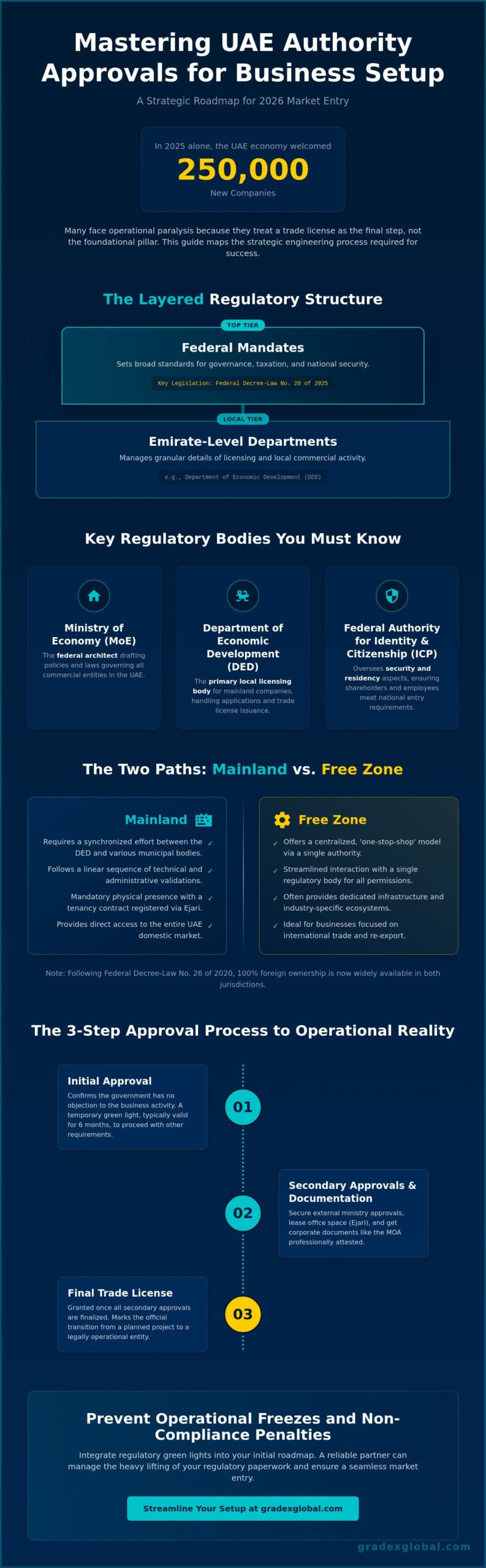
In 2025 alone, 250,000 new companies integrated into the UAE economy, yet many face operational paralysis because they treat a trade license as the final step rather than the foundation. Securing uae authority approvals for business setup isn’t a bureaucratic formality; it’s a strategic engineering process that demands absolute precision. If you don’t align with the specific mandates of ministries like the MoHAP or MOE, your capital is at risk before the first invoice is even issued.
It’s understandable if the evolving framework of Federal Decree-Law No. 20 of 2025 feels overwhelming, especially when navigating the distinction between jurisdictional and external permissions. We’ve designed this guide to help you master these complexities with the same rigor applied to large-scale infrastructure projects. You’ll gain a clear roadmap of mandatory approvals, learn how to avoid the fines associated with the 9% corporate tax threshold, and discover how a reliable partner can manage the heavy lifting of your regulatory paperwork.
Key Takeaways
- Identify the hierarchical regulatory structure between federal mandates and emirate-level departments to ensure your corporate foundation meets every legal standard.
- Learn how to secure the specific uae authority approvals for business setup required for your sector, from education to industrial manufacturing, before your trade license is finalized.
- Distinguish between the ‘one-stop-shop’ model of Free Zone Authorities and the multi-ministry requirements of Mainland jurisdictions to optimize your setup timeline.
- Streamline the corporate document attestation process by following a verified chain of authentication from international notaries to the UAE Ministry of Foreign Affairs.
- Prevent operational freezes and non-compliance penalties by integrating external regulatory green lights into your initial strategic roadmap.
Navigating the Regulatory Framework for UAE Business Incorporation
Establishing a commercial entity within the UAE’s economic landscape is a process defined by structural integrity and regulatory precision. It’s not a single-step registration but a multi-tiered permission system where each layer serves a specific sovereign or technical function. We define uae authority approvals for business setup as the sequence of mandatory clearances from federal and local bodies that validate your company’s legal existence and its right to conduct specific activities. In 2026, this framework has been further refined by Federal Decree-Law No. (20) of 2025, which prioritizes digital transparency and stringent ‘Know Your Customer’ (KYC) protocols to maintain the nation’s status as a global financial hub.
The hierarchy of regulation operates on two primary levels. At the top, federal laws set the broad standards for corporate governance, taxation, and national security. Below this, Emirate-level Economic Departments manage the granular details of licensing and local commercial activity. Understanding this vertical structure is essential for any investor aiming for a seamless market entry without the friction of bureaucratic delays.
The Logic of the Layered Approval System
The UAE utilizes a decentralized approval model to ensure that every business activity meets industry-specific safety and quality standards. This system separates administrative approvals from technical permissions. Administrative approvals involve the reservation of a trade name and the verification of the legal structure, while technical permissions focus on the physical and operational aspects of the business. Your specific activity dictates your roadmap; a civil engineering firm requires different technical clearances than a retail outlet. This precision-driven approach ensures that only qualified entities enter the market, protecting both the investor and the public interest.
Key Regulatory Bodies You Must Know
Navigating uae authority approvals for business setup requires an understanding of three core institutions. The Ministry of Economy (MoE) acts as the federal architect, drafting the policies and laws that govern all commercial entities. On a local level, the Department of Economic Development (DED) serves as the primary licensing body for mainland companies, handling everything from initial applications to the issuance of the final trade license. Finally, the Federal Authority for Identity, Citizenship, Customs & Port Security (ICP) oversees the security and residency aspects of the setup, ensuring that all shareholders and employees meet national entry requirements.
The journey begins with the ‘Initial Approval,’ a document that confirms the UAE government has no objection to the business being established. It’s important to realize this is a temporary green light, typically valid for six months, allowing you to proceed with other requirements like leasing office space. The ‘Final Trade License’ is only granted once all secondary approvals and legal documentations are finalized, marking the transition from a planned project to an operational reality.
The jurisdictional framework you select serves as the structural blueprint for your entire enterprise. While historical data often categorized Free Zones as the sole path to 100% foreign ownership, Federal Decree-Law No. 26 of 2020 fundamentally altered this landscape. Today, mainland companies can achieve full ownership across most commercial and industrial sectors, making the distinction between jurisdictions more about market access and regulatory oversight than equity control. Selecting the correct path is the first critical checkpoint in obtaining uae authority approvals for business setup.
In 2026, the UAE has moved toward unified digital platforms that bridge the gap between these jurisdictions. These systems streamline the interaction between federal mandates and local requirements, yet the technical workflow remains distinct. Mainland setups require a synchronized effort between the Department of Economic Development (DED) and various municipal bodies, whereas Free Zones offer a centralized, one-stop-shop model.
Mainland Approvals: The DED Workflow
The mainland process is a linear sequence of technical validations. It begins with trade name reservation and initial approval from the relevant Economic Department. Following this, the Memorandum of Association (MOA) must be attested to define the legal and operational boundaries of the entity. A physical presence is mandatory; this requires a verified tenancy contract registered through the Ejari system. This registration isn’t just a lease agreement; it’s a structural requirement that triggers the final issuance of the trade license. For those requiring technical precision in these early stages, utilizing professional business setup and Ejari services ensures that no administrative delays stall your progress.
Free Zone Approvals: Autonomous Regulation
Free Zone Authorities (FZAs) operate as autonomous regulators, often tailored to specific industries like technology, finance, or logistics. These bodies manage their own licensing frameworks, which can significantly expedite the setup for specialized firms. These jurisdictions are particularly advantageous for firms requiring industry-specific infrastructure, such as temperature-controlled warehousing or specialized data centers, as the FZA provides the necessary technical approvals as part of the unified setup package. If you’re transitioning from an existing UAE entity, obtaining a No Objection Certificate (NOC) from your current sponsor is a vital prerequisite. Immigration and visa protocols are handled through the E-channel system, a digital gateway managed by the ICP that centralizes residency approvals. This autonomous structure provides a high degree of control, but it requires strict adherence to the specific FZA’s internal bylaws and compliance standards.
Industry-Specific External Approvals: A Multi-Ministry Analysis
The UAE’s regulatory architecture demands that technical competence be verified by the specific governing body before administrative licensing occurs. While the Department of Economic Development (DED) manages the commercial registration, roughly 30% of business activities require ‘External Approvals’ from non-licensing federal or local bodies. These permissions are not elective; they are mandatory technical clearances that certify your entity is capable of operating within high-stakes or sensitive sectors. Securing uae authority approvals for business setup in these industries necessitates a precise sequence where the technical green light must precede the final trade license issuance.
This ‘Activity-First’ rule creates a specific hierarchy in your setup timeline. You don’t approach the DED for a final license until the relevant ministry has audited your qualifications, business plan, or physical premises. Because these bodies operate on independent schedules, external approvals often dictate the actual business launch date. For instance, a medical facility might wait 4 to 8 weeks for technical inspections, whereas a standard trading firm might finish in days. Managing these timelines requires an engineering-grade roadmap to prevent capital from sitting idle during bureaucratic processing.
Regulated Sectors and Their Governing Bodies
Different sectors answer to different masters. In the healthcare and pharmaceutical space, the Ministry of Health and Prevention (MOHAP) or local bodies like the Dubai Health Authority (DHA) must approve everything from facility blueprints to staff certifications. Educational ventures require a nod from the Ministry of Education (MoE) or the Knowledge and Human Development Authority (KHDA). If you’re entering the financial services market, the Central Bank of the UAE and the Securities and Commodities Authority (SCA) provide the necessary oversight. Engineering and construction firms, reflecting the high standards of the UAE’s infrastructure, must secure approvals from local Municipalities and Civil Defence for safety and structural compliance.
The Role of the Ministry of Foreign Affairs (MOFA)
The Ministry of Foreign Affairs (MOFA) serves as the definitive sovereign link that validates the legal standing of international corporate entities before they are permitted to operate within the UAE’s jurisdiction. MOFA is the final gatekeeper for all international corporate documentation, ensuring that papers issued outside the Emirates are legally recognized here. This is especially critical for foreign branch office setups, where the parent company’s documents must undergo a rigorous chain of authentication. MOFA attestation confirms that your international credentials meet the UAE’s stringent entry standards, providing the stability and trust required for complex cross-border operations. Without this final validation, your uae authority approvals for business setup remain incomplete, stalling bank account openings and visa processing.
The Mandatory Framework for Corporate Document Attestation
The administrative architecture of the UAE requires every international document presented for corporate registration to undergo a rigorous chain of authentication. Document attestation is frequently the primary bottleneck in the timeline for uae authority approvals for business setup, often adding weeks to the process if not managed with engineering-grade precision. This isn’t a mere stamp; it’s a sovereign validation process that confirms the legal standing of your foreign entity before the UAE Ministry of Foreign Affairs (MOFA) grants final recognition. In 2026, the standards for these approvals have become more stringent, utilizing digital verification to ensure the integrity of the global business ecosystem.
The ‘Chain of Authentication’ follows a non-negotiable sequence. It begins with a notary public in the document’s country of origin, followed by verification from that nation’s Ministry of Foreign Affairs and the UAE Embassy located there. The final checkpoint is the UAE MOFA, which provides the ultimate legal clearance. Any deviation in this sequence results in rejection, forcing a complete restart of the process. This mechanical precision ensures that all corporate participants enter the market with verified credentials.
Mandatory Documents Requiring Attestation
Precision in document preparation is the only way to ensure stability during the incorporation phase. For corporate shareholders, the Certificate of Incorporation and Articles of Association must be fully legalized to prove the existence of the parent entity. If a manager is being appointed via a third party, Board Resolutions and Powers of Attorney (POA) are required to define their specific authorities. Regulated professional activities demand even higher scrutiny; managers must provide educational degrees that meet the latest 2026 equivalence certificate requirements to prove technical competency. These standards ensure that only qualified professionals lead critical business operations within the Emirates.
Precision in Legal Translation
The UAE legal system operates primarily in Arabic, making certified legal translation a mandatory requirement for all non-Arabic documentation. Relying on non-certified services introduces unacceptable risks, as even minor terminological errors can lead to legal vulnerabilities during the Memorandum of Association (MOA) drafting phase. Certified translators don’t just swap words; they ensure that technical and legal nuances remain intact across jurisdictions. This level of clarity is vital for maintaining the structural integrity of your corporate bylaws. To mitigate these risks, the global translation and attestation services provided by Grad-Ex Consultancy offer the per-document precision needed to satisfy both local courts and federal ministries. We treat every translation as a technical drawing where accuracy is the only acceptable outcome.
Managing Regulatory Risk: Strategic Solutions for 2026 Business Setup
The cost of non-compliance in the UAE’s 2026 regulatory environment extends far beyond immediate financial penalties. While a 9% corporate tax rate applies to taxable income exceeding AED 375,000, the true risk lies in operational freezes that can paralyze a multi-million dirham investment. Precision during the initial phase of uae authority approvals for business setup prevents the cascading delays often caused by mismatched activity codes or incomplete documentation. In an economy projected to grow by 5% in 2026, a single administrative error can result in the suspension of banking facilities or the inability to process employee visas.
Grad-Ex Consultancy brings a 15-year history of institutional relationships and strategic advisory to every project. We operate with the same rigor as a lead engineering contractor, managing the complex interface between federal ministries and local departments. Our ‘Fixed-Fee’ advantage eliminates the uncertainty of government coordination costs, providing investors with a stable budgetary framework. This transparency ensures that your capital is allocated to growth rather than unforeseen administrative overheads. We don’t just facilitate registration; we build the legal infrastructure for your success.
Grad-Ex Consultancy as Your Strategic UAE Partner
Our methodology involves end-to-end management of all necessary clearances, from the initial DED registration to specialized industry-specific ministries. We leverage our deep expertise in certificate attestation to accelerate your setup timeline, ensuring that every international document meets the sovereign standards of the UAE Ministry of Foreign Affairs. To maintain long-term structural integrity, Grad-Ex Consultancy offers tiered consultancy subscriptions, including Basic, Standard, and Premium plans, designed for ongoing regulatory compliance. These plans provide a reliable safety net, allowing you to focus on large-scale execution while we handle the evolving landscape of uae authority approvals for business setup.
Next Steps for Your Business Launch
Initiating your market entry requires a customized approval roadmap that aligns with your specific commercial objectives. The final phase of your setup hinges on selecting a compliant office space and securing an Ejari registration, which acts as the technical trigger for your final trade license issuance. Before you launch, verify that your corporate structure is optimized for the latest amendments to the Commercial Companies Law. To ensure your entity is built on a foundation of total compliance, secure your UAE business setup with Grad-Ex Consultancy’s professional advisory services. Our expertise is the guarantee of your operational stability.
Strategic Execution for Your 2026 UAE Market Entry
Navigating the Emirates’ commercial landscape in 2026 requires a transition from basic registration to high-precision technical compliance. We’ve explored how the significant portion of businesses requiring external ministry nods must synchronize their timelines with federal mandates to avoid capital stagnation. Mastering the matrix of uae authority approvals for business setup is the definitive factor in ensuring your enterprise remains resilient against operational freezes and the complexities of the 9% corporate tax threshold.
Grad-Ex Consultancy provides the institutional stability required for such large-scale market entries. With over 15 years of strategic advisory experience, our team ensures expert coordination with all UAE federal ministries while providing fixed-fee document attestation and translation. Partner with Grad-Ex Consultancy for seamless UAE business setup and authority approvals to solidify your corporate infrastructure. Your vision deserves a foundation of engineering-grade precision.
Frequently Asked Questions
What is the difference between initial approval and a trade license in the UAE?
Initial approval is the formal acknowledgment that the UAE government has no objection to your business establishment. It’s a temporary permit, valid for six months, that allows you to finalize office leases and secondary certifications. The trade license is the final operational document issued only after all technical and legal requirements, including Ejari registration, are satisfied.
Which UAE authority is responsible for approving a new business name?
The Department of Economic Development (DED) is responsible for approving trade names for mainland companies, while Free Zone Authorities manage this process within their respective jurisdictions. This step ensures your chosen name doesn’t conflict with existing entities or national sensitivities. It’s the first technical checkpoint in the sequence of uae authority approvals for business setup.
Can a foreigner start a business in the UAE without a local partner in 2026?
Yes, 100% foreign ownership is now the standard for most commercial and industrial activities on the UAE mainland. This change, enacted by Federal Decree-Law No. 26 of 2020, removed the mandatory requirement for a local Emirati partner in most sectors. Only strategic industries, such as defense, telecommunications, and oil and gas, still require specific local equity structures.
How long does it typically take to get external ministry approvals?
Timelines for external approvals vary based on the technical complexity of the business activity. Standard certifications from the Ministry of Foreign Affairs (MOFA) typically take 3 to 5 working days. However, high-regulation sectors like financial services (SCA) or healthcare (MOHAP) often require 4 to 8 weeks for thorough technical audits and facility inspections.
What happens if my business activity is not listed on the DED website?
If your specific activity isn’t listed, you must apply for a ‘special activity’ approval through the DED’s technical committee. You’ll need to provide a detailed technical description of your operations. The committee will then determine if a new code is required or if you must seek additional uae authority approvals for business setup from a relevant federal ministry.
Is physical office space mandatory for all business setup approvals in the UAE?
Physical office space is mandatory for all mainland business licenses in the UAE as of 2026. You must provide a valid Ejari certificate to prove you’ve leased a physical premises that meets the DED’s size and safety requirements. While some free zones offer virtual desks, a physical address remains a foundational requirement for mainland corporate stability and visa processing.
Why do I need a No Objection Certificate (NOC) for business setup?
A No Objection Certificate (NOC) is required if a shareholder or manager is currently under the sponsorship of another UAE entity or family member. This document serves as a formal clearance from the current sponsor, confirming they permit the individual to engage in a new commercial venture. It’s a critical legal safeguard to prevent conflicts of interest or contractual breaches during the setup phase.
How much are the government fees for authority approvals in the UAE?
Government fees for a standard trading or commercial license on the Dubai mainland generally range from AED 10,000 to AED 20,000. Professional licenses typically cost between AED 10,000 and AED 18,000. These figures are exclusive of external ministry fees or the 2.5% to 5% market fee based on the annual rent of your physical office space as verified by the local municipality.