
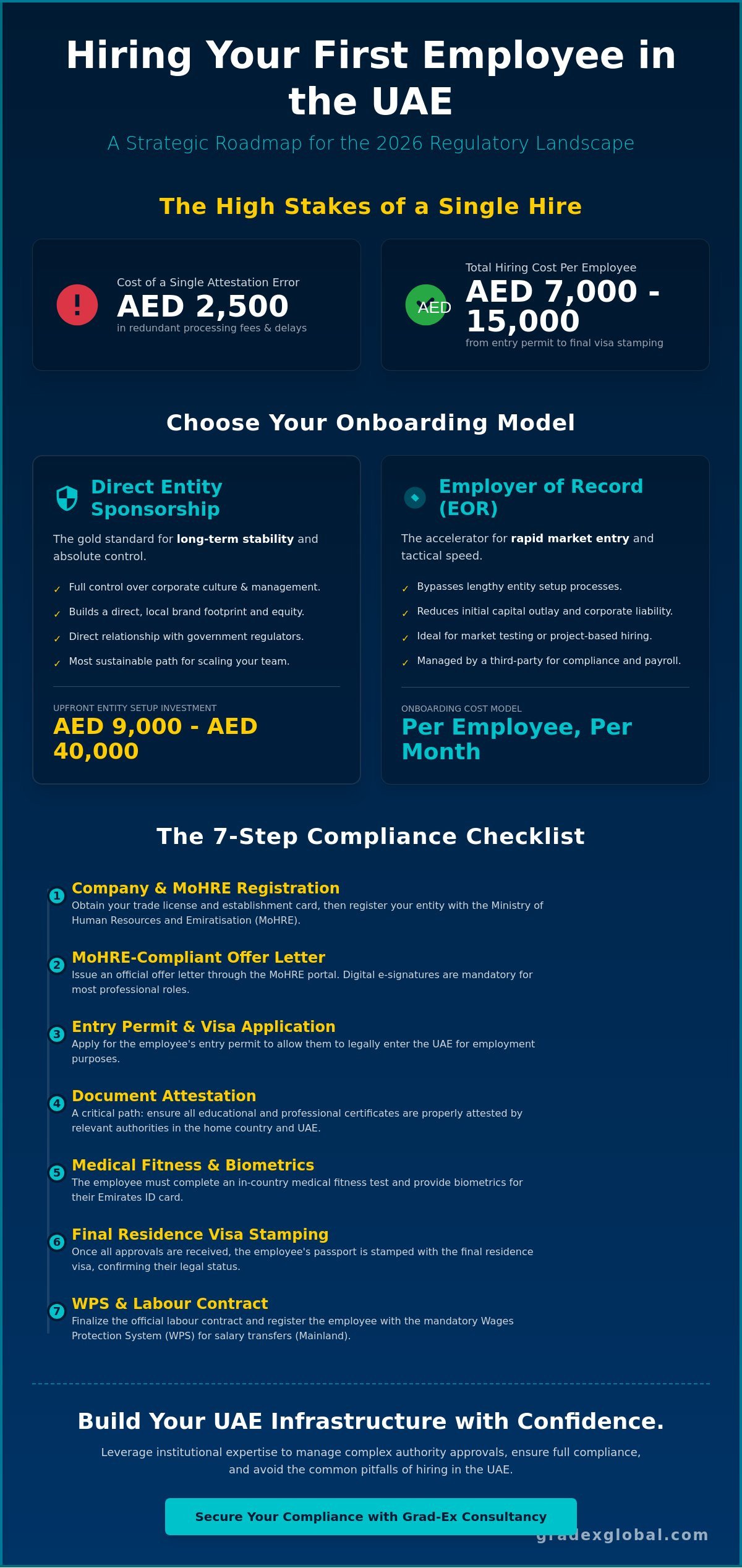
A single error in document attestation can stall your corporate momentum, potentially costing your business up to AED 2,500 in redundant processing fees before your first team member even arrives. You’ve likely recognized that while the Emirates offer a stable foundation for expansion, the technical rigour required by the Ministry of Human Resources and Emiratisation (MoHRE) demands absolute precision. Understanding how to hire your first employee in the uae is no longer just an HR task; it’s a strategic operation that requires navigating a complex regulatory landscape with engineer-like accuracy.
We’ll provide a clear, structured roadmap to ensure your recruitment process aligns with the latest 2026 labour laws and mandatory Wages Protection System (WPS) requirements. You’ll gain a comprehensive breakdown of the AED 7,000 to AED 15,000 total hiring costs, from entry permits to the final residence visa stamping. This guide ensures your onboarding infrastructure is built on compliance, preventing the common pitfalls of rejected applications and securing your company’s long-term stability in the UAE market.
Key Takeaways
- Navigate the 2026 UAE Federal Labour Law with precision to ensure your corporate recruitment framework meets all MoHRE compliance standards.
- Evaluate the technical advantages of direct sponsorship versus Employer of Record (EOR) models to optimize how to hire your first employee in the uae.
- Master the multi-stage document attestation and equivalency process to secure successful visa issuance for skilled professionals without administrative rejections.
- Implement a structured onboarding checklist that transitions from MoHRE-compliant offer letters to final residency visa stamping with engineered efficiency.
- Leverage institutional expertise to manage complex UAE authority approvals and ensure full compliance with the mandatory Wages Protection System (WPS).
Understanding the UAE Employment Regulatory Framework
The UAE’s recruitment infrastructure is built on the foundation of Federal Labour Law No. 33 of 2021. This legislation modernized the market by replacing decades-old regulations with a system designed for flexibility and transparency. It mandates that every employment relationship is documented through a fixed-term contract, which can’t exceed three years but remains renewable upon mutual agreement. For a business owner, determining how to hire your first employee in the uae starts with recognizing that legal compliance isn’t just a formality; it’s the primary metric of your company’s operational stability.
Mainland vs. Free Zone Jurisdictions
The jurisdiction of your trade license dictates your specific regulatory path. Mainland entities operate under the direct supervision of the Ministry of Human Resources and Emiratisation (MoHRE) and must strictly adhere to the Wages Protection System (WPS). This electronic framework monitors salary transfers to ensure workers are paid accurately and on schedule. Conversely, free zones like JAFZA or DMCC provide their own administrative environments. While they generally follow federal labour principles, they manage their own visa processing and internal regulations. However, financial hubs like the Dubai International Financial Centre (DIFC) or Abu Dhabi Global Market (ADGM) maintain entirely independent common law systems. Strategic selection of your jurisdiction impacts your initial visa quotas, which are typically determined by your office square footage and the nature of your business activity.
The Role of the Ministry of Human Resources and Emiratisation (MoHRE)
MoHRE acts as the central regulator for private sector employment across the mainland. Before you can issue an official offer letter to your first hire, your company must register with the ministry and obtain a dedicated establishment card. As of May 2026, the onboarding process has become almost entirely digital. Professional categories now require integrated e-signature systems to validate contracts. This digital shift has accelerated processing times but has also increased the demand for technical precision. Any discrepancy between the electronic filing and the physical documentation results in immediate system rejection, causing costly delays in your recruitment timeline.
Every employee must be backed by a valid residency visa and a work permit sponsored by your legal entity. In the 2026 landscape, the government has intensified its focus on Emiratisation targets. While the 1% growth target for June 30, 2026, applies to firms with 50 or more employees, the regulatory pressure for accurate reporting affects businesses of all sizes. Mastering how to hire your first employee in the uae means ensuring every document, from the initial MoHRE-approved offer to the final medical fitness certificate, is handled with engineering-grade accuracy to secure your standing in the UAE market.
Choosing the Right Onboarding Model: Entity vs. EOR
Selecting an onboarding model is the first structural decision you’ll face when expanding into the Emirates. It’s a technical choice between tactical speed and building long-term institutional equity. Determining how to hire your first employee in the uae requires a clear assessment of your capital allocation and your desired speed of execution. You aren’t just adding a team member; you’re selecting the legal vehicle that will carry your corporate liability and operational costs in a highly regulated market.
Direct Entity Sponsorship: Long-Term Stability
Direct sponsorship represents the gold standard for companies committed to a permanent market presence. This model necessitates a valid UAE trade license and an establishment card, forming the bedrock of your corporate structure. While the upfront investment to set up a legal entity ranges from AED 9,000 to AED 40,000, it provides absolute control over your corporate culture and internal management. It’s the most sustainable path for businesses planning to scale beyond a handful of staff. This model integrates seamlessly with business incorporation and licensing, ensuring that every hire contributes directly to your brand’s local footprint. By owning the visa sponsorship, you eliminate third-party dependencies and maintain a direct relationship with government regulators, which is vital for long-term compliance and security.
Employer of Record (EOR) for Rapid Market Entry
The Employer of Record (EOR) model serves as a high-velocity alternative, ideal for firms testing the local waters. It allows you to deploy talent in under 7 days without the immediate requirement for company formation or local bank accounts. The EOR partner assumes all legal liabilities and manages payroll through their established infrastructure. With EOR fees typically ranging from AED 735 to AED 5,500 per month per employee, it’s a predictable method for initial market entry. This tactical choice removes the administrative burden of managing the Wages Protection System (WPS) and mandatory health insurance, allowing you to focus entirely on project delivery. However, it’s important to remember that while EOR offers speed, it doesn’t build the same local asset value as a direct entity setup.
Grad-Ex Consultancy provides the professional oversight required to evaluate these models against your specific project metrics. If you’re seeking a partner to navigate these technical decisions, our experts offer the strategic advisory needed for a sustainable and compliant market entry. We’ll ensure your choice aligns with both your current budget and your 2026 growth targets.
The Critical Path: Document Attestation and Equivalency
The technical integrity of your recruitment process depends on the verification of your candidate’s academic credentials. While previous sections outlined the legal frameworks and onboarding models, the actual execution of a work permit for skilled professionals (Categories 1 and 2) hinges on document attestation. Successfully determining how to hire your first employee in the uae relies on more than just a signed offer letter; it requires a rigorous audit of the candidate’s educational history. Errors in this phase remain the primary cause of administrative rejections, often forcing companies to restart the entire application cycle at a significant loss of time and capital.
The 3-Step Attestation Process
Document attestation is a multi-stage verification protocol that bridges the legal gap between the home country and the Emirates. The process is linear and requires precision at every junction:
- Step 1: Local Authentication: The original certificate must be notarised and authenticated by the relevant educational board or department in the country of origin, such as India, the UK, or the USA.
- Step 2: Home Country MOFA: The document is then submitted to the Ministry of Foreign Affairs (MOFA) in the home country for official state-level verification.
- Step 3: UAE Legalisation: The final stage involves attestation by the UAE Embassy in the home country followed by the UAE Ministry of Foreign Affairs.
The standard fee for MOFA to attest a personal document in the UAE is AED 150. However, the total cost for foreign degree attestation typically ranges from AED 700 to AED 2,500. This variance depends on the country of origin and the required urgency. Investing in professional oversight during this phase ensures that your establishment avoids the common pitfall of document rejection due to incorrect seal sequences or expired stamps.
When is an Equivalence Certificate Mandatory?
For specific professional designations, a standard attestation isn’t sufficient. The UAE Ministry of Education (MOE) requires an equivalence certificate to validate that a foreign degree meets the rigorous standards of the local curriculum. This is a non-negotiable prerequisite for teachers, medical professionals, and certain engineering roles. It’s often the final hurdle for securing higher-tier visa categories or professional licenses. Because this process involves a deep technical comparison of credit hours and institutional accreditation, it demands expert handling. Grad-Ex Consultancy offers specialised certificate equivalency services, ensuring your first hire meets all MOE criteria without the risk of procedural delays. This precision-led approach is essential for any business owner learning how to hire your first employee in the uae while maintaining total regulatory compliance.
Step-by-Step Onboarding and Compliance Checklist
Once academic credentials are verified, the operational sequence of onboarding begins. Executing the process of how to hire your first employee in the uae requires a synchronized approach to meet government deadlines and avoid systemic fines. The first milestone is issuing a MoHRE-compliant offer letter. This document must align perfectly with the electronic contract later filed with the ministry. Upon the employee’s signature, you apply for the initial work permit, with fees ranging between AED 2,100 and AED 5,100 depending on the professional category. Following this, an entry permit is issued, costing between AED 1,100 and AED 1,200, to allow the candidate legal entry into the country for the finalization of their residency.
Upon arrival, the employee has a 60-day window to complete the medical fitness test (AED 200 to AED 320) and Emirates ID biometrics (AED 370). These steps are non-negotiable prerequisites for the residence visa stamping, which itself carries a fee between AED 510 and AED 1,110. Simultaneously, the employer must secure mandatory health insurance. Annual premiums vary from AED 500 to over AED 4,000 depending on the coverage level; failing to provide this basic protection results in immediate compliance blocks and potential fines during digital audits.
The Wage Protection System (WPS) Mechanism
The Wages Protection System (WPS) is the mandatory electronic framework that ensures salary disbursement matches the terms of the labour contract. Registration requires a local corporate bank account capable of generating SIF files for salary uploads. Banks typically charge a processing fee, such as AED 200 per file upload plus a per-record fee of AED 0.50. This system allows MoHRE to monitor payments in real-time. Any delay or shortfall in payment triggers automated alerts, which can lead to the suspension of your establishment’s ability to issue new work permits. Mastering how to hire your first employee in the uae involves integrating this payment protocol into your monthly accounting cycle with engineering-grade precision.
Mandatory Benefits and Gratuity
Sustainable financial planning must account for statutory liabilities beyond the basic salary. Under UAE Labour Law No. 33 of 2021, all contracts are fixed-term, and employers must budget for End-of-Service Benefits (EOSB). This gratuity is calculated based on the employee’s length of service and final basic wage. Additionally, the law mandates a minimum of 30 days of annual leave and, traditionally, includes annual flight tickets to the employee’s home country. Precision in these calculations prevents future disputes and ensures the long-term solvency of your UAE operations.
Managing these multi-layered requirements demands a partner who understands the technical engineering of UAE compliance. For expert assistance in securing UAE Authority Approvals and ensuring your onboarding is legally sound, Grad-Ex Consultancy offers the institutional stability your business requires.
Building Your UAE Infrastructure with Grad-Ex Consultancy
Establishing a corporate presence in the Emirates is a high-stakes engineering endeavor where the quality of your infrastructure determines the durability of your growth. For over 15 years, Grad-Ex Consultancy has provided the institutional stability required for international firms to navigate the GCC markets with precision. When you’re determining how to hire your first employee in the uae, you aren’t just looking for a service provider; you’re seeking a strategic partner capable of managing the entire project lifecycle from initial setup to final visa issuance. Our approach mirrors the rigour of a large-scale construction project, where every document and regulatory approval serves as a critical load-bearing element.
We provide fixed-fee document attestation services, which removes the pricing volatility often associated with international verification. By standardizing these costs, we ensure your first hire isn’t delayed by paperwork or unexpected administrative expenses. Our team manages the technical coordination between home-country ministries and UAE authorities, maintaining a clear timeline that allows your business to remain focused on its core operational objectives.
End-to-End Strategic Support
Our consultancy doesn’t stop at recruitment. We provide a comprehensive suite of services designed to secure every facet of your business environment. This includes expert coordination with UAE ministries to expedite authority approvals and managing complex trademark registration services to protect your intellectual assets from day one. For companies with a diverse workforce, we facilitate essential support such as Indian passport assistance and global translation services, ensuring that your human capital is legally mobile and fully compliant with local standards. By choosing the right trade license and business setup plan through our advisory, you build a framework that supports long-term scaling without the need for costly structural revisions.
Why Precision Matters in UAE Recruitment
In the 2026 regulatory environment, the cost of error is quantified in heavy financial penalties. As of May 2026, non-compliance with Emiratisation targets for larger firms results in fines of AED 72,000 per year. Even for smaller startups, administrative mistakes in the Wages Protection System (WPS) or incorrect document legalisation can lead to immediate operational freezes. Grad-Ex Consultancy eliminates these risks through meticulous oversight of the onboarding process. We ensure your first hire is a success, not a source of administrative friction.
A professional onboarding experience is the first signal of your company’s stability to top global talent. By partnering with a firm that prioritizes precision and sustainable growth, you ensure your international operations are built on a bedrock of compliance. Consult with Grad-Ex Consultancy today to secure your UAE business foundation. We bring the technical expertise and institutional memory needed to master how to hire your first employee in the uae with complete confidence.
Securing Your Corporate Future in the Emirates
Building a sustainable business in the UAE requires a transition from tactical entry to institutional stability. Success hinges on a clear understanding of the regulatory landscape, where compliance with the Wages Protection System (WPS) and MoHRE mandates forms the bedrock of your operations. By prioritizing the technical accuracy of document attestation and selecting a sponsorship model that supports long-term growth, you protect your company from the administrative friction that stalls less prepared competitors. Mastering how to hire your first employee in the uae is the first major milestone in establishing a permanent and profitable market presence.
Grad-Ex Consultancy brings over 15 years of strategic advisory experience to your expansion, offering the stability your international operations demand. Our fixed-fee document attestation models and deep institutional relationships with UAE authorities ensure your onboarding process is handled with engineering precision. We eliminate the guesswork from regulatory approvals, allowing you to focus on scaling your core business. Contact Grad-Ex Consultancy for Expert Business Setup and Attestation Services to secure your foundation. Your journey toward a successful UAE team starts with a partner who values precision as much as you do.
Frequently Asked Questions
Can I hire an employee in the UAE without a local company?
You can hire an employee without a local entity by utilizing an Employer of Record (EOR) service. This partner manages the legal sponsorship and payroll through their existing trade license, allowing for rapid market entry in under 7 days. It’s a strategic alternative for those learning how to hire your first employee in the uae while testing the market before committing to the AED 9,000 to AED 40,000 cost of a full company setup.
How long does the visa process take for a first-time hire?
The standard timeline for a first-time visa issuance ranges from 14 to 28 days. This includes obtaining the initial MoHRE work permit and the GDRFA entry permit, which typically takes 3 to 5 working days. The remaining duration is dedicated to the medical fitness test, Emirates ID biometrics, and final residency stamping. Precision in document preparation is the primary factor in maintaining this schedule when determining how to hire your first employee in the uae without administrative delays.
What is the minimum salary for a residency visa in the UAE?
There’s no federal minimum wage for expatriate employees in the private sector, though market standards and specific visa categories dictate salary levels. As of January 1, 2026, the minimum monthly salary for Emirati employees is AED 6,000. For expatriates in skilled categories, a monthly salary of at least AED 5,000 is often required to facilitate family sponsorship, ensuring the financial stability of the residency application meets all regulatory thresholds.
Is degree attestation mandatory for all visa categories?
Degree attestation is mandatory for all skilled professional roles classified under Category 1 and 2 by MoHRE. This verification ensures that foreign qualifications meet the UAE’s educational standards. While unskilled roles in Category 3 don’t require academic verification, any designation involving management, engineering, or specialized consulting remains impossible to sponsor without a fully attested certificate from the country of origin and the UAE Ministry of Foreign Affairs.
What happens if I fail to pay an employee through the WPS?
Failure to disburse salaries through the Wages Protection System (WPS) triggers immediate automated penalties. Fines start at AED 1,000 per employee and can escalate to AED 50,000 for prolonged non-compliance. Beyond financial loss, the MoHRE system will block your establishment card, preventing the issuance of any new work permits. This digital enforcement ensures that the financial infrastructure of your business remains transparent and legally sound under the 2026 labour laws.
Are there specific Emiratisation quotas for small businesses in 2026?
Private sector companies with 50 or more employees must achieve a 1% growth in Emiratisation by June 30, 2026. While small businesses with fewer than 50 staff members are currently exempt from these specific growth targets, they must still comply with all general labour regulations. For larger firms, the penalty for each unfilled Emirati position is AED 6,000 per month, totaling AED 72,000 per year, emphasizing the need for structured recruitment planning.
What are the mandatory health insurance requirements for employees?
Mandatory health insurance is a legal requirement for all employees in the emirates of Dubai and Abu Dhabi. Employers must provide a basic coverage plan, with annual premiums typically ranging from AED 500 to over AED 4,000. This coverage must be active before the residency visa is finalized. Failing to maintain valid insurance can lead to significant fines and blocks on the employee’s visa renewal process during annual digital audits conducted by local health authorities.