
Relying on a standard Apostille is the most efficient way to guarantee your residency or business application fails before it begins. While many professionals assume a single state-level stamp suffices, the rigorous process of attesting us documents for use in uae follows a specialized four-tier chain of command that leaves no room for error. The UAE isn’t a member of the Hague Apostille Convention; therefore, your documents require a precise sequence of federal and international verifications to be legally recognized.
We recognize the frustration of multi-state bureaucratic confusion and the high risk of rejection that comes with Apostille errors. It’s difficult to manage unclear US Department of State wait times while trying to finalize a high-stakes business setup or residency permit. This guide provides the strategic framework you need to master the legalization of your personal, educational, and commercial certificates with precision. You’ll gain a clear understanding of the UAE’s transition to a fully digital attestation system, including the mandatory $20 US authentication fees and the 2026 MOFA rates. We’ll outline the exact four-step chain from the initial notary to the final electronic certificate, ensuring your paperwork is rejected-proof and your business setup remains on track.
Key Takeaways
- Understand why the Hague Apostille Convention does not apply to the UAE and how this necessitates a specialized, multi-jurisdictional verification framework.
- Master the precise sequence of federal and international approvals required for attesting us documents for use in uae to ensure total compliance with 2026 regulations.
- Identify the specific nuances of authenticating educational degrees, including mandatory verification against the CHEA database and navigating distance learning restrictions.
- Learn the final requirements for UAE Ministry of Foreign Affairs (MOFA) digital attestation and the specific instances where legal Arabic translation is mandatory.
- Discover how leveraging institutional expertise and fixed-fee transparency eliminates the risk of hidden costs and document rejection throughout the legalization chain.
The US-UAE Legalization Framework: Why Apostilles Are Insufficient
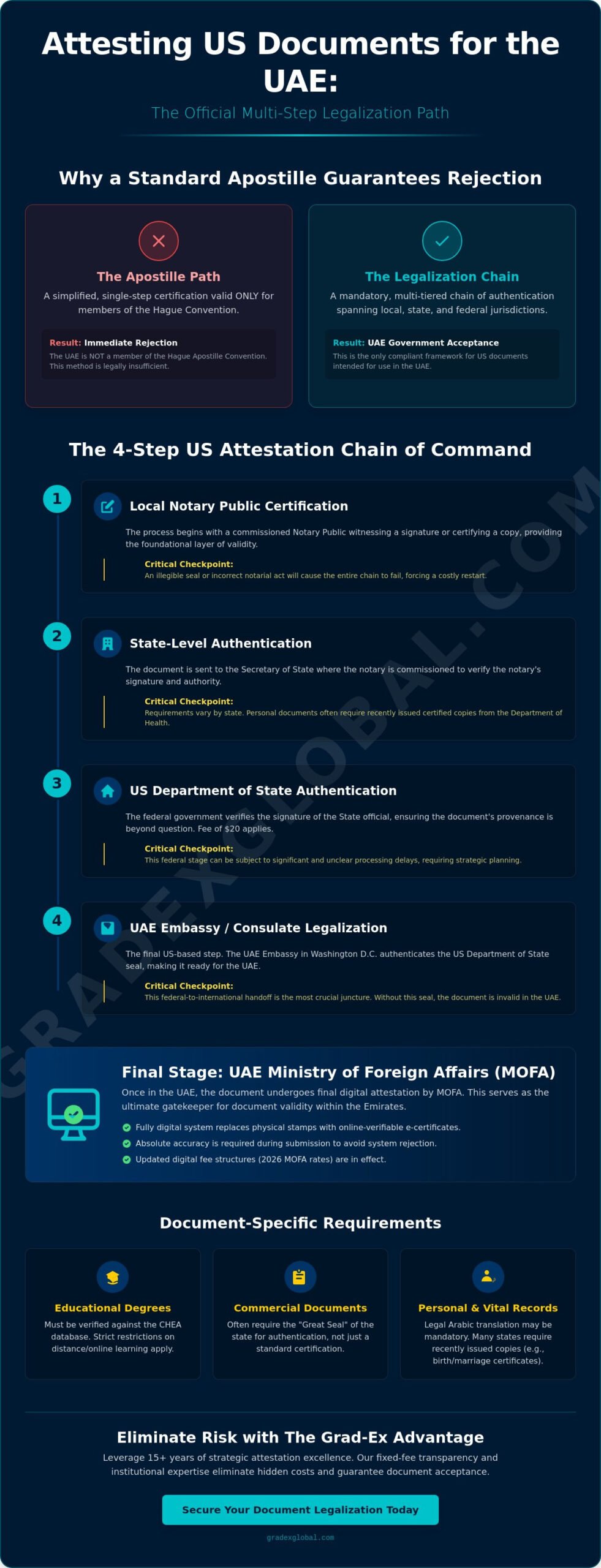
International document verification is a rigorous technical process designed to confirm the authenticity of signatures, seals, and the authority of the issuing official. For professionals and entities operating between the United States and the United Arab Emirates, understanding The US-UAE Legalization Framework is the first step toward successful residency or commercial integration. Many applicants incorrectly assume that a standard Apostille is sufficient for their needs. However, because the UAE is not a member of the 1961 Hague Apostille Convention, a single state-level certification is legally inadequate. Instead, the process of attesting us documents for use in uae requires a multi-tiered chain of authentication that spans local, state, and federal jurisdictions.
Failing to adhere to this specific sequence results in immediate rejection by UAE authorities. This causes significant delays in visa processing, business licensing, and school enrollments. Precision in the initial stages of this framework is not merely a recommendation; it’s a foundational requirement for any complex international project. Every seal in the chain must be verified by the subsequent authority, creating a transparent and immutable record of the document’s legitimacy.
Legalization vs. Apostille: A Technical Distinction
The Apostille is a simplified, one-step certification designed for use between member nations of the Hague Convention. It’s a streamlined protocol that doesn’t apply to the UAE. For non-member nations, a full legalization sequence is mandatory. This “Chain of Authentication” involves multiple independent verifications. Each tier of the US government must certify the previous official’s signature before the document can move to the next level of authority. This ensures that by the time a certificate reaches the federal stage, its provenance is beyond question. Relying on an Apostille when a full legalization is required is a common strategic error that halts progress and increases administrative costs.
The Role of the UAE Ministry of Foreign Affairs (MOFA)
The UAE Ministry of Foreign Affairs (MOFA) serves as the ultimate gatekeeper for document validity within the Emirates. However, MOFA cannot act on a document until it has been properly authenticated by the UAE Embassy or Consulate in Washington, D.C. This federal-to-international handoff is the most critical juncture in the process. As of May 2026, the UAE has transitioned to a fully digital attestation system. This modern infrastructure replaces traditional physical stamps with electronic certificates that can be verified online in real-time. While this increases efficiency, it also requires absolute accuracy during the digital submission phase. Any discrepancy between the physical document and the digital upload will result in a system rejection, necessitating a complete restart of the 4-tier chain.
The 4-Step US Attestation Chain: From Local Notary to Embassy
The process of attesting us documents for use in uae is a strictly sequential operation where each tier of government verifies the integrity of the preceding authority. This hierarchical structure begins at the local level with a commissioned Notary Public. The notary’s role is to witness the signing or certify a copy, providing the initial layer of technical validity for the document. If this foundation is flawed, such as through an illegible seal or an incorrect notarial act, the entire chain of command collapses, necessitating a costly restart of the project. It’s essential to ensure the notary’s signature matches the records held by the state to avoid immediate disqualification at the next stage.
State-Level Requirements and Secretary of State Verification
Following notarization, the document must be presented to the Secretary of State in the jurisdiction where the notary is commissioned. This stage is not uniform; requirements for birth, marriage, and death certificates vary significantly by state. For instance, many states require a recently issued certified copy from the Department of Health before they’ll apply the state seal. In the case of commercial documents, authorities often require the Great Seal of the state to confirm corporate standing. It’s vital to verify that the notary’s commission is active and valid for the entire duration of the processing window to avoid rejection during the federal verification phase.
Federal Authentication at the US Department of State
The third tier involves the US Department of State’s Office of Authentications in Washington, D.C. Their specific function is to authenticate the state official’s signature and seal. As of May 2026, the mandatory fee for this federal verification is $20 per document. Precision here is paramount; the “Authentication Certificate” (Form DS-4194) must be completed with exactitude. Current processing timelines for federal authentication typically range from 10 to 15 business days when managed through professional channels. Utilizing specialized attestation services ensures that these technical forms are error-free, maintaining the stability of your residency or business setup timeline.
The final step within the United States is legalization by the UAE Embassy or Consulate. This stage prepares the document for the final UAE Ministry of Foreign Affairs attestation by verifying the US Department of State’s federal seal. This transition into the UAE’s digital ecosystem requires submission through recognized diplomatic portals. By ensuring the embassy’s stamp is correctly applied and recorded, the document becomes eligible for final digital activation within the Emirates, completing the US-based portion of the legalization framework and securing the necessary approvals for use in the UAE.
Finalizing the Process: UAE MOFA and Educational Equivalency
Once the document has secured the UAE Embassy seal in Washington D.C., the operational focus shifts to the local jurisdiction within the Emirates. The process of attesting us documents for use in uae culminates at the Ministry of Foreign Affairs (MOFA). This final verification isn’t merely a formality; it’s the activation of the document’s legal status within the UAE domestic systems. To manage this transition with precision, applicants must integrate their records with the UAE Pass system. This centralized digital identity platform allows for real-time tracking of the attestation status and ensures high-level security across all government portals. Success in this stage requires a disciplined adherence to the latest digital protocols, as any discrepancy between the US-side authentication and the MOFA submission will result in a system-level rejection.
MOFA Attestation Procedures Within the UAE
The UAE has optimized its administrative infrastructure through a courier-based submission system that prioritizes efficiency and security. Physical documents are collected and delivered to specialized MOFA centers where officials verify the UAE Embassy seal from Washington D.C. In 2026, the fee structure remains fixed to ensure transparency: AED 150 for personal and educational documents, and AED 2,000 for commercial certificates. Payments are processed through the official MOFA portal using recognized digital methods. Once the verification is complete, the Ministry issues an electronic certificate. This digital record is legally recognized across all government departments, providing a durable foundation for residency, employment, or corporate operations.
Legal Translation and Document Formatting
Certain legal or personal documents require a secondary verification layer: legal translation into Arabic. This process must be performed exclusively by a translator licensed by the Ministry of Justice (MOJ). It’s vital to preserve all original seals and stamps during this formatting stage. Any alteration or obstruction of the US-side verifications will invalidate the document’s chain of command. For professionals requiring multiple sets of paperwork, the ‘true copy’ attestation process ensures that secondary document sets maintain the same legal weight as the original. This meticulous attention to document formatting prevents administrative friction during the final submission stages of a business setup or visa application.
For professionals seeking specialized licensure or government roles, attestation is the mandatory prerequisite for obtaining the equivalence certificate. This secondary framework validates that a US degree meets the specific academic and institutional standards of the UAE Ministry of Education. Without a correctly MOFA-attested document, the equivalency application cannot be initiated. This highlights the interconnected nature of these regulatory systems, where each step functions as a critical component of a larger professional infrastructure. Precision at the attestation stage is the only way to ensure a seamless transition into the UAE professional landscape.
Strategic Nuances: Educational, Personal, and Commercial Documents
The legalization process isn’t a uniform procedure; it requires specific adjustments based on the document’s classification. Precision in attesting us documents for use in uae depends on understanding the unique evidentiary standards set by different UAE ministries. While a birth certificate follows a standard vital records path, a commercial Board Resolution or a specialized medical report involves distinct federal-level stamps and jurisdictional verifications. These strategic nuances determine whether a document is accepted or flagged for technical non-compliance during the final stages of a residency or business application.
Educational Document Standards and MOE Compliance
The UAE Ministry of Education (MOE) maintains a rigorous stance on academic credentials, particularly regarding online and hybrid programs. Degrees earned through distance learning are frequently rejected unless they meet specific, limited criteria and are verified against the Council for Higher Education Accreditation (CHEA) database. To ensure compliance, applicants must provide “sealed transcripts” directly from the US university to accompany the attested diploma. This secondary verification layer confirms the program’s residency requirements and the institution’s federal accreditation status. Failure to provide these supporting documents often halts the professional licensing process, making it essential to secure expert education consultancy services before initiating the chain of command.
Commercial Attestation for Business Incorporation
Incorporating a business in the UAE, whether in a mainland jurisdiction or a specialized freezone, requires the attestation of foundational corporate documents. This includes Articles of Incorporation, Board Resolutions, and the Power of Attorney (POA). Each of these must be certified by the US Chamber of Commerce if they involve commercial invoices or trade-specific data. The strategic importance of trademark registration cannot be overstated, as it requires its own specialized attestation chain to protect intellectual property within the Emirates. A single error in the corporate seal or the signatory’s authority can jeopardize a company’s legal standing and delay bank account openings for months.
Specialized documents like FBI Background Checks or medical reports bypass state-level certification and move directly to federal authentication. These records require a federal-level stamp from the US Department of State because they’re issued by a national agency. Handling multi-state birth and marriage certificates also presents unique challenges, as each state uses varying security features and seals. Navigating these technical variations requires a stable, experienced partner who understands the specific requirements of every US jurisdiction and UAE authority. This engineering-level attention to detail ensures that your commercial and personal infrastructure remains secure throughout the transition.
The Grad-Ex Consultancy Advantage: 15 Years of Strategic Attestation Excellence
Executing a successful document legalization requires more than a basic understanding of the rules; it demands deep institutional relationships and a history of navigating complex government tiers. For over 15 years, Grad-Ex Consultancy has served as a stable partner for professionals and corporations, providing a reliable infrastructure for attesting us documents for use in uae. Our approach is defined by engineering precision and a commitment to stability, ensuring that every certificate, resolution, or diploma is handled as a critical component of your international project. We don’t just facilitate stamps; we manage a multi-jurisdictional framework that bridges the gap between US federal authorities and UAE regulatory bodies.
One of the primary friction points in the attestation chain is the lack of price transparency. Grad-Ex Consultancy eliminates this uncertainty through a fixed-fee model. By providing clear, upfront costs for the entire sequence, we remove the risk of hidden administrative fees that often emerge during the federal or embassy stages. This transparency allows our partners to plan their business setup or residency budgets with absolute certainty. Our end-to-end management covers every stage of the process, from the initial US Secretary of State certification to the final MOFA activation within the Emirates.
Engineering Precision in Document Handling
Our methodology is built on a rigorous pre-submission audit process. Before any document enters the government chain, our specialists at Grad-Ex Consultancy perform a technical review to verify notary validity, jurisdictional seals, and compliance with the specific standards discussed in previous sections. This proactive audit significantly reduces the risk of rejection at the US Department of State, where even a minor clerical error can result in weeks of lost time. We treat sensitive personal and corporate records with the highest level of security, utilizing established protocols to ensure your data remains protected throughout the international transit.
Comprehensive GCC Market Entry Support
Attestation isn’t an isolated requirement; it’s the foundation for your broader corporate infrastructure. Whether you’re pursuing mainland incorporation or a freezone license, your documents must be active and valid to satisfy banking and licensing authorities. Grad-Ex Consultancy integrates these services with broader business setup support and Indian passport assistance, providing a single point of control for your global mobility needs. We offer tiered consultancy plans, including Basic, Standard, and Premium options, to match the specific complexity of your corporate compliance requirements. This structured approach ensures that as your business grows, your legal documentation remains durable and compliant.
Secure your UAE document validity with Grad-Ex Consultancy’s expert attestation services and ensure your international transition is built on a foundation of professional precision and stability.
Secure Your Professional Infrastructure in the UAE
The transition to the UAE’s digital verification system has transformed document legalization into a high-precision technical requirement. As we’ve examined, the multi-tiered chain of command is the only valid path for US certificates, rendering standard Apostilles obsolete for this jurisdiction. Mastering the sequence of attesting us documents for use in uae is a strategic necessity for any professional or entity seeking long-term stability in the Emirates. By adhering to the specific evidentiary standards for educational and commercial records, you eliminate the risk of administrative delays that can jeopardize residency and business licensing.
Stability in global operations requires a partner who understands the intricate handoff between US federal agencies and UAE ministries. With over 15 years of strategic advisory experience, Grad-Ex Consultancy provides the engineering precision needed to manage these government protocols with total confidence. We handle the entire complexity of the legalization framework, including licensed translation and business setup support, through a transparent fixed-fee model. Partner with Grad-Ex Consultancy for Fixed-Fee Professional Attestation Services to ensure your documents are legally activated with certainty. Your successful integration into the UAE professional landscape depends on a foundation that stands up to every level of scrutiny.
Frequently Asked Questions
Why is an Apostille not accepted for US documents in the UAE?
An Apostille is insufficient because the United Arab Emirates is not a signatory to the 1961 Hague Apostille Convention. This regulatory status necessitates a full, multi-step legalization chain rather than a single simplified certification. Each jurisdictional tier must verify the previous official’s signature to ensure the document’s validity within the UAE legal framework. Without this full sequence, the document lacks the federal-level recognition required by Emirati authorities.
How long does the full US-to-UAE attestation process take in 2026?
The complete timeline for attesting us documents for use in uae typically spans 10 to 15 business days when utilizing expedited professional channels. Once the document reaches the UAE, the Ministry of Foreign Affairs (MOFA) processes digital attestations within 2 hours during working hours. Courier-based physical submissions within the Emirates generally require 1 to 3 business days for finalization, depending on the specific center’s volume.
Can I attest a US degree obtained through distance learning for a UAE visa?
The UAE Ministry of Education typically doesn’t recognize degrees obtained through 100% distance learning for professional equivalency or specific visa categories. Authorities require evidence of institutional residency and verify programs against the CHEA database to ensure academic standards are met. If your degree lacks a physical attendance component, it’ll likely fail the mandatory equivalency framework required for specialized professional licensure.
What are the specific requirements for US commercial documents like a Power of Attorney?
Commercial documents like a Power of Attorney require certification by the US Chamber of Commerce before they can proceed to federal authentication. This additional step verifies the corporate authority of the signatories and the legitimacy of the business entity. These documents also incur a higher MOFA attestation fee of AED 2,000 per document, reflecting the complex nature of corporate verification and the higher stakes of business incorporation.
Do I need to send my original US documents, or can I use a scanned copy?
You must provide the original physical document to complete the initial stages of the US-based attestation chain. While the UAE has transitioned to a digital MOFA system, the Secretary of State and the US Department of State require original signatures and embossed seals for physical verification. Scanned copies are only acceptable if they’ve been formally notarized as a “true copy” by a licensed official in the state of issuance.
What is the role of the US Department of State in the UAE attestation process?
The US Department of State acts as the federal-level verifier of the state-issued seal and signature. For a mandatory fee of $20 per document, the Office of Authentications issues a federal certificate that allows the UAE Embassy to recognize the document’s legitimacy. This step is a critical bridge between local US jurisdiction and international recognition, ensuring that the document’s provenance is verified at the highest national level.
How much are the MOFA attestation fees for US documents in the UAE?
As of May 2026, the UAE Ministry of Foreign Affairs (MOFA) charges AED 150 for personal and educational documents. Commercial documents are subject to a significantly higher rate of AED 2,000 per certificate. These fees are paid through the official digital portal and are separate from the $20 federal authentication fee required in the United States, making it essential to budget for the entire multi-step chain.
What happens if my US document is rejected by the UAE Embassy?
If the UAE Embassy rejects your document, you must identify the specific point of failure in the authentication chain and restart the process from that tier. Rejections usually stem from expired notary commissions, incorrect jurisdictional seals, or missing federal stamps from the US Department of State. Professional oversight during the initial audit phase is the only reliable way to prevent these costly administrative setbacks and ensure a stable transition.