
Would you risk a ten-year prison sentence and a permanent blacklist for a single procedural shortcut? As of May 2026, the UAE has intensified its scrutiny of document integrity, utilizing sophisticated AI-driven verification to detect even the most advanced forgeries. The legal and professional consequences of fake certificate attestation in uae are no longer just theoretical risks; they’re actively enforced mandates that can lead to immediate deportation or fines reaching AED 1,000,000.
It’s natural to feel overwhelmed by the intricate requirements of multi-country attestation chains or the fear of accidental non-compliance. We recognize the gravity of maintaining document validity within such a rigorous regulatory framework. This article provides a definitive overview of the current legal landscape, including the specific penalties under Federal Decree-Law No. 31 of 2021 and Federal Law No. 9/2021. You’ll learn how to navigate the attestation process with technical precision, ensuring your visa processing remains successful and your professional standing remains secure.
Key Takeaways
- Analyze the interplay between Federal Law No. 9/2021 and the UAE Penal Code to understand the specific legal classifications of document integrity.
- Evaluate the severe criminal and professional consequences of fake certificate attestation in uae, ranging from substantial financial penalties to permanent deportation.
- Examine how the UAE’s transition to digital-first verification systems, including QR codes and direct database synchronization, ensures absolute document validity.
- Implement a systematic checklist to verify the physical presence and licensing of consultancy partners to mitigate risks associated with fraudulent entities.
- Leverage established compliance frameworks and technical precision to secure residency status and professional longevity within the UAE’s regulatory environment.
The Legal Framework Governing Document Integrity in the UAE
The integrity of documents within the Emirates rests on a rigorous legislative foundation. The Legal Framework Governing Document Integrity in the UAE is primarily defined by Federal Law No. 9/2021 and Federal Decree-Law No. 31 of 2021, known as the UAE Penal Code. These statutes classify document integrity not as a mere administrative preference but as a pillar of national security. Authorities have significantly intensified their scrutiny in 2026. This shift is driven by the emergence of AI-generated forgery and sophisticated digital manipulation that threatens the stability of the labor market and public trust.
Understanding the technical consequences of fake certificate attestation in uae requires a precise look at how ‘legal validity’ is defined. For an international document to hold weight, it must undergo a verified chain of authentication that proves its origin at a licensed, recognized institution. Legal validity implies that a document has been vetted by the issuing country’s Ministry of Education, the Ministry of Foreign Affairs of that country, and finally the UAE Embassy. Only after these steps can the UAE MOFA provide the final stamp. The UAE jurisdiction doesn’t recognize any document that bypasses this sequence; anything less is categorized as a fraudulent instrument under the law.
Article 4 and the Mandate for Licensed Issuance
Article 4 of Federal Law No. 9/2021 explicitly prohibits the use of academic degrees issued by non-licensed entities. This mandate eliminates the acceptance of certificates obtained through ‘life experience’ credits or unaccredited online portals that lack physical campus infrastructure. The law doesn’t just penalize the individual. It places a clear legal obligation on employers to verify candidate credentials before recruitment. In 2026, hiring a candidate with unverified documents can lead to corporate liability. This makes the attestation process a critical risk-management step for both parties, as the consequences of fake certificate attestation in uae can result in immediate termination of employment and legal action against the entity.
The Role of MOFA and MOE in Regulatory Compliance
The Ministry of Foreign Affairs (MOFA) serves as the final gatekeeper in the attestation chain. Its role is to confirm that previous seals, such as those from international embassies, are authentic. This process is intrinsically linked to the equivalence certificate issued by the Ministry of Education (MOE). Through institutional data sharing, these ministries now maintain direct links with global university databases. This interconnectedness means that any discrepancy between a submitted document and the issuing institution’s records triggers immediate legal flags. Verification is no longer a manual, slow process. It’s a digital cross-reference that happens in real-time, ensuring that only legitimate credentials gain entry into the UAE system.
Criminal Penalties and Professional Repercussions of Forgery
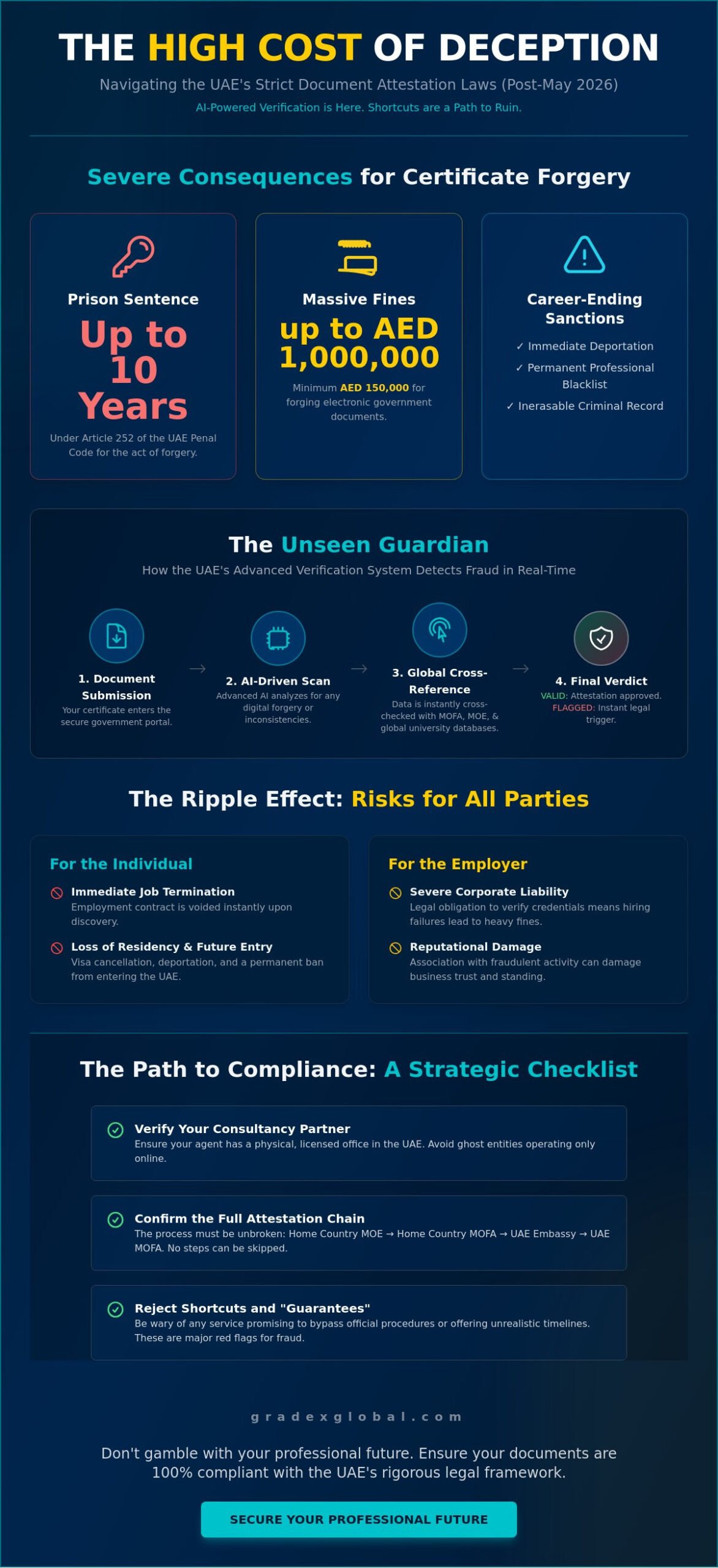
The submission of fraudulent credentials triggers a sequence of judicial actions that extend far beyond administrative rejection. Under the 2026 legal framework, the consequences of fake certificate attestation in uae involve a combination of punitive imprisonment and substantial financial liabilities. Public Prosecution evaluates these cases under Federal Decree-Law No. 31 of 2021, where the use of a forged official document can lead to temporary imprisonment for up to five years. If the forgery itself is attributed to the individual, Article 252 mandates sentences reaching ten years. These measures are designed to preserve the technical integrity of the nation’s labor market and professional standards.
Financial sanctions have become increasingly severe to deter the use of sophisticated AI-generated forgeries. Fines for such violations typically start at AED 30,000 but can escalate to AED 1,000,000 depending on the nature of the document and the intent behind its use. For instance, forging an electronic government document carries a minimum fine of AED 150,000 under Article 14 of Federal Decree Law No. 34 of 2021. These penalties reflect the state’s zero-tolerance policy toward any attempt to compromise the integrity of its digital and physical records. A criminal record of this nature doesn’t just end a career in the Emirates; it creates a permanent stain that complicates global travel and future employment in other jurisdictions.
Imprisonment and Financial Sanctions
Public Prosecution handles forgery cases with methodical precision, often initiating investigations immediately upon a report from the Ministry of Foreign Affairs or the Ministry of Education. Article 6 of Federal Law No. 9/2021 specifically targets academic degrees, where intentional submission can result in one year of imprisonment or fines up to AED 500,000. It’s vital to recognize that even accidental submission—resulting from negligence or hiring unverified third-party agents—doesn’t necessarily absolve an individual of legal responsibility. Employers also face secondary risks; failing to perform due diligence on a candidate’s credentials can lead to corporate fines and operational suspensions. Engaging with professional certificate attestation services ensures that every document meets the highest standards of technical precision and legal compliance.
Deportation and Lifetime Travel Bans
A criminal conviction for document fraud carries permanent administrative repercussions for expatriates. Once a judgment is rendered, the Ministry of Interior initiates the immediate cancellation of residency visas. This is followed by mandatory deportation under the grounds of “security and integrity” violations. Such convictions result in a lifetime entry ban, with the individual’s biometric data being blacklisted in the national database. This restriction often extends across the GCC through shared security protocols, preventing future employment or transit within the region. These bans are notoriously difficult to appeal, as they’re classified as threats to the public interest and the reliability of the UAE’s institutional systems.
How the UAE Verification System Detects Fraudulent Documents
The UAE’s regulatory infrastructure has undergone a fundamental transformation by mid-2026. Verification is no longer a manual inspection of paper fibers; it’s a digital-first protocol utilizing encrypted QR codes and electronic stamps that are cross-referenced against a centralized ledger. This technical shift means that physical documents are increasingly vulnerable if they don’t possess a corresponding digital twin in the government’s database. Any discrepancy between the physical ink and the digital record triggers an immediate investigation into the potential consequences of fake certificate attestation in uae.
Direct institutional links now exist between the UAE Ministry of Foreign Affairs (MOFA) and major international university databases. When a document is submitted, the system doesn’t just look at the stamp; it queries the issuing institution’s server to confirm the graduate’s records. This real-time synchronization makes it nearly impossible for “back-dated” or “shortcut” attestation stamps to pass through the system. These fraudulent markings are flagged the moment they’re scanned because they lack the cryptographic handshake required for official validation. Verification is now a matter of technical precision rather than subjective observation.
Intentional Forgery vs. Victimhood of Fraudulent Agents
The UAE legal system maintains a clear distinction between the act of creating a forgery and the act of using one. However, being a victim of a fraudulent agent doesn’t provide an automatic shield against prosecution. “Ignorance of the law” is rarely accepted as a valid defense in forgery cases. If you present a document with a fake stamp, the authorities treat the act as a violation of document integrity. Maintaining a meticulous paper trail of all communications with your consultancy is essential. This record serves as evidence that you sought legitimate services, though it may not entirely prevent the immediate consequences of fake certificate attestation in uae, such as visa delays or administrative audits.
Why Shortcut Services Pose the Greatest Risk
Professional attestation is a methodical process that respects international diplomatic timelines. A primary red flag is any agency offering a guaranteed “24-hour” turnaround for complex multi-country chains. These “shortcut” services often rely on sub-agents who use counterfeit stamps to bypass government fees and processing queues. The danger is absolute. A single fake stamp from a sub-agent can invalidate a perfectly genuine original degree, leading to its permanent confiscation. Once a document is marked as fraudulent within the UAE system, it’s effectively neutralized for all future professional use within the region.
Mitigating Risk: A Strategic Checklist for Safe Attestation
Strategic risk mitigation is the only path to ensuring long-term professional stability in the Emirates. Given the severe consequences of fake certificate attestation in uae, individuals must adopt a methodical approach to document verification. This isn’t merely about obtaining a stamp; it’s about validating the entire chain of custody for your credentials. A fragmented attestation chain, where even one link is bypassed or improperly executed, compromises the legal integrity of the entire document. Total compliance requires a verified sequence involving the home country’s authorities, the relevant UAE Embassy abroad, and the final Ministry of Foreign Affairs (MOFA) authentication within the UAE.
Technical precision in this process includes the integration of legal translation services. When documents originate in languages other than Arabic or English, they must be translated by a sworn translator licensed by the UAE Ministry of Justice. This ensures that the technical terminology and legal nuances of the original document are preserved accurately. Any discrepancy in translation can lead to rejection during the MOFA verification stage, potentially triggering an audit of the document’s authenticity. Maintaining a comprehensive paper trail, including receipts and communication logs, provides a necessary layer of protection against administrative errors.
Identifying Credible Attestation Partners
Selecting a consultancy requires rigorous due diligence. You must verify the physical presence and valid trade license of any agency before transferring original documents. A credible partner should demonstrate institutional relationships and a minimum of 15 years of operational history in the region. Transparency in pricing is a primary indicator of legitimacy. Official MOFA fees are fixed at AED 150 for personal documents and AED 2,000 for commercial certificates; any agency offering “negotiable” government fees or suspiciously low rates should be avoided. You can verify an agency’s registration through the relevant UAE economic departments to ensure they’re authorized to handle sensitive legal instruments. For those seeking absolute certainty, utilizing established professional certificate attestation services is the most secure method to maintain compliance.
The Final Step: MOFA Verification and E-Stamping
The final layer of security is the MOFA verification, which now utilizes digital e-stamping and QR code integration. You can use the official MOFA smartphone application to independently verify your own attestation status by scanning the digital mark on your document. This transparency allows you to confirm that your credentials meet the rigorous requirements for equivalence certificate processing. It’s also vital to understand that verification isn’t a one-time event. HR departments and government entities often perform periodic audits years after the initial hiring. If a document is found to be non-compliant during these retrospective checks, the consequences of fake certificate attestation in uae remain applicable, regardless of the time elapsed since the original submission.
Securing Your Professional Future with Grad-Ex Consultancy
Grad-Ex Consultancy stands as a pillar of stability within the UAE professional services sector, backed by a fifteen-year history of technical precision. We recognize that the consequences of fake certificate attestation in uae represent a definitive threat to both individual careers and corporate reputations. Our operations are designed to eliminate these risks through a rigorous, end-to-end compliance framework that prioritizes legal integrity over administrative speed. By maintaining deep institutional relationships with the Ministry of Foreign Affairs and international diplomatic missions, we navigate the complexities of government requirements with a level of control that shortcut providers cannot replicate.
Our methodology centers on technical independence and absolute transparency. Unlike decentralized agents who may utilize unverified sub-contractors, Grad-Ex manages every stage of the attestation chain through our own established resources. This internal control ensures that every document undergoes a multi-point verification process before submission. We strictly adhere to government-mandated fee structures, providing clients with fixed-fee transparency that removes the ambiguity often associated with fraudulent entities. This commitment to procedural accuracy is why major corporate entities trust us to secure their most sensitive legal instruments.
Expert Strategic Advisory for Expatriates and Businesses
We provide more than simple document handling; we offer strategic advisory services that facilitate sustainable growth. Our Education Consultancy Services assist professionals in aligning their academic credentials with UAE labor laws, ensuring they remain protected from the severe consequences of fake certificate attestation in uae. For corporate clients, our suite extends to Business Setup & Ejari Services and UAE Authority Approvals. This comprehensive approach allows us to manage the entire lifecycle of professional integration, from the initial Certificate Attestation to final trademark registration.
Initiating Your Compliance Journey
Securing your professional standing begins with a preliminary document audit conducted by our senior consultants. We evaluate the current status of your credentials and identify any potential gaps in the attestation chain. For businesses with ongoing requirements, we offer tiered subscription models, including our Basic, Standard, and Premium Plans, to provide consistent regulatory oversight. These plans are designed for entities that prioritize stability and long-term compliance over temporary fixes. Contact Grad-Ex Consultancy today to ensure your documents meet the highest standards of technical and legal validity.
Protecting Your Professional Trajectory in the Emirates
The UAE’s transition toward advanced digital verification makes the submission of unverified documents an unsustainable risk. As we explored, the legal and administrative consequences of fake certificate attestation in uae include severe criminal penalties and the permanent loss of residency status. Maintaining document integrity is no longer a choice; it’s a foundational requirement for any expatriate or business operating within this jurisdiction. The move toward real-time synchronization with international databases means that shortcuts are easily detected and strictly penalized.
Securing your future requires a partner with technical precision and deep institutional knowledge. Grad-Ex Consultancy brings over 15 years of strategic advisory experience and established relationships across UAE ministries to ensure your credentials meet every regulatory standard. We provide fixed-fee document processing that eliminates the uncertainty and danger of unverified shortcut providers. Consult Grad-Ex for Secure and Verified Attestation Services to guarantee your professional longevity. Your commitment to compliance today builds the stability you need for a successful and prosperous career tomorrow.
Frequently Asked Questions
What is the penalty for using a fake degree for a UAE visa in 2026?
The penalty for submitting a fraudulent academic degree involves up to five years of temporary imprisonment under Article 253 of the UAE Penal Code. Additionally, Federal Law No. 9/2021 mandates fines reaching AED 500,000 for the intentional use of degrees from non-licensed entities. These measures reflect the state’s rigorous approach to maintaining the technical integrity of its labor market and professional standards.
Can I be deported for an accidental fake certificate attestation?
Yes, deportation is a standard administrative consequence for any document fraud conviction, regardless of whether the individual claims the error was accidental. The UAE legal system rarely accepts “ignorance of the law” as a valid defense in forgery cases. Convictions typically lead to immediate residency visa cancellation and a mandatory exit on the grounds of security and integrity violations.
How do UAE authorities check if a degree is genuine?
UAE authorities utilize a sophisticated digital infrastructure that includes encrypted QR codes, electronic stamps, and AI-driven verification protocols. The Ministry of Foreign Affairs maintains direct institutional links with international university databases to cross-reference graduate records in real-time. This synchronization ensures that any physical document without a verified digital twin in the government ledger is flagged immediately during processing.
What should I do if I suspect my attestation agency used a fake stamp?
You should immediately halt any visa or equivalency applications and verify the document’s status through the official MOFA smartphone application. If the scan doesn’t return a verified digital record, the stamp is likely counterfeit. Maintaining a meticulous paper trail of your communication with the agency is vital for your defense, as it helps establish that you sought legitimate services from a third party.
Does a fake certificate result in a lifetime ban from the UAE?
A conviction for document forgery results in a permanent entry ban and blacklisting within the national and GCC-wide security databases. This restriction is classified under security violations, making it nearly impossible to reverse through administrative appeals. The consequences of fake certificate attestation in uae thus extend far beyond immediate legal penalties, permanently impacting your professional mobility and global travel rights.
Are employers held responsible if an employee submits a forged document?
Employers hold a clear legal responsibility to verify the authenticity of their employees’ academic credentials before recruitment. Under Federal Decree Law No. 33 of 2021, an employer can dismiss an employee immediately without notice if they’re found to have submitted forged documents. Failure to perform this due diligence can also expose the company to corporate fines and potential operational suspensions by the Ministry of Human Resources.
How can I verify my MOFA attestation is authentic?
You can verify the authenticity of your MOFA attestation by utilizing the official digital verification portal or the MOFA mobile application. By scanning the QR code or entering the document’s reference number, you’ll receive an immediate confirmation of its digital twin in the government ledger. This process ensures that your document meets the technical standards required for successful visa processing and long-term residency.
What is the difference between a fake degree and a fake attestation?
A fake degree refers to a fraudulent academic credential from a non-existent or unaccredited institution, while a fake attestation involves applying counterfeit government stamps to a genuine document. Both actions constitute document forgery under the UAE Penal Code and carry similar legal weight. In either scenario, the consequences of fake certificate attestation in uae involve imprisonment, heavy fines, and mandatory deportation from the country.