
A rejected document from the Ministry of Foreign Affairs is rarely a reflection of the document’s authenticity; instead, it represents a systemic failure in the chain of institutional verification and digital compliance. Many professionals find that the primary reasons for mofa rejection uae stem from a lack of technical precision during the preliminary stages of authentication. The unexpected suspension of visa processing or the loss of a critical employment opportunity due to a procedural oversight is a professional risk that carries significant administrative weight. These delays often introduce hidden costs and institutional confusion that can jeopardize long-term career or corporate objectives.
This expert guide identifies the critical pitfalls leading to document denial and provides the strategic steps necessary to ensure a seamless outcome. You’ll gain a clear understanding of the specific errors that trigger rejections, from incomplete prior attestations to the requirements of the current digital-only submission framework. By analyzing the roadmap to rectify errors and identifying a reliable partner for Certificate Attestation, you can navigate the institutional complexity of the UAE with confidence and professional stability.
Key Takeaways
- Identify the mandatory sequence of prerequisite attestations required from the issuing country to ensure documents meet UAE legal and security standards.
- Gain a technical understanding of the primary reasons for mofa rejection uae, focusing on information mismatches and the requirements of the 2026 digital submission framework.
- Learn to navigate document-specific triggers, including university accreditation for educational certificates and precise legal translation standards for personal records.
- Establish a robust pre-submission protocol involving a multi-point audit of all stamps and signatures to prevent administrative delays and the costs of re-submission.
- Understand the strategic advantage of leveraging specialized expertise in Certificate Attestation to manage institutional complexity and maintain procedural compliance.
Understanding UAE MOFA Attestation and the Strategic Significance of Compliance
MOFA attestation serves as the definitive legal confirmation for any foreign document intended for use within the Emirates. It is the terminal point of a rigorous validation process that transforms a foreign instrument into a legally recognized asset. The UAE Ministry of Foreign Affairs manages this protocol to safeguard the integrity of the nation’s legal and security framework. By 2026, the transition to a fully digital, UAE PASS-integrated system has increased the demand for technical precision. Any minor discrepancy in the digital file or the physical stamp sequence can lead to an immediate refusal. Understanding the primary reasons for mofa rejection uae is essential for anyone seeking residency or corporate establishment, as the system now operates with automated verification triggers that leave no room for administrative error.
The Legal Framework of Document Legalization
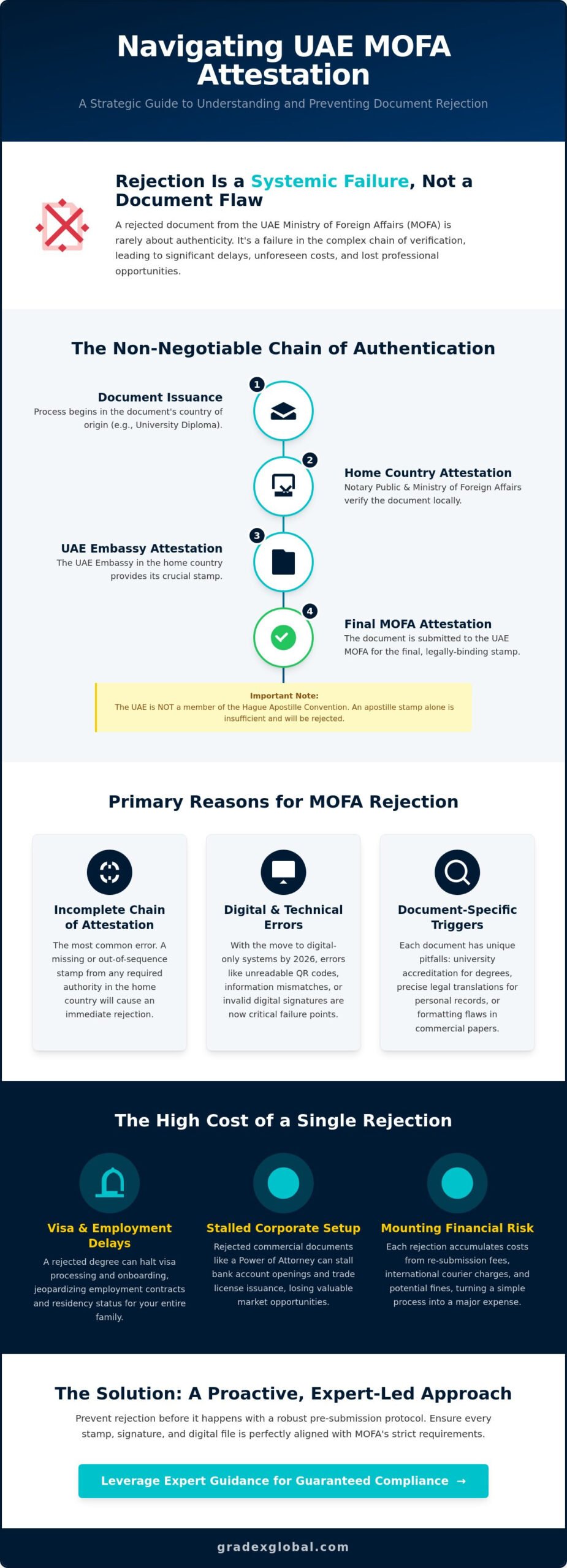
The legalization process follows a strict institutional hierarchy that cannot be bypassed. This chain of command typically originates at a Notary Public in the document’s country of origin, followed by authentication from the home country’s Ministry of Foreign Affairs and the UAE Embassy located there. It’s a common misconception that the UAE adheres to the Hague Apostille Convention. Since the UAE is not a member of this treaty, an apostille stamp alone is insufficient for legal use. Every foreign-issued certificate must undergo the full multi-stage legalization process to be accepted by local authorities. The Chain of Authentication is a non-negotiable legal requirement that ensures every institutional actor in the document’s history has verified its contents.
Economic and Professional Implications of Rejection
A rejection from MOFA is not merely an administrative setback; it’s a significant disruption to professional and commercial momentum. For businesses, a failed attestation for an Article of Association or a Power of Attorney can stall corporate bank account openings and the issuance of trade licenses for weeks. These delays often result in lost market opportunities and mounting operational costs. On a personal level, the reasons for mofa rejection uae often impact the stability of employment contracts and the residency status of family members. If a degree certificate is rejected, the associated work permit cannot be processed, which may lead to the immediate suspension of onboarding procedures. The financial loss associated with re-submitting documents and paying for expedited courier services can be substantial, especially when dealing with international jurisdictions. Maintaining compliance through technical accuracy is the only way to guarantee the stability of your professional standing in the UAE.
- Visa Processing: Delays in attestation directly correlate to delays in residency visa issuance.
- Corporate Setup: Unverified commercial documents prevent the legal execution of business contracts.
- Financial Risk: Re-submission fees and international courier costs accumulate quickly after a rejection.
Primary Technical and Administrative Reasons for MOFA Rejection
The institutional landscape of document legalization has evolved into a highly technical environment where administrative precision is mandatory. In 2026, the primary reasons for mofa rejection uae have shifted from simple missing stamps to complex digital synchronization errors. While the core legal requirements remain, the method of verification now relies heavily on automated systems that cross-reference document data against international databases in real time. A failure to align physical documentation with digital records often results in an immediate suspension of the application, necessitating a complete restart of the process.
Digital Verification and eDAS 2.0 Errors
The implementation of eDAS 2.0 has introduced a layer of digital scrutiny that many applicants overlook. Automated systems now scan for QR code readability and the validity of digital signatures embedded by foreign ministries. If a digital signature has expired or the QR code leads to a broken link on the issuing authority’s portal, the system triggers a rejection. One of the most frequent issues is the “Physical Attestation Pending” status. This occurs when the digital application is submitted, but the physical document arriving via courier does not perfectly match the uploaded scan in resolution or orientation. Following the official attestation requirements is the only way to ensure that file formats and metadata comply with the UAE’s rigorous security standards.
Institutional Chain Failures
A common point of failure in the legalization process is the omission of the UAE Embassy stamp in the document’s country of origin. Many professionals incorrectly assume that a Ministry of External Affairs (MEA) or a national-level foreign ministry stamp is the final requirement before submitting to the UAE. The UAE Ministry of Foreign Affairs will not attest any document that has not been first verified by its own diplomatic mission abroad. This institutional link is critical. Furthermore, regional or state-level authentication must be completed before the national-level stamp is applied. If this hierarchical sequence is broken, the document is considered legally incomplete. To mitigate these risks, many organizations utilize professional Certificate Attestation services to audit the document chain before final submission.
Administrative rejections also stem from information mismatches. If the name on a marriage certificate or degree does not match the passport exactly, including middle names or specific spellings, the application is denied. Expired documents represent another significant hurdle. While some certificates are “permanent,” certain commercial documents and police clearance certificates have a limited validity period, often ranging from three to six months. Submitting a document that has exceeded this window is among the leading reasons for mofa rejection uae in the current year. Maintaining a strict timeline for each stage of the authentication process is vital for successful compliance.
- Information Mismatch: Discrepancies between document text and UAE PASS profile data.
- Chain Interruption: Missing the mandatory UAE Embassy verification from the issuing country.
- Digital Integrity: Low-resolution scans or corrupted PDF files that fail eDAS 2.0 automated checks.
- Validity Windows: Using documents that have surpassed their institutional expiration dates.
Document-Specific Rejection Triggers: Educational, Personal, and Commercial
Document-specific nuances often represent the most complex reasons for mofa rejection uae because they require domain-specific knowledge beyond simple administrative procedures. While the technical chain of command is essential, the internal validity of the document’s content is equally scrutinized. Each category, whether educational, personal, or commercial, possesses unique regulatory hurdles that can stall an application even if the stamps appear correct. These rejections usually stem from a mismatch between the document’s purpose and the UAE’s specific institutional standards.
Educational Certificates and the Equivalency Factor
Educational documents face some of the most stringent verification protocols within the Emirates. A common trigger for rejection is the lack of university accreditation. The UAE Ministry of Education maintains a specific list of recognized global institutions; if your degree originates from an unapproved university, MOFA will refuse the attestation. In addition, the UAE Equivalence Certificate guide details how certain professional roles require this secondary verification before MOFA will proceed with final validation. Applicants often fail because they submit only the degree certificate, neglecting the mandatory original transcripts that prove the academic history. Without these supporting documents, the system’ll flag the application as incomplete.
Personal documents like marriage or birth certificates require precise linguistic accuracy. Any certificate not issued in Arabic or English must undergo legal translation. This isn’t a standard translation service; it must be performed by a translator licensed by the UAE Ministry of Justice. Utilizing the UAE Ministry of Foreign Affairs (MOFA) Attestation Service portal helps verify which channels accept specific translation formats. Errors in name spellings or date formats between the original and the translation are frequent reasons for mofa rejection uae that lead to immediate denial. Ensuring that Global Translation Services are handled by approved professionals is the only way to maintain document integrity.
Commercial and Business Document Pitfalls
Commercial documents involve a different set of institutional actors and more complex formatting requirements. Trade documents, such as commercial invoices or Board Resolutions, must be stamped by the Chamber of Commerce in the issuing country before reaching the national ministry. A common pitfall for corporate entities is the formatting of a Power of Attorney (POA). If the POA lacks specific clauses required for UAE business setup or doesn’t explicitly name the authorized representative as per their passport, the application’s rejected. These documents often require “True Copy” attestation if the original cannot be submitted, which adds another layer of complexity to the institutional chain. Professional Certificate Attestation for commercial files ensures that every corporate instrument meets the specific requirements of the UAE authorities.
- University Accreditation: Degrees from unapproved institutions are ineligible for MOFA stamps.
- MOJ Translation: Only Ministry of Justice approved translators are recognized for legal documents.
- Chamber Verification: Commercial documents must originate from a verified Chamber of Commerce.
- POA Nuances: Incorrectly worded Powers of Attorney are a leading cause of corporate application failure.
How to Successfully Overcome and Prevent MOFA Attestation Rejections
Achieving a successful attestation outcome requires more than just submitting paperwork; it demands a proactive strategy centered on procedural accuracy. Most reasons for mofa rejection uae are preventable through a rigorous pre-submission audit that identifies administrative gaps before they reach the Ministry’s digital portal. By adopting a methodical approach to document preparation, you can transform a complex institutional requirement into a predictable administrative milestone. Prevention of these delays is a hallmark of professional planning and technical foresight.
The Pre-Submission Audit Checklist
A comprehensive audit acts as the final gatekeeper for your documents. It’s essential to verify that the hierarchy of stamps is complete and legible. The system’ll reject any document where the primary verification chain is broken or where digital metadata doesn’t align with physical evidence. Before initiating the online application, ensure every item on this checklist is verified.
- Institutional Verification: Confirm the presence of the UAE Embassy stamp from the issuing country, as this is the most critical prerequisite for local MOFA acceptance.
- Data Alignment: Cross-reference name spellings, passport numbers, and dates across all supporting documents to ensure absolute consistency.
- Digital Accessibility: Test all QR codes on foreign ministry stamps to confirm they link to active, verifiable databases.
- Physical Integrity: Ensure the document isn’t laminated, as lamination prevents the application of mandatory UAE security stickers and ink stamps.
Strategic Timing and Translation Protocols
The sequence of your actions is just as important as the actions themselves. A common error is performing legal translation before securing the necessary home country stamps. In the UAE, the Ministry of Justice approved translation must reflect the final, fully-stamped version of the document. If you translate the document prematurely, the translation’ll lack the verification of the final embassy stamps, leading to a rejection. Securing professional Certificate Attestation services ensures that this sequence is managed with technical precision, eliminating the risk of redundant costs and missed deadlines.
Corrective Actions Post-Rejection
If you encounter a denial, the first step is to analyze the specific rejection code provided within the MOFA smart app or web portal. These codes often indicate whether the issue is a missing prerequisite or a technical file error. A MOFA rejection is a diagnostic tool, not a final verdict, provided you understand the underlying administrative gap. While fees are generally non-refundable for rejected applications, understanding the specific cause allows for a targeted fix. This prevents a cycle of expensive re-submissions and ensures your next application meets the 2026 compliance standards. Consulting with a strategic advisory firm can help navigate these institutional relationships and resolve complex disputes with the authorities.
Strategic Document Management: Leveraging Grad-Ex Consultancy for Guaranteed Compliance
Managing the validation of foreign documents within the UAE is a process defined by institutional complexity and a zero-tolerance policy for administrative errors. Grad-Ex Consultancy brings over 15 years of experience in navigating the specific requirements of UAE government ministries, providing a layer of stability that individual applicants often lack. By leveraging deep-seated institutional relationships, we ensure that every document is pre-vetted against the latest 2026 standards before it ever reaches a digital portal. This level of technical oversight is the most effective way to eliminate the primary reasons for mofa rejection uae, such as digital signature mismatches or broken chains of authentication. Our fixed-fee model provides additional security, removing the financial risk of multiple re-submissions that often plague unguided applications.
Why a Strategic Partner is Essential
The administrative burden of coordinating with multiple government bodies across different time zones is a significant hurdle for global professionals and corporate entities. Grad-Ex Consultancy acts as a single point of technical contact, managing the process from the home country to the final MOFA stamp in the UAE. We don’t rely on external vendors for critical steps; instead, we handle Global Translation Services and Online Notary requirements internally to maintain control over document integrity. This technical independence ensures that the legal translation is performed only after all prerequisite stamps are secured, preventing the sequencing errors that lead to immediate refusal. It’s this methodical approach that provides our partners with the peace of mind necessary to focus on their core commercial or professional objectives.
Beyond Attestation: Holistic Business and Personal Support
Our expertise extends beyond simple document validation to include a comprehensive suite of services designed for seamless integration into the UAE’s economic environment. We understand that attestation is often just one component of a larger project, such as a company launch or a family relocation. To support these goals, Grad-Ex Consultancy provides end-to-end management that includes Business Setup & Ejari Services, UAE Authority Approvals, and visa processing assistance. Our global reach, combined with local expertise in the GCC market, allows us to handle complex cross-border requirements with the same precision we apply to local administrative tasks. When you choose a strategic partner, you’re not just buying a service; you’re securing a guarantee of quality and professional longevity.
Contact Grad-Ex Consultancy for expert attestation support to ensure your documents are handled with the technical precision and institutional authority required for success in the Emirates.
Securing Your Professional Future through Institutional Precision
The evolution of document legalization in the Emirates necessitates a shift from manual submission to technical compliance management. Identifying the multifaceted reasons for mofa rejection uae is the primary step toward mitigating the risks of visa delays and corporate disruption. Success in the 2026 digital environment depends on adhering to the mandatory sequence of institutional stamps and ensuring digital integrity through eDAS 2.0 standards. By following a structured audit process, you can navigate the administrative landscape with confidence and professional stability.
Grad-Ex provides the technical precision and stability required to master this complexity. With over 15 years of UAE institutional expertise and a comprehensive GCC market strategic advisory, we ensure your documents meet every regulatory benchmark. Our fixed-fee service model eliminates the financial risk of multiple re-submissions, providing a transparent and predictable path to successful attestation. You can rely on our established institutional relationships to handle the most complex verification chains with absolute accuracy. Your professional transition deserves the security of a partner who understands the intricacies of the UAE’s legal framework.
Secure your seamless document attestation with Grad-Ex today
Frequently Asked Questions
What are the most common reasons for MOFA rejection in the UAE?
The primary reasons for mofa rejection uae include missing prerequisite stamps from the home country’s Ministry of Foreign Affairs or the UAE Embassy abroad. Additionally, discrepancies in name spellings between the certificate and passport or illegible QR codes on digital attestations often trigger automated refusals. Technical precision in the preliminary stages is the only way to avoid these administrative setbacks and ensure the document’s legal validity within the Emirates.
Can I re-apply for MOFA attestation after a rejection?
You can re-apply for attestation immediately after the specific cause for the initial rejection has been addressed. The Ministry’s system provides a diagnostic code that identifies the administrative gap, such as a missing prerequisite or a formatting error. Once the document is updated with the correct stamps or corrected data, the application can be re-submitted through the official digital portal for a new round of verification.
Do I have to pay the MOFA fee again if my document is rejected?
MOFA fees are non-refundable, so a new payment is required for every new application submission. This institutional policy emphasizes the importance of performing a multi-point audit before the initial filing to avoid redundant costs. Since each document processing attempt utilizes government resources and digital verification systems, the applicant bears the financial responsibility for ensuring the document’s compliance with current 2026 standards before payment is finalized.
Why is my digital attestation through eDAS 2.0 showing as pending?
A “pending” status in the eDAS 2.0 system typically indicates that the physical document hasn’t yet been synchronized with the digital application. This often happens if the courier service hasn’t delivered the document to the processing center or if the scanned metadata doesn’t perfectly match the physical instrument. Ensuring that the high-resolution scan uploaded during the application is identical to the physical document helps the automated system complete the verification.
Will MOFA accept a laminated document for attestation?
MOFA won’t attest any document that is laminated. Lamination creates a physical barrier that prevents the application of mandatory ink stamps and security stickers required for legal recognition. If a document is already laminated, you must obtain a duplicate original from the issuing authority or have the lamination professionally removed, though removal carries the risk of damaging the paper and rendering it illegible for verification.
Is a legal translation required before or after the UAE Embassy stamp?
Legal translation must be performed only after the document has secured all mandatory stamps from the issuing country and the UAE Embassy located there. The translation must include all stamps and signatures present on the original document to be considered legally complete. If the translation is done prematurely, it won’t reflect the final authentication chain, which is one of the technical reasons for mofa rejection uae frequently encountered by applicants.
How long does it take to fix a rejected MOFA application?
The timeline to rectify a rejection depends on the nature of the error, but it typically adds three to five working days to the standard process. If the rejection involves missing a home country stamp, the document must be sent back to the country of origin, which significantly extends the delay. Proactive verification of the institutional chain is the most efficient way to maintain your professional and commercial schedules without unnecessary interruptions.
Can I attest a copy of my certificate if the original is lost?
MOFA doesn’t attest standard photocopies; however, a “True Copy” can be processed if it’s authenticated by the issuing institution or an authorized notary public. This copy must follow the same legalization chain as an original document, including stamps from the home country’s foreign ministry and the UAE Embassy. For educational documents, it’s often more reliable to request a duplicate original from the university to ensure institutional compliance with UAE standards.