
Technical precision in document attestation is the only factor that separates a successful residency application from a costly, time-consuming rejection. Most expatriates recognize that the administrative landscape in the UAE requires a methodical approach, yet the complexity of cross-border verification often leads to avoidable delays. Getting documents ready for uae family visa sponsorship involves managing a multi-jurisdictional chain of custody where a single missing stamp can reset the entire timeline. It’s a process that leaves no room for error, especially when entry permits carry strict expiration dates.
You understand that securing your family’s future requires more than just meeting the AED 4,000 minimum salary threshold; it demands a flawlessly executed documentation strategy. This comprehensive 2026 guide provides a definitive roadmap to master the multi-step attestation process, covering everything from marriage certificates to the updated age limits for sponsoring sons up to 25. We will outline the exact sequence of embassy and Ministry of Foreign Affairs (MOFA) verifications required to ensure your submission is accepted without revision by the GDRFA or ICP. By following this structured framework, you can eliminate the high costs of re-doing paperwork and establish a stable foundation for your family in the Emirates.
Key Takeaways
- Understand the 2026 regulatory framework and how digital integration via ICP and GDRFA portals has streamlined the legal privilege of family sponsorship.
- Master the precise multi-jurisdictional attestation sequence required to give foreign birth and marriage certificates legal standing within the UAE.
- Utilize a structured checklist for getting documents ready for uae family visa sponsorship, ensuring all dependent records undergo mandatory legal translation.
- Eliminate the primary causes of visa rejection by aligning your documentation with current Ministry of Foreign Affairs and educational verification standards.
- Discover how professional management of the international attestation chain provides a technical advantage in meeting strict entry permit deadlines.
Understanding the Framework of UAE Family Visa Sponsorship
Sponsoring family members in the Emirates isn’t an automatic right; it’s a legal privilege granted to residents who meet specific professional and financial criteria. This privilege operates within the broader UAE Visa Policy Framework, which has undergone significant modernization to prioritize digital integration and administrative efficiency. In 2026, the regulatory environment focuses on the sponsor’s ability to provide a stable environment for dependents, shifting the emphasis from specific job titles to verifiable income and housing benchmarks.
The process is divided into two distinct legal phases: the entry permit and the residence visa. The entry permit serves as a temporary authorization, allowing family members to enter the country to finalize their administrative status. This is not the final residence visa, which is only granted after the successful completion of medical fitness tests and mandatory health insurance enrollment. Experience demonstrates that getting documents ready for uae family visa sponsorship is the most time-intensive phase of the entire lifecycle. While government approvals often take days, the international verification of certificates can take weeks of coordination across multiple jurisdictions.
Sponsor Eligibility and Salary Thresholds
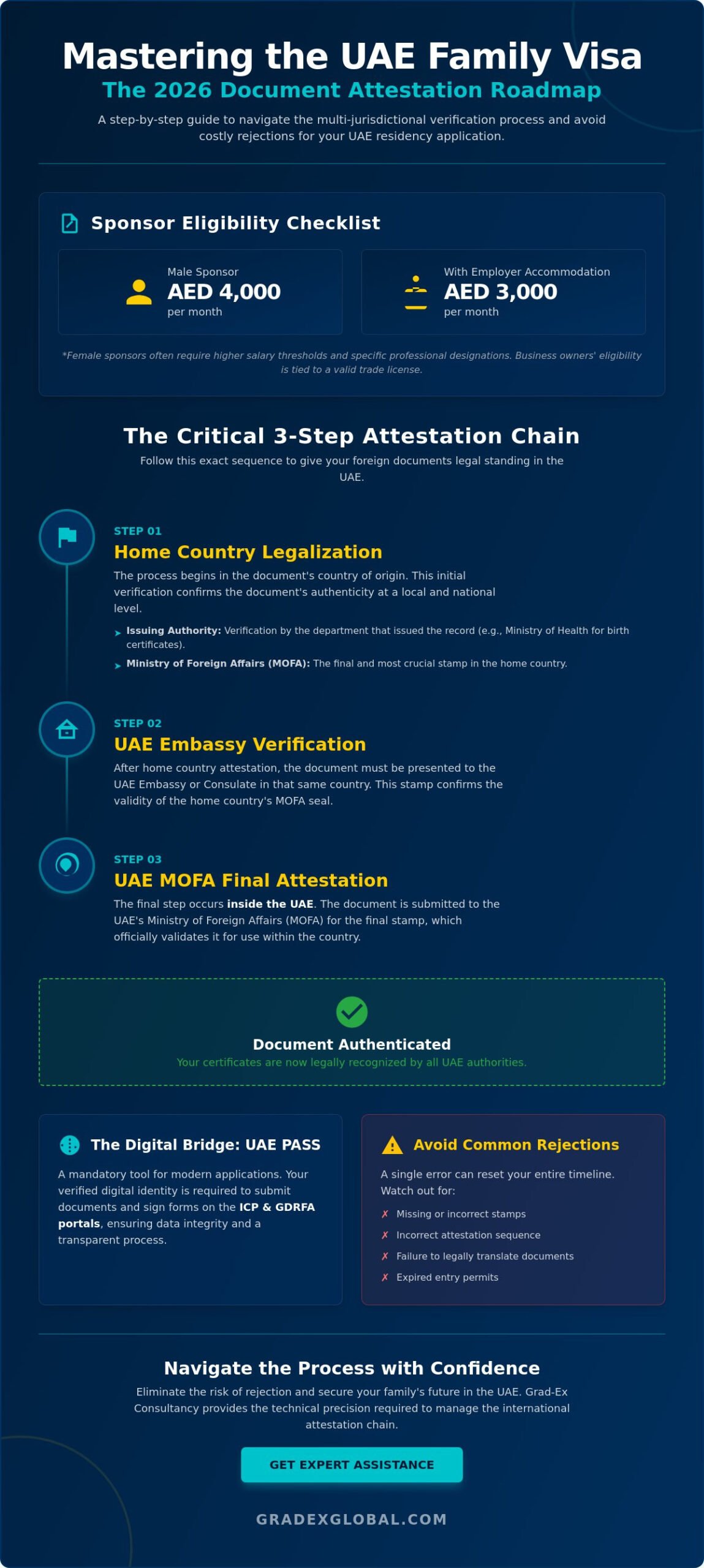
A male resident must demonstrate a minimum monthly salary of AED 4,000, or AED 3,000 if the employer provides documented accommodation. These figures represent the absolute baseline for sponsorship. Female sponsors often operate under different criteria, frequently requiring higher salary thresholds and specific professional designations to qualify. For business owners and investors, eligibility is tied to the validity of their trade license and proof of company ownership. It’s essential to understand that accommodation allowances are only factored into the total calculation when supported by a registered Ejari or employment contract.
The Role of Digital Identity (UAE Pass)
The UAE Pass has revolutionized the administrative landscape by centralizing document submission through a secure digital identity. It’s no longer just a convenience; it’s a requirement for sponsors to provide verified digital signatures on electronic forms. This transition from physical paperwork to digital verification within the ICP and GDRFA portals ensures higher data integrity and reduces the risk of fraud. Sponsors must ensure their digital profiles are fully upgraded to the ‘verified’ status to access the full suite of residency services. This digital shift ensures that once the technical preparation of documents is complete, the final submission process remains efficient and transparent.
The Attestation Chain: Getting Documents Ready Internationally
A foreign document possesses no inherent legal validity within the United Arab Emirates until it has successfully navigated a rigorous, multi-jurisdictional verification sequence. This technical hurdle is the primary reason why getting documents ready for uae family visa sponsorship is often perceived as the most complex phase of the relocation lifecycle. Without a complete attestation chain, authorities cannot verify the authenticity of birth or marriage certificates, leading to immediate rejection of the Official GDRFA Dubai Family Visa Process application. Success requires a methodical adherence to a specific order of operations that begins in the document’s country of origin.
Step 1: Home Country Legalization
The process initiates with local verification, typically involving a public notary or the department that originally issued the record, such as the Ministry of Health for birth certificates. For educational credentials, this often necessitates approval from the national Ministry of Education before progressing to the Ministry of Foreign Affairs (MOFA) in the home country. While the Hague Apostille serves as a simplified verification for member states, the UAE mandates a comprehensive attestation sequence that involves multiple levels of government and diplomatic seals. This ensures the document’s integrity is preserved as it moves through the international chain of custody.
Step 2: UAE Embassy Attestation Abroad
Once the home country’s MOFA has verified the document, it must be presented to the UAE Embassy or Consulate within that same jurisdiction. This diplomatic stamp confirms that the previous signatures are legitimate according to UAE standards and is a non-negotiable requirement for all foreign-issued papers. In regions where no direct UAE diplomatic mission exists, documents are typically routed through a designated neighboring mission or a specialized Certificate Attestation partner to bridge the geographical gap. International courier timelines for this stage generally fluctuate between seven to fifteen business days depending on the efficiency of the local mission and the complexity of the verification.
Step 3: UAE MOFA Final Verification
The final link in the chain occurs within the Emirates through the Ministry of Foreign Affairs. While the UAE has introduced digital MOFA attestation via official government portals to streamline the experience, certain document types still require a physical verification stamp to be recognized by the GDRFA or ICP. It’s critical to remember that while the attestation itself doesn’t technically expire, certain supporting documents like police clearance certificates often carry a strict 90-day validity window from the date of the final stamp. Maintaining this technical timeline is essential for getting documents ready for uae family visa sponsorship without incurring the costs of document expiration. Precise coordination ensures that the entry permit application can proceed immediately upon the document’s arrival in the UAE.
Core Document Checklist for Dependents and Sponsors
Successfully getting documents ready for uae family visa sponsorship requires a meticulous classification of records into two primary categories: sponsor credentials and dependent status certificates. While the previous phase focused on the international attestation chain, this stage demands the consolidation of local UAE-issued records with verified foreign documents. Precision here is vital. Any discrepancy between the names on a labor contract and a marriage certificate can trigger an immediate system flag, stalling the application before it reaches the review stage. Expatriates often find that a Comprehensive Guide to UAE Family Visas helps clarify the interplay between housing and residency, particularly regarding the foundational role of the tenancy contract.
A critical technical requirement often overlooked is the necessity of legal translation. If the original attested document is not in Arabic or English, it must undergo Global Translation Services by a sworn translator recognized by the UAE Ministry of Justice. This ensures that the GDRFA and ICP officers can verify the legal standing of the relationship without ambiguity. Additionally, the Ejari (registered tenancy contract) serves as the physical proof of the sponsor’s ability to house the dependents. Without a valid Ejari or a title deed in the sponsor’s name, the application lacks the essential infrastructure required for approval.
Sponsor’s Mandatory Documentation
The sponsor must provide a verified set of personal and professional records to establish their eligibility. This includes the original Emirates ID and a high-resolution copy of the current residency visa. Employment status is verified through a Labor Contract for private sector employees or a formal Salary Certificate for those in government or Free Zone jurisdictions. Business owners must substitute these with company trade licenses and proof of shareholding. Finally, the registered Ejari must be present to confirm that the living arrangements meet the government’s space requirements for the number of dependents being sponsored.
Dependent’s Specific Requirements
Each dependent requires a passport with at least six months of validity. The core of the application rests on the attested marriage certificate for spouses and birth certificates for children, which prove the legal relationship to the sponsor. For all dependents over the age of 18, a medical fitness certificate from a government-approved center is mandatory. It’s important to note that getting documents ready for uae family visa sponsorship for parents or siblings involves higher complexity. These cases usually require a minimum salary of approximately AED 20,000 and the provision of a security deposit for each dependent, reflecting the increased financial responsibility involved in extended family sponsorship.
Avoiding Common Rejections in the Sponsorship Process
Administrative rejection in the UAE residency process is rarely the result of a single missing document; rather, it typically stems from a failure in technical execution. When getting documents ready for uae family visa sponsorship, the primary cause of failure is an incorrectly sequenced attestation chain. If a document receives the UAE Ministry of Foreign Affairs stamp before the home country’s UAE Embassy seal, the entire record is deemed invalid for residency purposes. This methodical requirement ensures that every signature in the chain of custody is verified by the preceding authority, leaving no room for administrative ambiguity.
Specific attention must be directed toward mother-sponsored applications. While the UAE has increased flexibility for female sponsors, a No Objection Certificate (NOC) from the father remains a critical legal requirement in most jurisdictions. This NOC must often be notarized and attested to carry legal weight. Additionally, sponsors must manage the transition of family members already within the country on tourist visas. Failure to adjust their status before the entry permit expires leads to overstay penalties that must be cleared before the residency visa can be stamped. For newborns, this timeline is even stricter: a residence visa must be applied for within 120 days of birth to avoid cumulative fines.
Technical Discrepancies and Name Matching
Precision is mandatory. A single character difference between a passport and a birth certificate can halt the entire administrative workflow. In cases where international documents contain minor spelling variations or missing middle names, authorities often require a ‘One and the Same’ certificate or a formal affidavit. These legal instruments serve as technical bridges, confirming that the different name variations refer to the same individual. Ensuring that all dates on attested certificates match the digital data provided in the ICP or GDRFA portals is essential for a zero-rejection submission. Any mismatch between physical stamps and digital entries will trigger an automated system flag.
Accommodation and Space Requirements
The UAE government maintains specific standards for living conditions to ensure the welfare of sponsored dependents. In many jurisdictions, a one-bedroom apartment is the minimum requirement for sponsoring a spouse and children. If your housing is company-provided and the Ejari is not in your personal name, you must provide a formal letter from the employer, attested by the relevant authority, confirming the accommodation details. Certain professional benefits or visa categories may also require you to provide an equivalence certificate to prove your educational standing meets the required professional tier. If you are facing complex documentation hurdles, securing professional UAE Authority Approvals can ensure your application aligns perfectly with 2026 regulatory standards.
Professional Facilitation: Why Grad-Ex Consultancy is Your Strategic Partner
Mastering the administrative requirements for residency is a task that demands institutional knowledge and technical precision. For over 15 years, Grad-Ex Consultancy has cultivated deep-rooted relationships with UAE ministries and international diplomatic missions, providing a stable foundation for expatriates who cannot afford administrative delays. Getting documents ready for uae family visa sponsorship is a process fraught with jurisdictional friction; our role is to eliminate that friction through a controlled, methodical workflow. By integrating Global Translation Services and Online Notary Services into a single operational chain, we ensure that every document is legally fortified before it reaches the GDRFA or ICP review stage.
Our organization operates on a fixed-fee model that prioritizes transparency and predictability. This structural approach protects our clients from hidden government service surcharges or the fluctuating costs of international courier services. We don’t just facilitate paperwork; we provide a technical infrastructure that manages the entire lifecycle of a document’s verification. This includes International Notary & True Copy Attestation for those who require certified copies of sensitive records without risking the original certificates. Our commitment to technical independence ensures that Grad-Ex Consultancy maintains total control over the verification process from the moment a document is collected until it’s ready for submission.
Our End-to-End Attestation Solution
We manage the entire logistical lifecycle of your documents, including secure pickup and delivery across national boundaries. Grad-Ex Consultancy ensures that birth and marriage certificates move through home-country ministries and UAE embassies with zero administrative gaps. Clients benefit from a structured tracking system that provides full visibility into the document’s progress through the international attestation chain. This level of technical oversight is essential for getting documents ready for uae family visa sponsorship within the narrow windows provided by entry permits. By coordinating directly with foreign missions, we eliminate the need for sponsors to navigate foreign bureaucracies independently.
Strategic Consultancy for Complex Cases
Certain sponsorship scenarios, such as bringing parents or step-children to the UAE, require a higher tier of strategic planning due to increased salary thresholds and security deposit requirements. Our consultants provide expert guidance on these specific legal prerequisites, ensuring that every affidavit and NOC is drafted to meet 2026 regulatory standards. For residents transitioning to investor status, we offer integrated Business Setup & Ejari Services to align their corporate structure with their family residency goals. Grad-Ex Consultancy treats every application as a large-scale project where precision is the only guarantee of a successful outcome. It’s about providing a permanent administrative solution that allows you to focus on your family’s future.
Secure your family’s future with Grad-Ex Consultancy professional attestation services
Achieving Administrative Success in Family Sponsorship
The path to family residency in the Emirates is defined by the integrity of your documentation and the precision of your attestation sequence. Success depends on more than meeting salary thresholds; it requires a systematic approach to verifying foreign-issued records across multiple government tiers. Getting documents ready for uae family visa sponsorship is a technical project that demands absolute accuracy in name matching and legal translation. By adhering to the 2026 regulatory framework, you eliminate the risk of costly rejections and status adjustment penalties.
Grad-Ex Consultancy provides the institutional stability and technical oversight needed to manage this complex lifecycle. With over 15 years of GCC market expertise and strategic relationships with UAE ministries, we provide comprehensive legal translation support and end-to-end attestation management. Our fixed-fee model ensures your costs remain predictable throughout the process. Contact Grad-Ex Consultancy for a Fixed-Fee Document Attestation Quote to secure your family’s future with confidence. Your family’s relocation is a significant milestone, and we’re here to ensure the administrative foundation is unbreakable.
Frequently Asked Questions
What is the minimum salary to sponsor a family in the UAE in 2026?
A male resident must have a minimum monthly salary of AED 4,000, or AED 3,000 if the employer provides accommodation, to qualify for family sponsorship. These financial benchmarks are strictly enforced as of May 2026. Sponsors must provide a verified labor contract or a formal salary certificate to demonstrate they meet these income requirements.
How long does it take to get documents ready for UAE family visa sponsorship?
The timeline for getting documents ready for uae family visa sponsorship typically spans two to three weeks. International attestation through home-country ministries and the UAE Embassy generally requires 7 to 15 business days. Once the documents arrive in the Emirates, the final MOFA verification is often completed within 24 to 48 hours via digital portals.
Can I sponsor my family if I am on a freelance visa or a remote work visa?
Residents holding freelance or remote work visas are eligible to sponsor their dependents provided they meet the standard income thresholds. They must present a valid residency permit and proof of earnings that aligns with the AED 4,000 monthly requirement. The technical documentation process, including the full attestation chain, remains identical to traditional employment-based sponsorship.
Do I need to attest my birth certificate if I am only sponsoring my spouse?
You don’t need to provide an attested birth certificate if the application is exclusively for a spouse. The marriage certificate is the foundational document required to establish the legal relationship for a husband or wife. Birth certificates are only mandatory when sponsoring children to prove parental links to the sponsor.
What is the difference between MOFA attestation and UAE Embassy attestation?
UAE Embassy attestation is performed in the document’s country of origin, while MOFA attestation is the final verification step conducted within the UAE. These are sequential requirements. A document must bear the seal of the UAE Embassy abroad before the local Ministry of Foreign Affairs will recognize it as a valid legal instrument.
Can a wife sponsor her husband and children in the UAE?
A wife can sponsor her husband and children if she meets the professional and salary criteria established by the ICP or GDRFA. While female sponsors may face specific designations or higher income benchmarks in certain jurisdictions, the process centers on the ability to provide stable housing and financial support. She must provide the same attested certificates required of any other resident sponsor.
What happens if my marriage certificate was issued in a language other than English or Arabic?
Certificates issued in foreign languages must undergo legal translation by a provider recognized by the UAE Ministry of Justice. This translation is a technical requirement that must be completed after the international attestation chain is finalized. It ensures that residency officers can verify the document’s legal standing without language barriers during the review process.
Is a medical test required for children when applying for a family visa?
Medical fitness tests are only mandatory for dependents who are 18 years of age or older. Children under this age limit are exempt from the formal health screening process during the residency application. However, securing mandatory health insurance remains a requirement for every sponsored family member regardless of their age.