
What if the document you’ve spent months attesting is rejected because you applied for an Equivalency instead of the newly mandated Certificate of Recognition? In 2026, educational verification in the Emirates has evolved into a rigorous institutional audit that demands absolute technical precision. It’s understandable if you feel overwhelmed by the multi-country attestation chains or the fear of losing non-refundable fees due to a minor clerical error. Understanding the specific uae ministry of education equivalency certificate requirements is no longer just an administrative task; it’s a critical prerequisite for securing your Golden Visa or professional license.
This strategic guide empowers you to master the complex submission process with confidence. You’ll gain a clear understanding of the mandatory Primary Source Verification through DataFlow, the updated 2026 fee structures for higher education, and the transition to fully digital recognition standards. We’ll examine every stage from initial home-country attestation to the final digital issuance. This ensures your career progression remains on a stable and predictable path, backed by the technical accuracy that UAE authorities demand for professional compliance.
Key Takeaways
- Distinguish between traditional equivalency and the 2026 Recognition of Higher Education Qualifications digital standard to avoid common application errors.
- Identify the essential academic documents required for submission, including original transcripts and the critical Letter of Genuineness from issuing authorities.
- Master the uae ministry of education equivalency certificate requirements by understanding the mandatory Primary Source Verification (PSV) conducted through DataFlow.
- Navigate the MOE digital portal with technical precision to ensure your application moves seamlessly from account creation to final certification.
- Understand how professional consultancy can manage the end-to-end attestation lifecycle, ensuring compliance with evolving GCC institutional standards.
Understanding the UAE Ministry of Education Equivalency and Recognition Framework
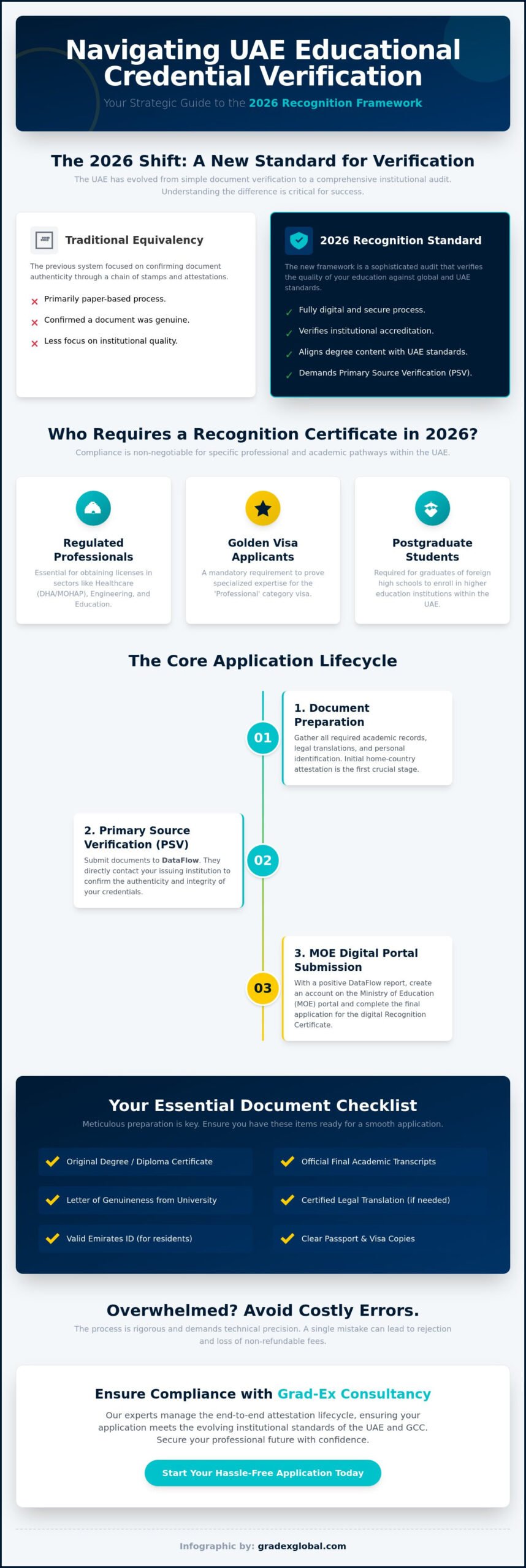
The UAE Ministry of Education has fundamentally restructured how international academic credentials are validated within the country. As of 2026, the framework has moved beyond traditional document attestation toward a sophisticated “Recognition” model. This shift represents a strategic effort to ensure that all professional qualifications entering the UAE labor market align with specific institutional standards. The current uae ministry of education equivalency certificate requirements demand more than just a sequence of stamps; they require a verified link between the applicant’s academic history and the global standing of the issuing university. This transition ensures that the nation’s professional sectors remain populated by individuals with verified, high-quality educational backgrounds.
The Ministry no longer issues paper certificates, having digitized the entire process to enhance security and efficiency. This modernization means that academic integrity is now verified through a multi-layered institutional audit. While simple attestation confirms that a document is genuine, the equivalency process confirms that the content of your degree is comparable to the standards set for UAE-based graduates. This distinction is vital for maintaining the country’s competitive edge in the global economy. By integrating rigorous verification steps, the Ministry protects the integrity of its academic and professional landscape.
Who Specifically Requires an Equivalency Certificate in 2026?
Mandatory compliance is strictly enforced for professionals in regulated sectors, including healthcare, engineering, and education. If you’re seeking a professional license from the Dubai Health Authority (DHA) or the Ministry of Health and Prevention (MOHAP), a positive equivalency report is non-negotiable. Furthermore, obtaining a UAE Golden Visa under the “Professional” category requires this certification to prove your specialized expertise. Students who have completed their secondary education outside the UAE must also meet the uae ministry of education equivalency certificate requirements to enroll in local postgraduate programs. It’s a foundational step for career progression and academic advancement within the Emirates.
Recognition vs. Equivalency: Navigating the Terminology
In 2026, the Ministry uses specific terminology that applicants must master to avoid rejection. “Recognition of Higher Education Qualifications” is the standard term for degrees issued by accredited international universities outside the UAE. “Equivalency” is more frequently applied to General Education certificates, such as Grade 12 high school diplomas. The primary factor in determining your application route is institutional accreditation. If your university is on the Ministry’s pre-approved list of global institutions, you’ll follow the recognition path. For school-level certificates, the process involves aligning different international curriculums with the UAE national standard to ensure academic parity.
Mandatory UAE Ministry of Education Equivalency Certificate Requirements
Achieving compliance with the uae ministry of education equivalency certificate requirements requires a methodical assembly of specific academic and legal records. The foundation of any application rests upon the original degree certificate and the final, official transcripts. These aren’t merely digital copies; they must be the definitive versions issued by the institution’s registrar. For documents issued in languages other than Arabic or English, a certified legal translation is mandatory. This ensures that technical terminology remains consistent across all governmental databases. Crucially, residents must also provide a valid Emirates ID and passport copies, while non-residents must submit clear visa records to establish their legal identity within the system.
Prospective students and professionals should review university equivalency requirements to understand how these standards apply to specific academic pathways. For instance, the Ministry now places significant weight on the “Letter of Genuineness.” This document, often obtained from the issuing university or the relevant cultural attaché, serves as a verified confirmation that the degree was earned through legitimate institutional channels. Beyond this, applicants for specific degree types may need to provide proof of residency in the country of study, such as entry and exit stamps, to confirm they were physically present during their education.
The Attestation Chain: Pre-requisites for MOE Submission
The attestation process follows a strict hierarchy that cannot be bypassed. It begins in the country of issuance with legalization from the local Education Ministry and the Ministry of Foreign Affairs. Following this, the UAE Embassy in that country must verify the stamps. The final step occurs within the Emirates, where the UAE Ministry of Foreign Affairs (MOFA) provides the ultimate validation. Only after this chain is complete can the file be submitted for MOE review. Managing this multi-country sequence requires technical precision, which is why many professionals seek specialized certificate equivalency services to ensure no step is overlooked.
Special Requirements for Professional and Research Degrees
Master’s and PhD candidates face additional scrutiny. The Ministry requires thesis abstracts and proof of research focus to verify the depth of the qualification. Medical professionals must align their documentation with MOH or DHA standards, often involving clinical verification. A critical aspect of the 2026 audit is the “Ghost Institution” check. The MOE verifies that the awarding body isn’t only accredited but also maintains a legitimate faculty standard. This level of detail is particularly vital for those pursuing the UAE Golden Visa, where academic excellence is a primary eligibility criterion for the professional category.
The Role of DataFlow and Primary Source Verification (PSV)
Primary Source Verification (PSV) serves as the technical backbone of the modern recognition framework. The Ministry utilizes DataFlow to conduct a direct, registrar-to-registrar audit of academic credentials. This isn’t a surface-level review; it’s a deep-dive verification that ensures every applicant meets the uae ministry of education equivalency certificate requirements by proving the institutional legitimacy of their degree. By outsourcing this to a specialized entity, the MOE maintains a rigorous barrier against “ghost institutions” and non-accredited entities that don’t meet the Emirates’ academic standards. This institutional audit is mandatory for higher education qualifications before the final application can even be initialized on the Ministry’s dashboard.
The verification journey begins when you upload your documents to the DataFlow portal. Their analysts contact your university’s registrar directly, bypassing any potential for document tampering or secondary-source errors. Once verified, the report flows digitally into your MOE dashboard. In 2026, standard service timelines typically range from 15 to 25 working days. However, complex cases involving older records or institutions in high-risk regions can extend to 30 or 45 working days. Using an express service can shorten this to approximately 14 working days. Precision remains more important than speed in this phase, as a “positive” report is the only way to advance through the compliance chain.
Navigating the DataFlow Application Process
Selecting the correct package is the most critical step for success. You must choose the specific MOE equivalency category to ensure the final report is formatted for Ministry acceptance. A common pitfall is submitting low-resolution scans or incomplete transcripts, which triggers immediate delays. Applicants can opt for the “Applicant Assist” service for approximately 147 AED to ensure their file is technically sound before submission. Tracking your status is done through the DataFlow portal using your unique reference number. Once the status shows “Report Issued,” you can proceed with the final MOE filing.
What Happens if Verification Fails?
A “Discrepancy” status indicates a direct conflict between your submitted documents and the university’s records. This is a serious red flag that often leads to permanent rejection. Conversely, an “Unable to Verify” status often means the institution is non-responsive or no longer operational. If this occurs, you’ll need to provide secondary evidence, such as graduation photos, old student IDs, or embassy letters of support. Disputed findings can be appealed through a formal process, but this requires providing new, verifiable evidence that wasn’t included in the initial audit. Technical accuracy at the start prevents these costly complications.
Step-by-Step Application Procedure on the MOE Digital Portal
Initiating the final stage of the recognition process requires a secure digital identity. Applicants must first create and verify an account on the Ministry of Education’s official portal, ideally utilizing the UAE Pass for seamless integration with other government databases. Once logged in, the system requires you to select the precise service category. For international degrees, this is typically the “Recognition of Higher Education Qualifications” path. Precision at this stage is vital; selecting the wrong service type often results in immediate file closure and the forfeiture of processing fees. Mastering the uae ministry of education equivalency certificate requirements involves ensuring that your digital profile matches your legal identity with absolute consistency.
The core of the application involves uploading your fully attested documents and your positive DataFlow verification report. You’ll need to input your DataFlow reference number directly into the MOE dashboard, allowing the Ministry’s system to pull the verified institutional data automatically. After the technical audit of your uploads, the portal will prompt for payment. In 2026, the official fees are structured as follows: 100 AED for Undergraduate degrees, 150 AED for Postgraduate degrees, and 200 AED for Doctorate qualifications. For general school education certificates, the fee is a standard 50 AED. Once payment is confirmed, the system generates an application reference number, which serves as your primary tool for monitoring the “Application Under Review” status.
Managing this administrative lifecycle can be technically demanding for busy professionals. To ensure your submission meets every institutional standard without error, you can utilize expert certificate equivalency services to handle the portal filing on your behalf.
Avoiding Common Rejection Reasons in 2026
Incomplete attestation chains remain the primary cause of application returns. If a single stamp from the Ministry of Foreign Affairs is missing or illegible, the system will flag the file as non-compliant. Discrepancies between the degree title on your certificate and the specific course names on your transcript also trigger manual reviews. Additionally, certain jurisdictions now require a specific Genuineness Letter that must be uploaded as a supplementary document. Failure to include this often leads to a “Clarification Requested” status, which resets your processing timeline.
Timelines and Expedited Processing Expectations
Processing times vary significantly based on the document type and origin. General education certificates issued within the UAE typically reach completion within 5 working days, while those issued outside the country can take up to 30 working days. For higher education, the timeline depends heavily on the university’s response speed to the Ministry’s final inquiries. Delays often occur during international public holidays or university semester breaks. If your application exceeds the standard 30-day window, you should use the MOE inquiry system to request a technical status update using your reference number.
Strategic Consultancy: Ensuring Success with Grad-Ex
Grad-Ex Consultancy provides a foundation of stability for professionals by leveraging over 15 years of institutional expertise within the GCC market. We don’t just facilitate document processing; we provide a technically precise roadmap through the uae ministry of education equivalency certificate requirements. For high-level executives and specialized professionals, the administrative burden of managing multi-country attestation chains can be a significant drain on resources. Grad-Ex Consultancy manages the entire lifecycle of the equivalency process, from the initial home-country verification to the final digital issuance by the UAE authorities. This end-to-end management ensures that your application remains compliant with the most current 2026 regulatory standards.
Our team specializes in strategic advisory for complex cases that often fall outside standard automated processing. Grad-Ex Consultancy provides specialized solutions for degrees obtained through distance learning, qualifications from defunct universities, or non-standard academic credentials that require additional institutional proof. By utilizing established communication channels with global registrars and cultural attachés, we secure the necessary evidence to satisfy the Ministry’s rigorous audit. This proactive approach mitigates the risk of rejection and ensures that your academic history is presented with the technical accuracy required for institutional recognition.
The Grad-Ex Advantage in Document Processing
Transparency and predictability are central to our service delivery model. Grad-Ex Consultancy operates with fixed-fee structures to ensure our clients have full visibility into their investment without the risk of hidden administrative costs. Our consultants coordinate directly with global embassies and UAE ministries on your behalf, handling the logistical complexities of the attestation chain. Learn how we manage the equivalence certificate process by integrating local expertise with international standards. This meticulous coordination allows you to focus on your professional objectives while we ensure your documentation meets every technical prerequisite.
Beyond Equivalency: Comprehensive Expat and Business Support
Educational recognition is rarely an isolated requirement; it’s often the catalyst for broader career or business milestones. Grad-Ex Consultancy integrates our equivalency services with comprehensive support for UAE Golden Visa applications and business setup strategies. Our in-house global translation services provide 100% compliance with MOE standards, ensuring that technical transcripts are accurately localized. By aligning your educational credentials with your long-term residency or corporate goals, we create a stable path for your growth in the Emirates. Consult with our experts for your MOE Equivalency today and secure a partner who understands the technical depth of the UAE’s institutional framework.
Mastering Your Professional Future in the Emirates
The transformation of the UAE’s academic recognition system into a digital-first framework necessitates a high degree of technical accuracy. Successfully addressing the uae ministry of education equivalency certificate requirements is a vital step toward securing professional licensing and ensuring your long-term residency. By understanding the institutional shift from simple attestation to comprehensive recognition, you can avoid common document rejections and administrative delays. This strategic preparation ensures that your credentials are verified with the rigor required by the Emirates’ most prestigious professional sectors.
Grad-Ex Consultancy offers the professional stability and technical resources needed to master this complex verification cycle. With over 15 years of GCC market expertise, we provide fixed-fee attestation services and specialized advisory for Golden Visa candidates. We manage the institutional communications on your behalf, providing a predictable and secure route to academic recognition. Entrusting your documentation to a partner with deep local knowledge allows you to focus on your career while we ensure every regulatory standard is met with absolute precision.
Secure Your UAE Academic Recognition with Grad-Ex Consultancy
Your professional future in the UAE starts with a verified foundation that guarantees your expertise is recognized and respected across the nation.
Frequently Asked Questions
Is an equivalency certificate mandatory for all jobs in the UAE?
No, an equivalency certificate isn’t universal for every private sector role, though it’s strictly mandatory for regulated professions. Healthcare workers, engineers, and educators must meet these standards to obtain their professional licenses. Many government entities also require this verification as a prerequisite for employment. It serves as a guarantee of your academic integrity within the UAE’s institutional framework.
Can I apply for an MOE equivalency certificate if I am outside the UAE?
Yes, you can initiate the application from any global location since the Ministry of Education has fully digitized the recognition process. You’ll need a verified UAE Pass account to access the portal and submit your attested documents. While the filing is digital, ensure your physical documents have completed the mandatory attestation chain in your home country before uploading them to the system.
What is the difference between MOFA attestation and MOE equivalency?
MOFA attestation simply validates that the signatures and stamps on your document are authentic. In contrast, the uae ministry of education equivalency certificate requirements involve a comprehensive audit of the academic content and the awarding institution’s accreditation. Attestation confirms the document is real, while equivalency confirms the degree meets the UAE’s specific academic standards for professional parity.
How long does the UAE Ministry of Education equivalency process take in 2026?
Processing times depend on the document’s origin and the level of education. General education certificates issued within the UAE typically take 5 working days, while those from outside the country require up to 30 working days. Higher education recognition depends on the DataFlow verification, which adds another 15 to 25 working days. These timelines remain subject to the responsiveness of your awarding university’s registrar.
Do I need an equivalency certificate for a UAE Golden Visa application?
Yes, candidates applying under the “Professional” category for the Golden Visa must provide a Certificate of Recognition. This document serves as institutional proof that your specialized expertise aligns with the nation’s high-level workforce standards. Without meeting the uae ministry of education equivalency certificate requirements, your visa application may face technical rejection due to insufficient academic verification. It’s a critical component of the eligibility audit.
What should I do if my university is not on the MOE accredited list?
If your institution isn’t pre-approved, the Ministry will require a manual institutional audit. You’ll likely need to provide a Letter of Genuineness from the relevant cultural attaché or embassy. In some cases, the Ministry may request additional evidence of the university’s global standing and curriculum structure. This process is technically complex and requires precise coordination between the awarding body and UAE authorities.
Are distance learning or online degrees eligible for UAE equivalency?
Distance learning degrees are eligible only if they meet strict accreditation and residency criteria. The issuing university must be recognized by the Ministry, and the specific program must allow for digital delivery under UAE regulations. Some degrees still require proof of physical residency in the country of study for specific durations. It’s vital to verify your program’s status before initiating the costly attestation and DataFlow sequences.
How much are the official fees for the UAE MOE equivalency certificate?
Official fees are structured by the level of the qualification being recognized. Undergraduate degrees cost 100 AED, Master’s degrees are 150 AED, and Doctorate qualifications are 200 AED. General school education certificates, including Grade 12, require a standard fee of 50 AED. Note that these figures don’t include the separate Primary Source Verification fees charged by DataFlow, which are required for higher education applications.