
On June 14, 2025, a senior engineering consultant in Dubai discovered that a single missing stamp from his home country’s ministry rendered his entire family residency application invalid, resulting in over 5,000 AED in lost processing fees and avoidable delays. You likely recognize that the legal framework in the UAE demands absolute precision, much like a large-scale infrastructure project where every structural component must be verified before progress continues. Navigating the multi-stage attestation for your marriage certificate is often a source of significant stress, especially when the sequence of government approvals remains unclear.
This 2026 comprehensive guide provides the technical roadmap needed to master these complex legal requirements and secure your family’s legal status. We will detail the exact hierarchy of stamps from the Ministry of Foreign Affairs and explain how to build a verified document chain that guarantees successful spouse visa approval and immediate access to corporate insurance benefits. By following this structured approach, you can eliminate the fear of application rejection and ensure your domestic foundation is as stable as a professionally engineered skyscraper.
Key Takeaways
- Understand why a verified marriage certificate is the fundamental legal requirement for securing spouse sponsorship, newborn registration, and joint health insurance in the UAE.
- Navigate the multi-stage attestation workflow, ensuring your documents progress correctly from local authorities in the issuing country to final authentication by the UAE Ministry of Foreign Affairs.
- Learn the critical distinction between standard translations and Ministry of Justice (MOJ) licensed translations to prevent administrative rejection and ensure legal validity.
- Identify the 2026 GDRFA and ICP residency criteria, including the specific salary and accommodation benchmarks necessary for a successful family visa application.
- Discover how professional, fixed-fee verification services provide a precise and reliable alternative to the logistical complexities and potential delays of DIY attestation.
The Legal Significance of a Marriage Certificate for UAE Residents
The UAE’s legal landscape operates with a level of structural precision that requires residents to maintain impeccable documentation. At the core of this system, a marriage certificate functions as the primary personal status document for expatriates and citizens alike. It’s not just a record of a union; it’s a legal necessity that validates a family’s standing before the Ministry of Justice and other regulatory bodies. Understanding the legal significance of a marriage certificate is essential because this document acts as the master key for accessing social, financial, and residency rights within the Emirates.
The distinction between locally issued marriage contracts and foreign-issued certificates is a critical technical detail. While a local contract is registered directly with the UAE courts, a foreign certificate requires a multi-step verification process to ensure its validity within the state’s jurisdiction. This process maintains the integrity of the legal system and ensures that all personal status claims are backed by verifiable evidence.
When is a Marriage Certificate Required?
The requirement for a verified certificate isn’t optional. It’s a mandatory component of the UAE’s administrative framework. You’ll need it for:
- Spouse Sponsorship: The General Directorate of Residency and Foreigners Affairs (GDRFA) won’t issue a family residency visa without a fully attested certificate.
- Financial Services: Opening a joint bank account or securing a home mortgage requires proof of a legal relationship to satisfy “Know Your Customer” (KYC) regulations.
- Newborn Registration: Legalizing a child’s birth within the UAE healthcare system requires the parents to present a recognized marriage certificate. This is the only way to obtain a birth certificate and an Emirates ID for the child.
- Joint Health Insurance: Adding a spouse to a corporate or private health insurance plan requires this document to verify dependency status.
The Shift Toward Civil Marriage Recognition
The UAE’s legal system underwent a significant transformation with the enactment of Federal Decree Law No. 41 of 2022. This law established a secular legal framework for non-Muslim expatriates, introducing civil marriage as a recognized standard. By 2026, this framework has simplified the recognition of international civil contracts, provided they meet specific attestation standards. This transition toward civil recognition reflects the UAE’s commitment to a modern, inclusive, and stable legal environment for its diverse workforce. It ensures that international residents can maintain their personal status without conflict between their home country’s laws and local regulations. Maintaining document integrity through proper attestation ensures that your family’s legal status remains stable across different international jurisdictions.
The Multi-Stage Attestation Process: A Comprehensive How-To
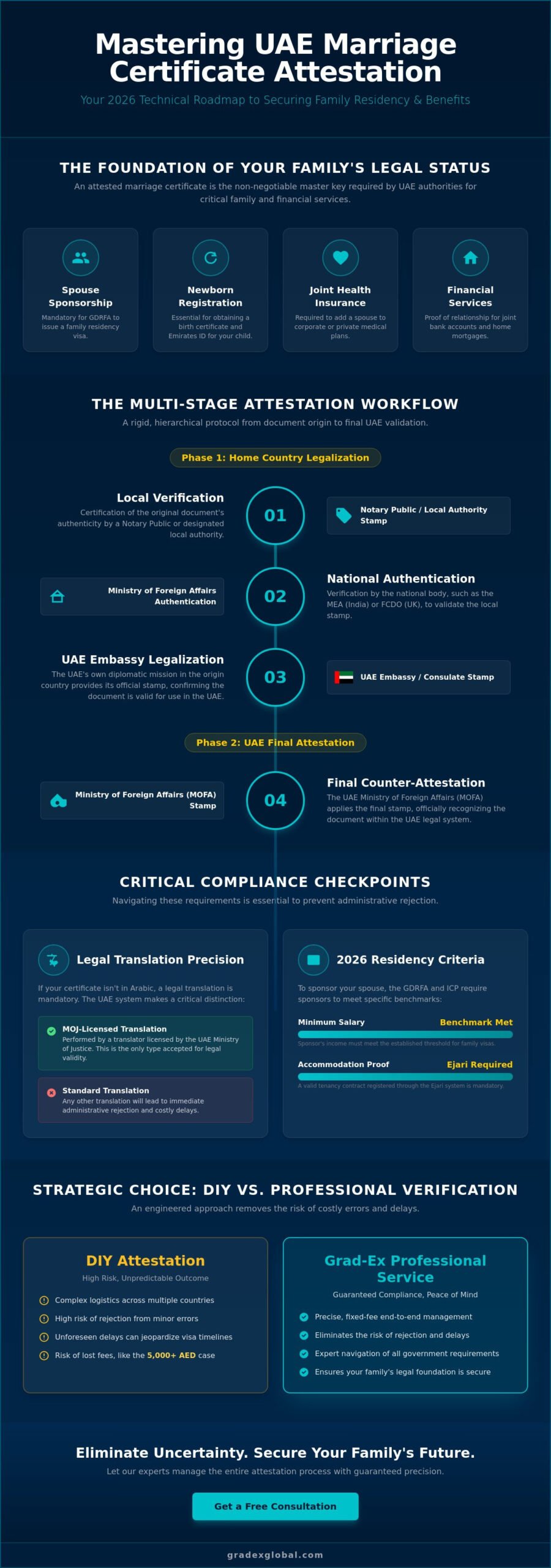
The validation of a marriage certificate for use in the UAE follows a rigid, hierarchical protocol. This sequence ensures every legal document meets the stringent standards required for residency, spousal sponsorship, or legal proceedings. The process isn’t a single event but a series of verified handovers between sovereign authorities.
- Verification by a Notary Public or local authority in the issuing country.
- Authentication by the Ministry of Foreign Affairs or equivalent national body.
- Legalization by the UAE Embassy or Consulate in the country of origin.
- Final counter-attestation by the Ministry of Foreign Affairs (MOFA) within the UAE.
Phase 1: Home Country Legalization
The process begins with local verification. A Notary Public or the relevant local authority must first certify the original document’s authenticity. Once verified, the document moves to the national level. In India, this involves the Ministry of External Affairs (MEA); in the United Kingdom, the Foreign, Commonwealth & Development Office (FCDO) manages these duties. For expatriates from North America, U.S. citizen services in the UAE provide essential preliminary guidance on how these documents transition from domestic to international jurisdiction. The final step in the home country is legalization by the UAE Embassy. This act bridges national law with the UAE’s regulatory framework, confirming the document’s readiness for cross-border recognition.
Phase 2: UAE MOFA Counter-Attestation
Upon the document’s arrival in the Emirates, the final stage of verification occurs through the Ministry of Foreign Affairs (MOFA). By 2026, the UAE has fully integrated prompt attestation services into its digital infrastructure. This system utilizes UAE PASS for identity verification, allowing for a seamless transition between physical and digital records. It’s a system built on precision and security.
The 2026 standards prioritize digital stamping over traditional physical seals. While physical stamps are still issued for specific legacy requirements, most approvals are now verifiable via secure QR codes. Once the marriage certificate enters the UAE system, typical timelines for final MOFA approval range from 24 to 48 hours. This efficiency is a direct result of the UAE’s commitment to technological modernization. Ensuring your documents are properly processed prevents administrative delays in visa applications or banking procedures. If you require assistance with these complex administrative workflows, our team can provide the professional guidance needed to secure your documentation accurately.
Document Standards and Legal Translation Requirements
The UAE Ministry of Justice (MOJ) enforces rigorous technical standards for every marriage certificate entering the attestation pipeline. Precision isn’t merely a preference; it’s a legal mandate. Documents issued in languages other than Arabic must undergo a formal conversion process through licensed legal translators. Standard translation services don’t meet the criteria for government submission because they lack the official MOJ accreditation required to verify the document’s content against UAE legal frameworks. This specialized licensing ensures that the translated text carries the same legal weight as the original instrument.
Physical document integrity remains a primary reason for processing delays in 2026. Authorities require the original document to maintain its “True Copy” status throughout the verification cycle. Common errors, such as laminating the document to protect it, actually invalidate the certificate for attestation purposes. Officials must apply physical stamps and adhesive labels to the reverse side of the original. If a document is laminated, the ink won’t adhere and the security stickers can’t be applied, leading to an immediate rejection. In such cases, you’ll need to secure a “New Issue” from the issuing authority in your home country before proceeding with the UAE Ministry of Foreign Affairs (MOFA).
- Legibility: All stamps from the home country’s Ministry of Foreign Affairs must be clear and dark enough for digital scanning.
- Signatures: Unauthorized or digital-only signatures without a verifiable QR code often face scrutiny.
- Condition: Tears, heavy stains, or faded ink can trigger a request for a fresh copy to ensure the document’s long-term stability in state archives.
Precision in Legal Translation
Legal translation in the UAE is a regulated profession governed by Federal Law No. 6 of 2012. The translator’s stamp must be registered with the UAE courts to ensure the marriage certificate terminology aligns with local personal status laws. This translation occurs after the initial home country attestations but before the final MOFA verification in the UAE. It’s a critical bridge that converts foreign legal standing into a format recognized by the Dubai or Abu Dhabi judicial systems, ensuring that names and dates match your passport data with 100% accuracy.
Physical Integrity and Security Features
By 2026, the UAE has fully integrated digital verification systems into its administrative workflow. Modern certificates featuring encrypted QR codes expedite the process by allowing officials to verify authenticity against blockchain-backed databases instantly. If you’re handling an older, fragile document, the risk of damage during the multi-stage stamping process is high. We recommend obtaining a fresh version if the original lacks modern security features or shows signs of structural degradation. This proactive step prevents technical failures during the high-stakes verification sequence and ensures your residency or visa application remains on schedule.
Utilizing Your Marriage Certificate for Residency and Family Sponsorship
A verified marriage certificate acts as the foundational document for any expatriate seeking to establish a family unit in the Emirates. Without this legal proof, the General Directorate of Residency and Foreigners Affairs (GDRFA) or the Federal Authority for Identity, Citizenship, Customs and Port Security (ICP) cannot process sponsorship applications. The document serves as the primary evidence of a legal union, allowing the government to maintain precise records of the resident population and their dependents.
In 2026, the regulatory framework maintains a minimum monthly salary requirement of AED 4,000, or AED 3,000 plus company-provided accommodation, to sponsor a spouse. These standards ensure that sponsors possess the financial stability required to support their families within the UAE’s economic environment. Beyond residency, the document is vital for professional mobility. If a spouse intends to pursue high-level career opportunities, the marriage certificate facilitates the process of obtaining a UAE equivalence certificate for their educational credentials, ensuring their previous qualifications align with local Ministry of Education standards.
The Family Sponsorship Workflow
Digital transformation remains the priority for UAE immigration authorities. Sponsors must upload the attested marriage certificate via the ICP smart application or the DubaiNow portal to initiate the process. This document directly dictates the validity of the dependent’s visa, which typically mirrors the sponsor’s residency duration. When sponsoring children alongside a spouse, the marriage certificate serves as the prerequisite link that validates the family structure before birth certificates are even considered. Once the visa is approved, residents must update their Emirates ID and health insurance records to reflect their new status.
Beyond the Visa: Legal Protections
Registration offers more than just residency. Under the current legal framework, an attested certificate secures inheritance rights for surviving spouses, providing a layer of security for family assets. For non-Muslim residents, these documents are critical in civil court proceedings or mediation, providing a clear legal framework for asset division or custody. It’s also essential to register the marriage with your respective national consulate in Abu Dhabi or Dubai. This step ensures that your marriage is recognized both in the UAE and your home country, preventing future administrative hurdles.
Ensuring your documentation meets every technical requirement is the first step toward long-term stability in the region. Contact Gradex Global to manage your attestation and residency logistics with professional precision.
Strategic Solutions for Complex Document Verification
Navigating the administrative requirements for a marriage certificate in the UAE requires more than just following a checklist. It demands a systematic approach to cross-border logistics. Individuals who attempt the DIY route often encounter unexpected delays that result in significant financial loss. These setbacks typically stem from a lack of familiarity with the specific sequencing required by international consulates and the UAE Ministry of Foreign Affairs (MOFA). A single administrative error can invalidate weeks of effort, forcing applicants to restart the process and pay additional government fees in excess of 500 AED per document.
Professional fixed-fee services provide the stability needed for these high-stakes transitions. Grad-Ex Consultancy applies fifteen years of institutional experience to ensure every document meets the precise technical standards of the local authorities. We view document verification as a critical piece of your personal infrastructure. By leveraging established relationships with government bodies, we bypass common bottlenecks. This professional review process mitigates risks such as document mishandling or rejection due to non-compliant legal translations.
The Grad-Ex Advantage in Attestation
We provide end-to-end management that spans from the document’s country of origin directly to the UAE MOFA. Our operational framework includes:
- Secure logistical handling of original documents with real-time tracking systems to ensure chain of custody.
- Strategic advisory for complex cases involving multiple jurisdictions or non-standard legal formats.
- Direct oversight of the entire authentication chain to prevent unauthorized third-party interference.
Our team doesn’t just process paperwork; we manage the risks associated with international relocation. This ensures your marriage certificate is recognized as a valid legal instrument immediately upon arrival, allowing for seamless integration into the UAE’s social and legal systems.
Conclusion: Securing Your Future in the UAE
Success in the Emirates depends on administrative readiness. To avoid gaps in residency or delays in family visa sponsorship, you should initiate the attestation process at least 45 days before your planned move. A final checklist for a successful outcome includes verifying the validity of all stamps, ensuring translations are performed by MOFA-licensed professionals, and confirming that the document’s physical condition meets official standards. Don’t leave your legal status to chance. Contact Grad-Ex Consultancy today for a strategic consultation to secure your document needs with engineering precision.
Securing Your Family’s Legal Future in the UAE
Navigating the administrative landscape of the Emirates requires precision and a clear understanding of evolving 2026 regulations. A properly attested marriage certificate acts as the foundational pillar for family sponsorship, residency permits, and legal recognition within the country. This multi-stage verification process demands strict adherence to document standards and official translation requirements to avoid costly delays in your application. Managing these complexities alone often leads to administrative friction that can stall your personal and professional transition.
Grad-Ex Consultancy brings 15+ years of experience in UAE document processing to ensure your paperwork meets every institutional benchmark. Our fixed-fee structure eliminates hidden government coordination costs. You’ll receive a transparent service backed by deep institutional relationships with ministries and embassies. We manage the entire lifecycle of your document verification with the same technical rigor applied to large-scale infrastructure projects. This stability allows you to focus on your professional commitments while we handle the complex logistics of global attestation.
Contact Grad-Ex Consultancy for Professional Marriage Certificate Attestation to streamline your residency journey today. Your family’s stability in the UAE starts with a verified legal foundation.
Frequently Asked Questions
Can I attest a copy of my marriage certificate for use in the UAE?
No, the Ministry of Foreign Affairs (MOFA) and other UAE authorities require the original document for the attestation process. Photocopies, even if they’re notarized, aren’t accepted unless they’re official “True Copies” issued and stamped by the original issuing department in your home country. You must present the original marriage certificate to ensure the legal validity of any visa sponsorship or administrative application.
How long is an attested marriage certificate valid in the UAE?
An attested marriage certificate doesn’t have a formal expiration date under UAE Federal Law No. 28 of 2005. Once the MOFA stamp’s applied, the document remains legally recognized for the duration of its use in the country. However, if the physical document is damaged or the issuing country changes its certificate format, some departments might request a fresh copy issued within the last 180 days.
What happens if my marriage certificate is in a language other than English or Arabic?
You must obtain a legal translation from a translator certified by the UAE Ministry of Justice if the document isn’t in Arabic. While English is often accepted in initial stages, official government submissions for residency or legal proceedings require an Arabic version. This translation’s attached to the original marriage certificate and must undergo the same attestation sequence to be recognized by UAE authorities.
Can I sponsor my spouse if we had a civil marriage in another country?
Yes, the UAE recognizes civil marriages for sponsorship purposes as long as the certificate’s fully attested by the home country’s Ministry of Foreign Affairs and the UAE Embassy. Following the 2023 implementation of the Federal Personal Status Law for non-Muslims, the recognition of civil contracts has become a standardized administrative procedure. This allows expatriates to secure residency permits for their partners without specific religious requirements.
Is the process different for Muslim and non-Muslim marriage certificates?
The fundamental attestation steps remain identical, but the governing legal framework differs during the final recognition phase in the UAE. Muslim marriages are processed under Sharia principles, whereas non-Muslim certificates are governed by Federal Decree-Law No. 41 of 2022. Both groups must complete the same chain of authentication through the Ministry of Foreign Affairs to ensure the document’s legitimacy for official use.
How much does it cost to attest a marriage certificate in 2026?
The Ministry of Foreign Affairs (MOFA) charges a standard fee of AED 150 for the attestation of individual documents like a marriage certificate. This fee’s paid through the official MOFA smart channels or the e-Das system. Additional costs include the fees charged by your home country’s Ministry of Foreign Affairs and the UAE Embassy located in that specific jurisdiction, which vary by nation.
What should I do if my marriage certificate is rejected by MOFA?
You should first verify the specific rejection code provided in the MOFA digital portal, as 85% of rejections stem from missing prior stamps from the country of origin. If the rejection’s due to a lack of authentication, you must return the document to that nation’s foreign ministry. Ensure all seals are legible and that the document has no physical alterations or unauthorized markings before you resubmit it.
Do I need to attest my marriage certificate if I am a tourist?
Tourists don’t need to attest their marriage certificates for standard leisure visits or hotel stays within the Emirates. Attestation’s only mandatory if you intend to apply for a long-term residency visa, open a joint bank account, or access maternity services in a UAE hospital. For simple entry and travel, your passport’s the only identification document you’ll need to present to authorities.