
In 2026, a physical signature on a legal document in Dubai is no longer the gold standard; it’s a logistical liability that slows down high-stakes operations. Most business leaders agree that the UAE’s transition to a paperless judiciary has significantly increased efficiency, yet the technical hurdles of online notary services can still cause costly delays for the unprepared. You understand that precision in legal documentation is as critical as the structural integrity of a large-scale engineering project. Mistakes in formatting or digital ID authentication don’t just waste time; they compromise the stability of your commercial and personal agreements.
This guide ensures you master the complexities of the UAE’s digital notary framework with a precise, step-by-step methodology for securing online legalisation. We’ll clarify the distinct roles of public and private notaries, solve common UAE Pass authentication errors, and outline the exact steps to guarantee your documents are accepted by local authorities. We’ve structured this analysis to remove the confusion surrounding document rejection and digital formatting. Our preview covers the essential requirements for 2026, providing a clear roadmap for your next legal transaction in the Emirates.
Key Takeaways
- Navigate the UAE’s digital transformation by understanding the structural shift toward secure, virtual verification within the nation’s judicial framework.
- Distinguish between the regulatory roles of Public and Private online notary services to ensure precise jurisdictional compliance for your legal documents.
- Identify specific commercial and personal document eligibility to optimize efficiency and eliminate the logistical burdens of traditional physical notarisation.
- Master the technical prerequisites of UAE PASS integration and formatting requirements to ensure a seamless and legally sound digital legalisation process.
- Discover how a strategic partnership with Grad-Ex streamlines the entire document lifecycle, from professional translation to final MOFA attestation.
Understanding Online Notary Services in the UAE’s Digital Ecosystem
The UAE’s legal landscape has undergone a fundamental structural shift, moving from traditional paper-based systems to a high-precision digital framework. At the core of this transformation are online notary services, which provide a secure, government-authorized method for authenticating documents without requiring physical presence. This evolution isn’t merely a convenience; it’s a strategic component of the UAE’s Digital Government Strategy 2025, ensuring that legal transactions maintain the highest standards of integrity while achieving maximum operational efficiency. Understanding Online Notary Services is essential for any entity operating within this modern jurisdiction, as it represents a permanent transition in how corporate and personal legal standing is verified.
The implementation of Federal Decree-Law No. 46 of 2021 on Electronic Transactions and Trust Services provides the necessary legal scaffolding for these digital processes. This legislation ensures that every digital notarization carries the same weight as its physical predecessor. For businesses, this means that Power of Attorney (POA) documents, articles of association, and commercial contracts can be finalized in minutes rather than days. It’s a system built on stability and technical precision, mirroring the infrastructure-grade reliability required by large-scale enterprises. Maintaining legal standing in 2026 requires a thorough adoption of these digital tools to ensure compliance with the nation’s evolving regulatory standards.
The Evolution of the E-Notary System
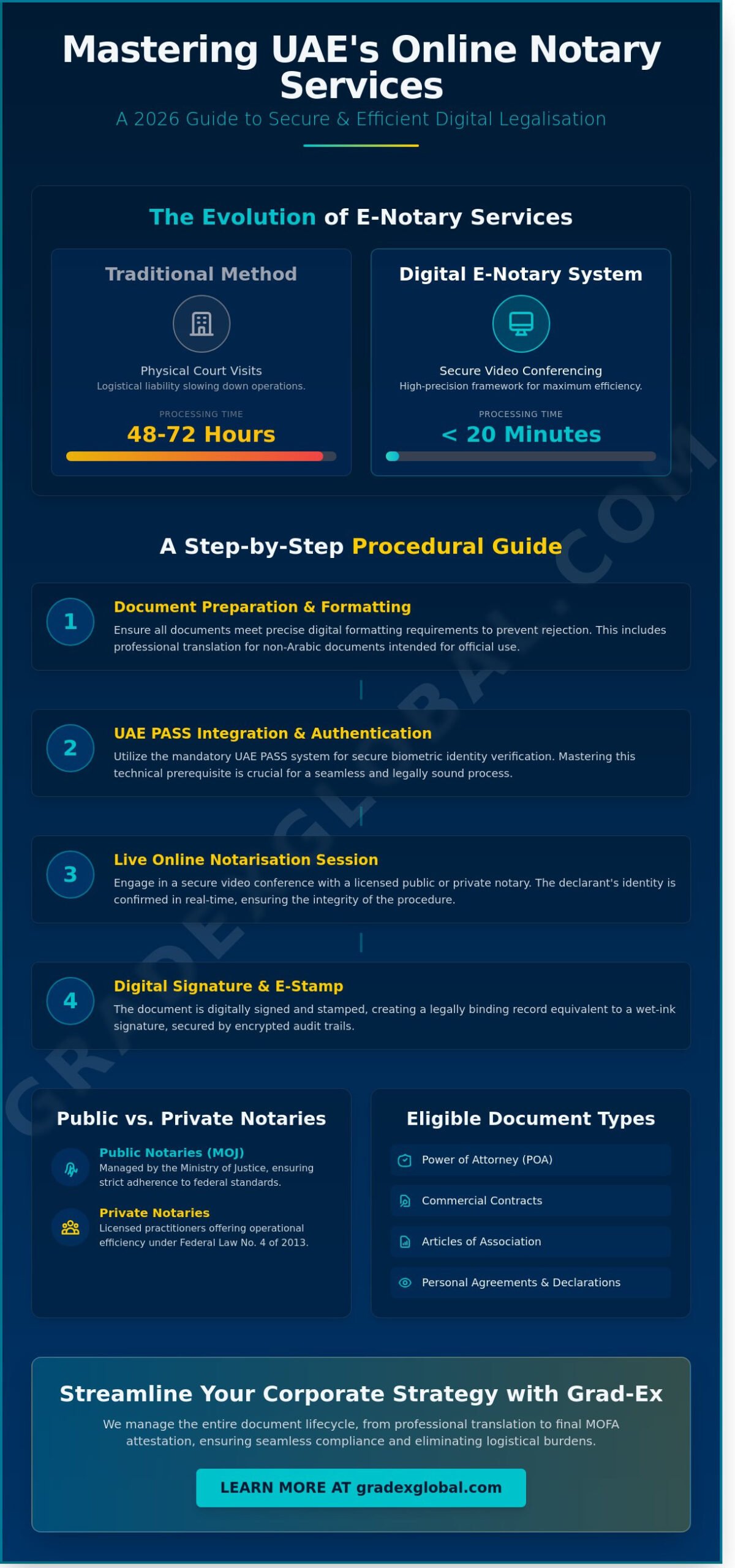
The transition from physical court visits to the Ministry of Justice (MOJ) e-system has eliminated the logistical bottlenecks that once hindered commercial progress. Before the full integration of this digital infrastructure, notarizing a single document often required 48 to 72 hours of administrative processing. Today, the system utilizes secure video conferencing to conduct identity verification in real-time. This protocol allows a notary public to confirm the declarant’s identity through biometric data and UAE Pass integration, reducing the entire cycle to less than 20 minutes in most instances. It’s a testament to the UAE’s commitment to building a world-class digital environment where online notary services act as a catalyst for professional speed.
Key Legal Foundations for Digital Signatures
Under current UAE regulations, a digital signature isn’t just a placeholder; it’s legally equivalent to a wet-ink signature. This equivalence is maintained through rigorous verification protocols that judicial departments use to prevent fraud. These include multi-factor authentication and encrypted audit trails that track every modification to a document. The cross-border acceptance of UAE digitally notarised documents has increased significantly since 2021. By 2026, the interoperability of these digital certificates with international legal standards ensures that documents notarized in Dubai or Abu Dhabi are recognized by global partners, providing a stable foundation for international trade and legal compliance. This system ensures that the technical integrity of a document is never compromised, providing a guarantee of quality that matches the highest engineering standards.
Public vs. Private Online Notaries: Navigating the Regulatory Framework
The United Arab Emirates legal landscape operates through a dual-track system designed to balance regulatory stability with operational efficiency. This structure is governed by Federal Law No. 4 of 2013, which expanded the notary profession to include private practitioners alongside government officials. Understanding the distinction between public and private online notary services is essential for corporate entities managing large-scale infrastructure or commercial projects that require precise legal execution.
The Role of the Ministry of Justice (MOJ)
The Ministry of Justice (MOJ) manages the federal framework, ensuring all legal documentation adheres to strict national standards. This system serves as the backbone for the UAE’s Digital Ecosystem, providing a centralized point for authentication and document verification. Users typically access the MOJ e-portal using UAE PASS, the national digital identity, to initiate proceedings for personal documents like a General Power of Attorney (POA).
A critical technical requirement within this framework is the mandatory use of Arabic. All documents must undergo legal translation by an MOJ-licensed translator before digital submission. The MOJ system is highly structured, offering a cost-effective solution for standard filings where the timeline permits government processing windows, which usually align with standard office hours from 7:30 AM to 3:30 PM.
Licensed Private Notaries: Flexibility and Speed
Private notaries are licensed law firms authorized by local judicial departments, such as the Dubai Courts or the Abu Dhabi Judicial Department (ADJD), to perform specific legal functions. These entities operate with the same legal authority as public notaries but offer a service model tailored to the fast-paced corporate environment. They’re particularly effective for complex commercial transactions, including Memorandum of Association (MOA) amendments or high-value asset transfers that require immediate attention.
The primary advantage of using private online notary services lies in their flexibility. Many private firms provide extended availability, often operating outside standard government hours to meet urgent corporate filing deadlines. This model reduces the administrative burden on businesses, as private practitioners often handle the technical upload and verification processes on behalf of the client.
Strategic considerations for businesses choosing between these models include:
- Complexity of Document: Use private notaries for multi-party commercial contracts that require bespoke clauses and rapid iterations.
- Budget vs. Urgency: Public notaries are more economical for high-volume, non-urgent personal filings, while private services prioritize speed for a higher service fee, often starting at AED 500 plus government costs.
- Jurisdictional Reach: Ensure the chosen notary has the specific authority for the emirate where the document will be used, as local judicial departments maintain distinct digital platforms.
For organizations managing complex cross-border logistics or engineering projects, selecting a partner that understands these integrated legal frameworks ensures that project timelines remain intact. Choosing the right notary model isn’t just about a signature; it’s about maintaining the structural integrity of your corporate legal standing in a digital-first economy.
Document Eligibility and Strategic Advantages of Digital Notarisation
The transition to online notary services represents a fundamental upgrade in the UAE legal infrastructure. It mirrors the structural precision found in large-scale engineering projects where efficiency and reliability are the primary benchmarks. The government’s integration of the UAE Ministry of Justice E-Notary System ensures that every transaction adheres to rigorous technical standards. This digital framework eliminates the logistical friction inherent in physical document handling. It replaces manual queuing with a structured, 24/7 accessible portal. Security is anchored by blockchain technology and UAE PASS multi-factor authentication. These systems provide a level of verification that exceeds traditional paper-based methods, ensuring that document integrity remains uncompromised during the entire legalisation cycle.
A cost-benefit analysis reveals that digital notarisation reduces administrative overhead by approximately 60% compared to physical office visits. While statutory fees remain consistent, often starting from AED 100 for basic attestations, the elimination of travel time and courier expenses provides immediate financial optimization. For high-volume corporate entities, this systematic approach to legal documentation ensures that project timelines aren’t delayed by bureaucratic bottlenecks. The process is now a matter of minutes rather than days, reflecting a modern, tőkeerős (capital-strong) economy that values professional time as a critical resource.
Common Commercial Documents for Online Notarisation
Corporate entities require stability and speed to maintain their market position. The digital system supports complex commercial structures with millimetre-perfect legal accuracy. Key documents eligible for this streamlined process include:
- Memorandum of Association (MOA) and Articles of Association (AOA) for new or existing LLCs.
- Board Resolutions and Power of Attorney for company managers, ensuring continuous operational control.
- Sales and Purchase Agreements for commercial assets, processed through secure digital channels.
Personal Legal Documents and Expats
For the expat population, online notary services offer a reliable bridge for cross-border legal matters. The system handles personal declarations with the same level of professional rigour as corporate contracts. Eligible documents include:
- General and Special Powers of Attorney for property management or legal representation in UAE courts.
- Declarations of Residency and Job Offers required for visa processing and employment verification.
- Wills and inheritance-related declarations for non-Muslims, providing long-term security for family assets.
The UAE’s commitment to this digital evolution ensures that the legal framework is as robust and permanent as the infrastructure it supports. By removing the need for physical presence, the Ministry of Justice has created a scalable solution for a globalised workforce.
How to Secure Online Notary Services: A Step-by-Step Procedural Guide
Securing legal recognition for documents in the UAE requires a methodical approach that mirrors the precision of a large scale engineering project. The transition to digital systems hasn’t lowered the standard of scrutiny; it has simply shifted the medium. Successfully utilizing online notary services requires strict adherence to a multi stage technical framework designed to ensure the integrity of the legal record.
Step 1: Document Preparation and Legal Translation
The foundation of any notarization process is the quality of the source material. All documents issued in languages other than Arabic must undergo legal translation by professionals licensed by the UAE Ministry of Justice (MOJ). These files must be formatted as PDF/A, a specialized version of the PDF standard designed for long term archiving and digital preservation. Before submission, you must determine if your specific paperwork requires a prior equivalence certificate or specific attestations from the Ministry of Foreign Affairs. Overlooking these preliminary certifications often leads to immediate rejection during the judicial review phase.
Step 2: Digital Identity Verification via UAE PASS
UAE PASS serves as the singular digital identity for all citizens and residents, making it the mandatory gateway for 100% of federal digital government transactions. To access the judicial portals for online notary services, your account must be upgraded to the “Verified” status. This requires a biometric scan via a smartphone or at a physical kiosk location. If you encounter authentication errors during the notary session, they’re typically linked to outdated biometric data or mismatched mobile numbers. Ensuring your digital credentials are current is a technical prerequisite that can’t be bypassed.
Step 3: The Virtual Appointment and Approval
Once you submit your documents through the relevant judicial portal, such as the Abu Dhabi Judicial Department (ADJD) or the Dubai Courts, you’ll be assigned a virtual hearing. This video call is a formal legal proceeding. You must present your original Emirates ID or Passport to the camera for real time verification. The Notary Public will confirm your identity, your understanding of the document, and your intent to sign. Following the confirmation, you’ll receive a payment link for the judicial fees, which typically range from AED 100 to AED 500 depending on the document type. Once payment is confirmed, the system generates a digitally signed and stamped electronic document featuring a unique QR code for instant verification by third parties.
Precision in documentation is the hallmark of professional success. If you require expert assistance with complex corporate or personal legalizations, contact our specialist team at Gradex Global to ensure your submissions meet every regulatory benchmark.
Integrating Notary Services into Your Corporate Strategy with Grad-Ex
Grad-Ex Consultancy serves as the technical bridge between global clients and the UAE’s judicial infrastructure. We view document legalisation as a critical path in project management rather than a simple administrative task. Our team manages the entire document lifecycle, starting from initial legal translation to the final MOFA attestation. This comprehensive oversight eliminates the 15% to 20% delay typically caused by administrative errors in independent filings.
By integrating online notary services into your broader corporate strategy, you secure a foundation of legal stability. We conduct expert pre-submission audits for every file. These audits function as a quality control gate, ensuring that documents for multinational corporations and high-net-worth individuals meet the exact specifications of the 2026 regulatory standards. This proactive stance mitigates the risk of rejection by judicial officers, which can otherwise stall transactions worth millions of AED.
Our Precision-Led Approach to Document Management
Our methodology relies on 15 years of institutional experience and established relationships with UAE authorities. We provide a single point of contact for complex workflows, which streamlines communication and ensures total accountability. Following the January 2026 UAE regulatory updates, our processes now include enhanced biometric verification and blockchain-anchored digital seals. We don’t just process papers; we maintain the integrity of your corporate identity across all UAE jurisdictions. This stability is essential for entities managing high-value assets or sensitive intellectual property. Protecting that intellectual property begins well before notarisation, and our clients frequently pair document legalisation with professional trademark registration services to secure complete legal ownership of their brand assets in the UAE market.
Strategic Consultation for Market Entry
Strategic market entry requires speed and precision. Utilizing online notary services facilitates rapid company formation by allowing stakeholders to execute founding documents from any global location. We coordinate between specific freezone authorities and mainland judicial departments to ensure your licenses are issued without technical friction. Our data indicates that clients using our integrated strategy experience a 30% faster path to operational readiness compared to traditional methods. Whether you’re establishing a regional headquarters or managing private wealth, our structured approach ensures your legal documents are a catalyst for growth, not a bottleneck.
Mastering Digital Legalisation for Your UAE Enterprise
The UAE’s shift toward a fully digital legal ecosystem in 2026 has transformed online notary services from a convenience into a strategic necessity for modern business operations. Successfully navigating this framework requires more than just technical access; it demands a precise understanding of the regulatory distinctions between public and private notarial systems. By digitising your legal workflows, you’ll eliminate traditional administrative delays while ensuring your corporate documents, such as complex MOA and POA legalisation, remain fully compliant with the latest Ministry of Justice standards.
Grad-Ex brings 15 years of strategic GCC consultancy experience to every engagement, providing the stability and engineering-level precision your high-value projects deserve. We operate with absolute fixed-fee transparency across all attestation and notary workflows, ensuring your budget remains predictable and your focus stays on growth. Our team’s deep expertise in UAE regulations allows us to handle the most intricate legalisation requirements with the same rigor we apply to large-scale infrastructure planning. It’s time to fortify your corporate structure with reliable, digital-first legal solutions that reflect the professional standards of your organization.
Secure Your Professional Notary Consultation Today
Frequently Asked Questions
Is an online notarised document accepted by all UAE banks and government departments?
Online notarised documents carry full legal weight across all UAE government departments and financial institutions. Federal Law No. 11 of 2021 establishes the framework for digital signatures, ensuring that electronically authenticated documents possess the same evidentiary value as traditional paper versions. Banks and entities such as the Ministry of Justice or Dubai Economy and Tourism process these files through secure digital verification portals. This technological infrastructure eliminates the need for physical presence while maintaining rigorous security standards.
Can I use online notary services if I am currently outside the UAE?
You can access online notary services from any global location, provided you have a stable internet connection and valid identification. The process utilizes secure video conferencing platforms to verify the identity of the signatory in real-time. This remote capability is essential for international investors who need to execute Powers of Attorney or corporate resolutions without traveling to the UAE. It represents a significant shift toward a borderless legal infrastructure that supports global business operations.
How much are the government fees for online notarisation in 2026?
Government fees for online notarisation in 2026 remain structured according to the complexity of the document, typically starting at 100 AED for standard signatures. More complex instruments, such as memorandum of association amendments, may incur fees of 300 AED or higher per document. These costs are paid directly through the Ministry of Justice or Judicial Department portals. Total expenditure often includes a separate service fee for the private notary firm’s digital processing and administrative handling.
What is the difference between a notary public and a legal translator?
A notary public serves as a government-authorized official who authenticates the identity of signatories and the legality of the document’s content. In contrast, a legal translator is a licensed professional who converts text from one language to another while maintaining legal accuracy. For online notary services, you’ll often require both. The legal translator first prepares the document in Arabic, and the notary public then validates the execution of that specific text to ensure it’s legally binding.
How long does the entire online notary process typically take?
The entire online notary process typically concludes within 30 to 60 minutes once all documentation is uploaded and verified. After the initial review, the video conferencing session itself lasts approximately 10 minutes. This efficiency is a core component of the UAE’s digital transformation strategy, allowing for same-day issuance of legalised documents. The speed of execution depends on the precision of the initial submission and the availability of the signatories for the live verification call.
What happens if my document is in a language other than Arabic or English?
Documents in languages other than Arabic or English must undergo legal translation by a Ministry of Justice licensed translator before notarisation can proceed. Arabic is the official language for all legal proceedings in the UAE, meaning any foreign document requires a side-by-side translation. Once the professional translation is complete, the notary public authenticates the bilingual version. This dual-layer process ensures that the document’s intent is clear and remains compliant with local regulatory frameworks.
Is a UAE PASS account mandatory for non-residents seeking online notary services?
A UAE PASS account is the primary requirement for residents, but non-residents can often utilize alternative verification methods for online notary services. While the UAE PASS provides the highest level of digital security for those with an Emirates ID, international clients may verify their identity through passport scans and live biometric checks during the video session. By 2026, the integration of global identity verification systems has made it easier for foreign nationals to access the digital legal ecosystem without a local residency visa.
Can online notary services be used for real estate title deed transfers?
Online notary services are fully integrated into the Dubai Land Department systems for real estate title deed transfers and related transactions. The Pre-Registration and E-Grant systems allow owners to transfer property titles remotely through authorized digital channels. This precision-driven approach ensures that high-value assets are handled with maximum security. It’s a robust solution for investors who want to manage their UAE real estate portfolios from abroad while maintaining absolute legal certainty.