
The era of regulatory flexibility in the Emirates is ending; by 2026, the UAE’s transition to a high-transparency, 9% corporate tax environment will demand a structural precision that legacy models cannot support. You’ve likely recognized that selecting business incorporation services based on the lowest initial quote often results in hidden jurisdictional costs and compliance failures that jeopardize institutional stability. The complexity of the new Anti-Money Laundering (AML) frameworks and the 2026 fiscal updates requires a shift from mere registration to rigorous corporate engineering.
This executive guide delivers a precision-engineered roadmap designed to eliminate regulatory opacity and secure your long-term growth. We’ll provide the technical clarity needed to master UAE company formation while ensuring your entity achieves full compliance with the latest 2026 mandates. You’ll gain a comprehensive understanding of jurisdictional hierarchy, the financial implications of specific licensing structures, and the protocols required to maintain a legally robust corporate presence in the Emirates.
Key Takeaways
- Evaluate the strategic distinctions between Mainland, Free Zone, and Offshore jurisdictions to ensure your corporate structure aligns with your specific trade scope and physical office requirements.
- Navigate the rigorous UAE regulatory landscape by implementing robust Anti-Money Laundering (AML) and Ultimate Beneficial Ownership (UBO) frameworks to safeguard institutional stability.
- Streamline your market entry using a precision-engineered 5-step roadmap that simplifies the transition from initial concept to a fully operational trade license.
- Leverage professional business incorporation services to mitigate bureaucratic risks and secure the document attestations necessary for a seamless pre-incorporation phase.
- Discover how institutional expertise and integrated legal support provide a foundation for sustainable growth within the evolving 2026 GCC economic landscape.
The Strategic Importance of Professional Business Incorporation Services
The UAE is consolidating its status as a premier global hub for sustainable industrial and commercial growth as we approach 2026. Entering this market requires more than just administrative filing. It demands a level of engineering-grade precision that only professional business incorporation services can provide. At Grad-Ex Consultancy, we view market entry as a high-stakes infrastructure project. We apply the same institutional depth and stability to corporate structuring that a lead contractor applies to a multi-billion AED development. This approach mitigates operational risks before they manifest in the balance sheet. It’s about building a vehicle capable of sustained performance in a high-velocity economy.
The Evolving Regulatory Landscape of the GCC
The introduction of the 9% corporate tax rate and the subsequent 2026 updates have fundamentally altered the regional economic framework. Simple “off-the-shelf” licensing packages fail to address these complexities. Modern firms must align their operations with the specificities of UAE corporate law to ensure long-term compliance across different jurisdictions. Strategic advisory is now mandatory for navigating the nuances between mainland and free zone regulations. Without this technical foresight, companies risk structural obsolescence within their first twenty-four months of operation. We provide the technical mastery needed to manage these multi-emirate regulations with absolute certainty.
Incorporation as a Foundation for Global Success
A robust corporate foundation is the primary prerequisite for institutional scaling. We ensure that every business incorporation services engagement aligns the initial setup with future exit strategies or international expansion. Choosing a partner with over 15 years of regional experience provides the stability needed to secure essential financial infrastructure. Professional setup isn’t a formality; it’s a strategic asset that facilitates:
- Accelerated corporate banking approvals through verified compliance trails.
- Enhanced creditworthiness for future capital expenditure and project financing.
- Precision-engineered shareholding structures that protect intellectual property and equity.
- Seamless integration with global tax reporting standards.
Grad-Ex Consultancy operates with the mindset that a business is only as strong as its legal and structural architecture. We don’t offer generic advice. We deliver institutional-grade solutions. Our team manages the entire process with the same control and oversight we apply to our proprietary machinery and technical assets. This ensures that every client enters the UAE market with a structure built for permanence and high-volume performance. We don’t just facilitate entry; we engineer a platform for long-term dominance in the regional market.
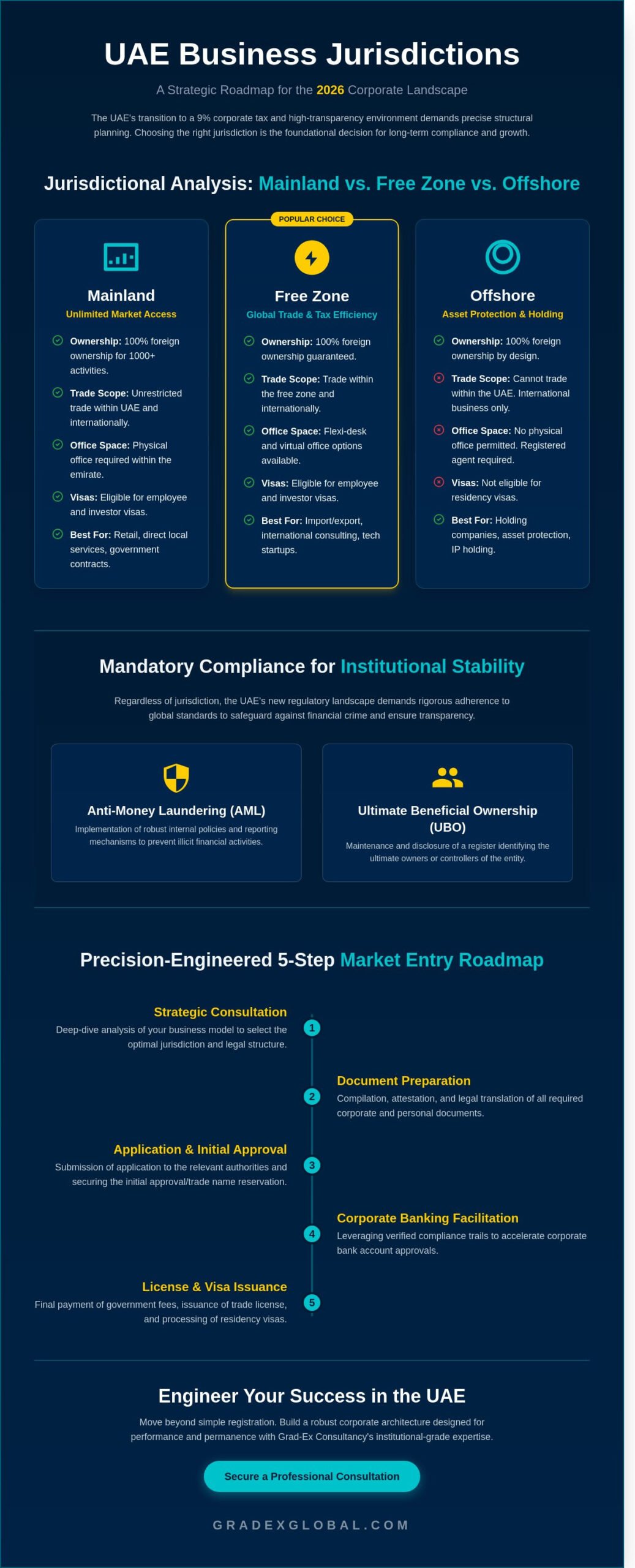
Jurisdictional Analysis: Mainland vs. Free Zone vs. Offshore
Selecting the correct legal structure is a foundational engineering decision for any enterprise entering the Middle Eastern market. The UAE offers three distinct frameworks, each governed by specific regulatory bodies and designed for different operational scales. According to the World Bank’s Doing Business report, the UAE’s streamlined processes for business incorporation services have consistently placed it among the top global performers for ease of starting a business. This efficiency is built upon a dual-system of civil and common law, providing a stable environment for capital investment.
Mainland Incorporation: Unlimited Market Access
Operating under the relevant local economic development authorities allows for unrestricted trade throughout the nation and international markets. A pivotal shift occurred on June 1, 2021, when the UAE implemented updates to the Commercial Companies Law. This reform removed the requirement for a local national sponsor to hold 51% of shares for over 1,000 commercial and industrial activities. By 2026, the full integration of these ownership structures will be the standard for mainland entities. This jurisdiction is essential for companies requiring physical retail space or those bidding for large-scale government infrastructure tenders. It offers the highest level of flexibility for firms looking to scale operations within the local economy.
Free Zone Ecosystems: Specialized Industry Hubs
Free Zones offer a specialized environment with 100% foreign ownership and 100% repatriation of capital and profits. There are currently over 45 Free Zones in the UAE, including various industry-specific hubs tailored for sectors such as commodities, industrial production, media, and technology. For entities requiring robust legal protections, certain specialized financial free zones operate under independent English Common Law frameworks, providing a familiar judicial environment for international investors seeking high-level asset security. Utilizing professional business incorporation services ensures your commercial activity aligns with the specific regulations of these zones, avoiding costly administrative delays.
Offshore Entities: Asset Protection and Privacy
Offshore companies, registered primarily within designated offshore jurisdictions across the UAE, serve as strategic vehicles for international tax planning and global asset holding. These entities cannot trade within the UAE market but offer significant privacy and simplified administration. In 2024, compliance remains a priority, as offshore firms must adhere to Economic Substance Regulations (ESR) and Anti-Money Laundering (AML) standards. This structure is ideal for holding intellectual property or managing international real estate portfolios without the need for a physical office presence. If your project requires a stable and technically sound foundation in the region, consult with experts who understand the structural complexities of UAE law to ensure long-term stability.
- Mainland: Best for local government contracts and UAE-wide retail.
- Free Zone: Ideal for tech, logistics, and professional services targeting global markets.
- Offshore: Suited for holding companies and international asset management.
Regulatory Precision: Compliance, AML, and UBO Frameworks
Navigating the UAE’s regulatory architecture is often cited as the primary hurdle for international investors. It’s a system built on rigorous oversight rather than arbitrary bureaucracy. Successful business incorporation services must prioritize structural integrity in compliance to ensure long-term operational stability. The UAE Ministry of Economy has intensified its focus on financial transparency; this makes the alignment of corporate structures with federal mandates a non-negotiable prerequisite for market entry. Investors shouldn’t view these protocols as obstacles, but as the necessary foundations for a secure, globally recognized enterprise.
The AML and CFT Compliance Mandate
The Anti-Money Laundering (AML) and Countering the Financing of Terrorism (CFT) framework is the cornerstone of the UAE’s financial security. Designated Non-Financial Businesses and Professions (DNFBPs), including real estate agents, precious metal dealers, and independent legal consultants, must register on the GoAML portal. It’s a mandatory requirement that demands the implementation of robust internal compliance policies during the initial incorporation phase. By the 2026 regulatory cycle, the environment will likely transition toward even more stringent real-time monitoring. Companies that don’t establish these protocols early face administrative fines starting from AED 50,000, while severe infractions can lead to penalties of AED 1,000,000 and license revocation.
UBO and ESR: Transparency as a Business Asset
Transparency isn’t a burden; it’s a strategic asset that builds institutional trust with banks and international partners. Under Cabinet Decision No. 58 of 2020, every entity must maintain a Private Register of Ultimate Beneficial Owners (UBO). This data must be submitted accurately during every license renewal to the relevant licensing authority. Economic Substance Regulations (ESR) add another layer of precision to corporate filings. If your entity generates income from Relevant Activities, such as banking, insurance, or headquarters business, you must demonstrate “adequate” substance within the UAE. This assessment involves a three-part test:
- The activity must be directed and managed in the UAE.
- The business must maintain an adequate number of qualified employees physically present in the country.
- Sufficient operating expenditure must be incurred locally.
Leveraging professional business incorporation services ensures these filings contain zero errors. This precision is vital, as the penalty for failing to provide accurate ESR information currently stands at AED 50,000 for the first instance. Expert oversight ensures that your corporate structure remains a stable, compliant vehicle for growth, allowing you to focus on core operations while the regulatory details are managed with engineering-grade accuracy.
The 5-Step Roadmap to Successful Company Formation
Establishing a corporate entity in the United Arab Emirates requires the same structural rigor as a large-scale infrastructure project. A haphazard approach leads to delays, while a precision-managed strategy ensures operational readiness within predictable timeframes. Professional business incorporation services act as the lead engineers for this process, transforming a commercial concept into a fully licensed legal reality. This roadmap focuses on the technical milestones that define a successful setup, moving from initial classification to government-sanctioned approval.
Step 1: Activity Selection and Legal Structure
Precision begins with identifying the correct business activity. The Department of Economic Development (DED) maintains a registry of over 2,000 distinct activities. Your choice dictates whether you can operate as a Limited Liability Company (LLC), a Branch of a Foreign Company, or a Sole Establishment. Since the 2021 updates to the Commercial Companies Law, 100% foreign ownership is available for most commercial and industrial activities. However, specialized sectors like healthcare or education require additional vetting from the Ministry of Health or the Knowledge and Human Development Authority (KHDA).
Step 2: Document Attestation and Legal Translation
The integrity of your corporate framework depends on the validity of your paperwork. Many investors find that certificate attestation is the first major logistical hurdle. Any document issued outside the UAE, such as a Board Resolution or a Power of Attorney, must be verified by the issuing country’s Foreign Ministry and the UAE Embassy. Once these documents reach Dubai or Abu Dhabi, they require a final stamp from the Ministry of Foreign Affairs (MOFA). Every non-Arabic document must undergo legal translation by a Ministry of Justice-licensed translator to ensure it’s recognized by local courts and registries.
Step 3: Initial Approval and Name Reservation
Securing a trade name is a formal legal procedure, not just a branding exercise. The Registry of Companies enforces strict naming conventions; names can’t contain references to political entities, religious terms, or globally established trademarks without authorization. After the Registry clears the name, you’ll receive an Initial Approval Certificate. This document is a critical prerequisite. It signals to the government that the UAE doesn’t object to your business presence. It also allows you to proceed with the physical requirements of business incorporation services, such as signing a commercial lease for your office or warehouse space. This certificate is typically valid for six months, providing a window to finalize the remaining administrative steps.
Success in the UAE market isn’t about speed alone; it’s about the durability of the legal foundation you build today. Our team ensures every document and approval meets the highest standards of regulatory compliance.
Ready to begin your expansion? Consult with our formation experts to secure your UAE operational license.
Grad-Ex Consultancy: Institutional Expertise for Your Market Entry
Grad-Ex isn’t a mere intermediary; it’s a dedicated institutional partner for serious investors. We’ve spent 15 years building deep, professional relationships within GCC regulatory bodies and free zone authorities. Our business incorporation services prioritize structural stability over quick fixes. We apply a rigorous, engineering-based methodology to every application. This ensures your entity isn’t just registered, but fully optimized for the UAE’s specific legal environment. We’ve eliminated the anxiety of setup costs by implementing a strict fixed-fee transparency policy. You won’t face the hidden administrative surcharges that often plague the local market. By providing clear cost structures in AED from the outset, we allow your finance team to plan with 100% accuracy.
Our firm operates with the mindset of a large-scale project manager. We understand that a business setup in the Emirates requires more than just filling out forms; it requires a strategic alignment with local economic goals. Whether you’re establishing a mainland company or a specialized free zone entity, our 15-year track record serves as a guarantee of quality. We don’t guess at regulations; we master them through constant institutional engagement.
End-to-End Support Beyond the License
Establishing a legal entity is only the first milestone in your journey. Grad-Ex manages the entire operational lifecycle to ensure your market entry is seamless and durable. Our team handles Ejari registration for physical office spaces and executes complex trademark filings to secure your brand’s future. We treat authority approvals from bodies like the Department of Economy and Tourism (DET) or the Ministry of Human Resources and Emiratisation (MoHRE) with the same precision required for a major civil engineering project. For companies seeking long-term scaling, our subscription-based consultancy provides ongoing strategic oversight. We manage the heavy lifting of visa processing and labor department approvals, letting you focus on core revenue activities while we maintain your compliance infrastructure.
The Grad-Ex Advantage in 2026
In 2026, professional stability is the most valuable currency in the Middle East. Grad-Ex offers a tőkeerős (capital-strong) foundation that guarantees your business won’t be left without support during regulatory shifts. Our history of managing high-volume projects means we possess the internal resources to handle any corporate or personal service requirement. We don’t just promise results; we deliver them through a proven track record of over 1,500 successful business incorporation services delivered to date. If you’re ready to build a lasting presence in the region, you need a partner who understands the value of durability and precision. Partner with Grad-Ex for your business incorporation today and secure your professional future in the UAE.
Mastering Your Market Entry for the 2026 Fiscal Landscape
Navigating the UAE’s evolving regulatory environment requires a sophisticated approach to structural compliance and jurisdictional strategy. Success in 2026 depends on your ability to align with rigorous AML frameworks and UBO requirements while selecting the most efficient corporate vehicle for your specific operations. Whether you’re targeting the Mainland’s domestic reach or a Free Zone’s specialized ecosystem, the technical accuracy of your setup determines your long-term stability. Mistakes during the formation phase often result in significant operational friction that’s difficult to correct later.
Partnering with professional business incorporation services provides the institutional security necessary to protect your capital and reputation. Grad-Ex Consultancy brings 15+ years of strategic advisory experience to your project, ensuring every document meets the highest standards of precision. Our methodology utilizes fixed-fee document processing and established GCC institutional relationships to streamline your entry into the market. We don’t just facilitate registrations; we build the legal infrastructure your enterprise requires to thrive. Secure your UAE business future with Grad-Ex Consultancy and establish your presence with absolute confidence in the Emirates’ enduring growth.
Frequently Asked Questions
Can a foreigner own 100% of a business in the UAE in 2026?
Foreign investors can maintain 100% ownership of their entities across the majority of economic sectors in the UAE. This regulation, solidified by Federal Decree-Law No. 26 of 2020, eliminated the previous requirement for a local Emirati sponsor to hold 51% of shares in mainland companies. While certain strategic sectors like oil and gas still require local participation, over 1,000 commercial and industrial activities allow full foreign control and operational autonomy.
What is the difference between a trade license and business incorporation?
Business incorporation refers to the legal process of establishing a corporate entity, while a trade license is the specific permit issued by the Department of Economy and Tourism or a Free Zone authority. Incorporation creates the legal structure and capital foundation of the firm. Our business incorporation services ensure that both the legal registration and the acquisition of the relevant trade license align with the technical requirements of your specific industry.
How much does it cost to start a business in the UAE?
The total expenditure for establishing a company varies based on the jurisdiction, but a basic Free Zone license typically starts at approximately AED 12,500. Mainland setups often require a minimum investment of AED 20,000 to AED 30,000, which includes registration fees and initial visa processing. These figures fluctuate depending on the number of visas required and the specific physical office requirements mandated by the licensing authority for your operations.
What documents are required for business incorporation in the UAE?
Standard documentation includes passport copies of all shareholders, a colored passport-sized photograph, and a copy of the entry stamp or residency visa. For corporate shareholders, the company’s Certificate of Incorporation and a Board Resolution must be attested by the UAE Embassy in the country of origin. Each document undergoes rigorous verification to ensure compliance with the UAE’s legal framework and anti-money laundering regulations during the setup phase.
Is an office space mandatory for all UAE company types?
Physical office space is mandatory for mainland companies as per government regulations, though many Free Zones offer flexi-desk or smart office solutions. A mainland entity must provide a valid Ejari (tenancy contract) for a minimum of 200 square feet to secure its trade license. Free Zone authorities provide more flexible infrastructure options, allowing startups to operate without a permanent physical lease during their initial growth phase while maintaining a legal address.
How long does the business incorporation process take?
The timeline for completion ranges from 24 hours for Instant Licenses to approximately 15 working days for more complex corporate structures. Free Zone setups typically conclude within 5 to 7 days once all documentation is submitted and verified. Mainland registrations involve multiple government departments, which may extend the duration depending on the specific approvals required for your industrial or commercial activity. Precision in the initial application prevents unnecessary delays.
Do I need a local partner to set up a mainland company?
You don’t need a local Emirati partner for the majority of commercial and industrial activities following the 2021 amendment to the Commercial Companies Law. Foreigners can now register mainland companies with 100% ownership without a local agent or sponsor in most cases. However, a UAE National must still act as a Local Service Agent for professional licenses, where they manage administrative liaisons with government bodies for a fixed annual fee without holding equity.
What are the post-incorporation compliance requirements I should know about?
Companies must comply with the 9% Corporate Tax on profits exceeding AED 375,000 and register for VAT if taxable supplies exceed AED 375,000 annually. Other critical obligations include maintaining a Real Beneficial Owner register and submitting Economic Substance Regulations notifications if applicable to your business activity. Utilizing professional business incorporation services ensures these technical compliance milestones are met with the precision required to avoid administrative penalties and maintain your license status.