
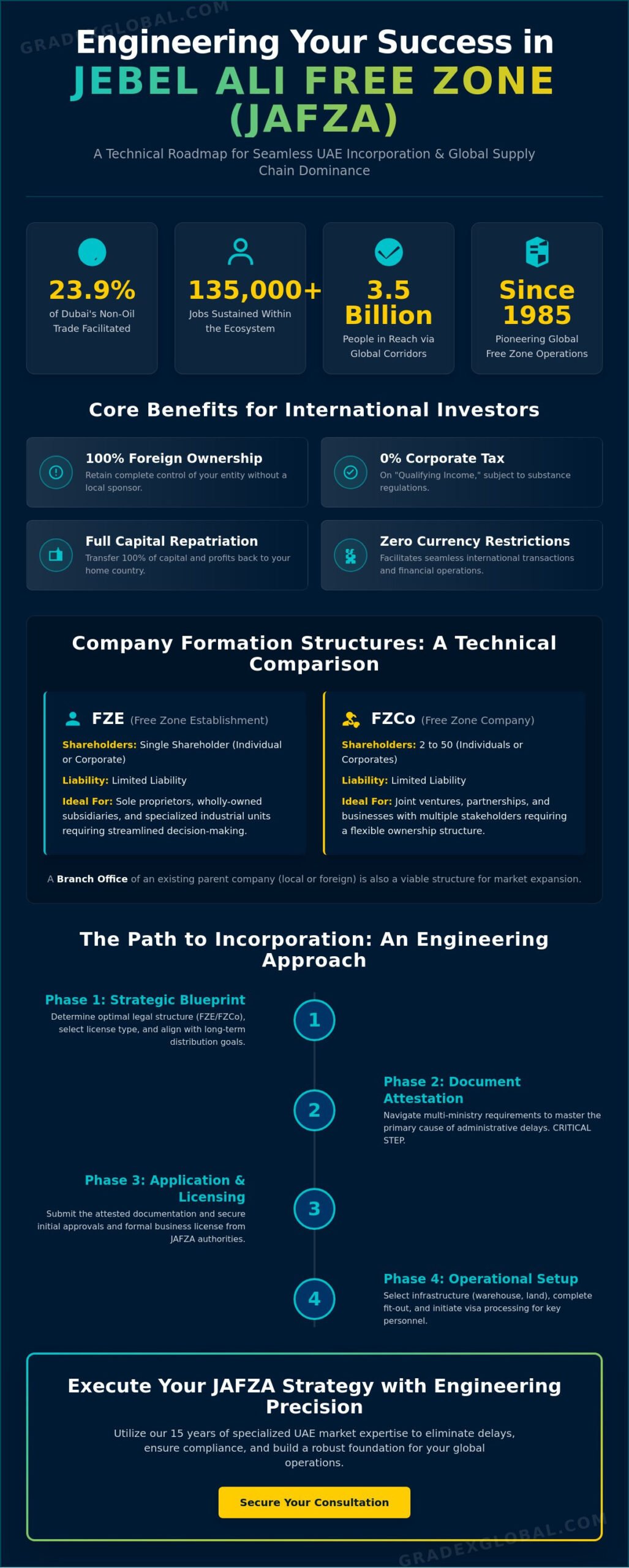
For the sophisticated investor, establishing a presence in the jebel ali free zone isn’t merely a logistical decision; it’s a precise engineering of a global supply chain for the 2026 fiscal landscape. You likely recognize that while the zone facilitates over 23.9% of Dubai’s non-oil trade according to 2023 data, the path to successful incorporation often feels like a labyrinth of multi-ministry documentation and rigid compliance hurdles. It’s natural to feel concerned about document rejection or the technical nuances between FZE and FZCO structures when the stability of your international infrastructure is at stake.
This guide provides a rigorous framework to master these complexities, ensuring you navigate document attestation and licensing with the same precision you apply to your core engineering projects. We’ll provide a technical roadmap for seamless integration into the UAE’s federal regulatory environment. By following this structured approach, you’ll secure your operational foundation and ensure your business remains compliant with the latest zone-specific mandates and logistics requirements.
Key Takeaways
- Leverage the unique synergy between DP World and JAFZA to establish a high-scale logistics foundation that connects your business to global trade corridors.
- Determine the most advantageous legal framework for your enterprise by differentiating between FZE, FZCo, and Branch office structures for maximum operational efficiency.
- Master the mandatory document attestation sequence to eliminate the primary cause of administrative delays during your incorporation within the jebel ali free zone.
- Evaluate diverse infrastructure options, from pre-built units to strategic land plots, to ensure your physical facilities align with long-term regional distribution goals.
- Adopt an “Engineering Precision” approach to your setup strategy by utilizing proven institutional relationships and fifteen years of specialized UAE market expertise.
Understanding the Strategic Value of Jebel Ali Free Zone (JAFZA)
The Jebel Ali Free Zone (JAFZA) represents the pinnacle of industrial and logistical engineering in the Middle East. As the flagship entity within the DP World portfolio, it functions as a critical node in the global supply chain, integrating maritime, land, and air transport into a single, cohesive framework. This infrastructure isn’t merely a business park; it’s a massive economic engine that sustains over 135,000 jobs. Its contribution to the UAE’s non-oil GDP remains a cornerstone of the nation’s 2031 economic vision, providing a stable environment for large-scale industrial operations and complex manufacturing projects.
The synergy between Jebel Ali Port and the free zone infrastructure creates an unparalleled operational advantage. By eliminating the friction between cargo arrival and industrial processing, the jebel ali free zone allows companies to maintain lean supply chains and high-precision logistics. This structural efficiency is why the zone remains the primary choice for capital-intensive sectors. Petrochemical firms, automotive manufacturers, and FMCG giants utilize the specialized facilities to manage high-volume throughput with predictable results. The technical sophistication of the warehouses and industrial plots ensures that complex distribution processes meet international quality standards.
The Ecosystem of Global Trade
JAFZA provides direct connectivity to a market of 3.5 billion people, leveraging its position at the crossroads of East and West. It stands as the largest customs-bonded zone in the Middle East, allowing for the seamless movement of goods under a single administrative umbrella. Since its inception in 1985, the zone has evolved from a regional hub into a multi-award-winning global destination for foreign direct investment. This growth is driven by a commitment to technological modernization and the continuous expansion of its integrated sea-land-air corridors, including the dedicated Dubai Logistics Corridor that links the port directly to Al Maktoum International Airport.
Core Benefits for International Investors
Investment in the jebel ali free zone offers a robust legal framework designed for long-term stability and corporate security. Foreign investors retain 100% ownership of their entities and enjoy full repatriation of capital and profits without restriction. While the UAE introduced a federal corporate tax of 9% for income exceeding 375,000 AED, JAFZA entities typically qualify for a 0% rate on “Qualifying Income” throughout 2026, provided they maintain adequate economic substance and meet regulatory requirements. Additional advantages include:
- Tax Incentives: Exemption from personal income taxes for all employees and zero customs duties on re-exported goods.
- Financial Freedom: Zero currency restrictions, facilitating transactions in AED or international currencies without friction.
- Operational Efficiency: Streamlined recruitment processes and visa processing through integrated government service portals.
- Infrastructure Access: Immediate access to world-class industrial plots and pre-built warehouses designed for heavy machinery.
The operational reliability of the zone ensures that enterprises can focus on technical execution and market expansion rather than administrative hurdles. It’s a platform built for companies that prioritize precision, scalability, and long-term asset security in a volatile global market.
Company Formation Structures and Licensing Options
Establishing a presence in the jebel ali free zone requires a methodical approach to corporate architecture. The decision on legal structure dictates your operational capacity and long-term scalability within the UAE’s industrial framework. Precision in selecting the right entity ensures that your business aligns with the regulatory standards of the DP World ecosystem. It’s not just a matter of registration; it’s about building a foundation for complex, large-scale operations.
FZE vs. FZCo: Choosing Your Corporate Vehicle
Investors must distinguish between the Free Zone Establishment (FZE) and the Free Zone Company (FZCo). An FZE operates as a single-shareholder entity, owned by either one individual or one corporate body. This structure offers a streamlined decision-making process for specialized industrial units. In contrast, the FZCo accommodates a multi-shareholder structure, allowing between 2 and 50 partners. This model is the standard for joint ventures and large-scale infrastructure projects where diverse capital sources are necessary.
Both structures provide limited liability protection, ensuring that shareholder risk is confined to the paid-up capital. For those seeking broader capital markets, the Public Listed Company (PLC) option exists, while existing international firms can opt for a Branch office. A Branch office maintains the legal identity of its parent company, which is a strategic choice for established global brands expanding their logistics footprint. Understanding the nuances of JAFZA company formation is essential for ensuring that your corporate vehicle supports your 2026 growth targets.
Navigating License Types and Permitted Activities
Licensing in the jebel ali free zone is activity-specific. You must align your operations with JAFZA’s approved list of over 4,000 activities to avoid compliance bottlenecks. The authorities categorize these into distinct groups:
- Trading License: Covers the import, export, and distribution of specific items. A General Trading License is available for those managing a diverse portfolio of high-volume goods.
- Industrial License: Required for manufacturing, processing, and packaging units. These licenses often require physical production space within the zone to accommodate heavy machinery.
- Service License: Designed for consultancy and professional firms, including engineering and technical services.
- Logistics License: Specifically for firms providing specialized supply chain services, such as cargo clearing or warehousing.
Aligning your license with your actual operations is a technical necessity. In 2024, JAFZA updated its activity classifications to include more green energy and advanced manufacturing codes; by 2026, these categories will dominate the industrial landscape. If your project involves heavy machinery or complex site preparation, securing a partner for expert project execution ensures your physical infrastructure matches your legal permissions. Most industrial licenses require a minimum share capital of AED 500,000, though specific high-impact sectors may face different requirements based on their environmental footprint.
The Critical Role of Document Attestation in JAFZA Setup
Precision is the foundation of every successful jebel ali free zone setup. Administrative errors in document processing account for approximately 65% of all delays in company formation. This isn’t merely a clerical hurdle; it’s a rigorous legal requirement that ensures the structural integrity of the UAE business registry. The 2026 administrative landscape demands a zero-error approach to the mandatory chain of authentication. This process begins at the local notary in the document’s country of origin, moves through the state’s Ministry of Foreign Affairs, and requires an endorsement from the UAE Embassy. The final step occurs within the Emirates, where the UAE Ministry of Foreign Affairs (MOFA) applies the terminal attestation stamp, often costing approximately 2,000 AED per corporate document.
Board Resolutions, Power of Attorney (POA), and Memorandums of Association (MOA) must meet exacting standards. According to the UAE Ministry of Economy & Tourism on JAFZA, the clarity of these legal instruments is vital for maintaining the zone’s status as a global logistics hub. If a POA lacks specific clauses regarding the right to sign lease agreements or open bank accounts, the jebel ali free zone authority will reject the application. This necessitates a restart of the entire international attestation loop, adding weeks to the timeline.
Attesting Corporate Documents for International Shareholders
Establishing a subsidiary involves a multi-layered authentication of the parent company’s Certificate of Incorporation and Articles of Association. Each document must be verified by the UAE Embassy in the home country to prove its legitimacy. For specialized roles like General Managers or Technical Directors, obtaining an equivalence certificate is mandatory to ensure educational credentials align with UAE Ministry of Education standards. This step is a prerequisite for visa processing and professional licensing in 2026.
Legal Translation and Notary Requirements
Documents not issued in Arabic must undergo legal translation by professionals licensed by the UAE Ministry of Justice. This isn’t a standard translation; it’s a legal certification that carries federal weight. While traditional methods remain, the role of online notary services has accelerated the JAFZA application process, allowing for digital verification of signatures in real-time. The 2026 standard for a “True Copy” attestation requires a digital or physical stamp from a UAE-resident notary or an authorized free zone official confirming the replica’s absolute fidelity to the original instrument. This level of scrutiny ensures that every entity within the zone operates on a verified legal basis, reflecting the stability and engineering-like precision of the UAE’s regulatory framework.
Infrastructure and Operational Facilities: Warehousing to Land
JAFZA provides a robust physical foundation for industrial operations. Investors choose between raw land plots for bespoke development and pre-built units for immediate occupancy. For heavy industry, the jebel ali free zone offers plots starting from 5,000 square meters, often leased on long-term arrangements reaching 15 to 20 years. These plots come with infrastructure readiness, including high-voltage power grids and telecommunication networks already at the site boundary.
The Jafza Logistics Parks serve as a critical node for regional distribution. They integrate directly with the DP World terminal operations. This proximity reduces drayage costs and transit times. Efficiency is driven by the Dubai Trade portal, a single-window interface that handles customs clearances and port documentation. In 2023, DP World reported that this digital integration helped process millions of TEUs with minimal manual intervention. Companies requiring customized development solutions can partner with JAFZA for “Build-to-Suit” projects. These allow for specific structural requirements, such as specialized cooling systems for pharmaceutical storage or reinforced foundations for heavy machinery. This level of customization ensures that the facility meets the exact engineering standards of the tenant from day one.
Warehousing and Showroom Solutions
Pre-built warehouses in the jebel ali free zone, often referred to as Light Industrial Units (LIUs), feature floor load capacities of approximately 5 tons per square meter. These units range from 313 to 1,110 square meters. They include integrated office spaces, fire suppression systems, and thermal insulation. For businesses needing a retail presence, showroom facilities provide 100% glass frontages and dedicated parking. Technical specifications are standardized to ensure high-performance operations, with power supplies typically starting at 15kW to 50kW depending on the unit size.
Office Space and Worker Residences
Office configurations scale from 20-square-meter workstations to entire floors in the Jafza One complex. Every lease requires Ejari registration; this is the official record of the rental contract with the Dubai Land Department. This document is essential for visa processing and corporate bank account openings. To optimize labor costs, JAFZA hosts on-site worker residences. These facilities accommodate over 10,000 personnel, which significantly reduces daily transportation expenses and improves operational stability. Managing staff within the zone’s perimeter streamlines logistics and ensures personnel are available for shift-based industrial work without the delays of external traffic.
Executing Your JAFZA Strategy with Grad-Ex Consultancy
Establishing a presence in the jebel ali free zone demands more than simple administrative filing; it requires a structural framework built on technical expertise and institutional trust. Grad-Ex Consultancy applies an engineering precision approach to business advisory, treating corporate architecture as a critical infrastructure project. With 15 years of established relationships across UAE government entities, we bypass the typical bureaucratic friction that often delays 40% of new market entries. Our methodology is rooted in stability and high-level project management, ensuring your transition into the Middle East’s premier logistics hub is executed without structural flaws.
Our model eliminates the financial volatility often associated with international expansion. We utilize fixed-fee attestation models for all commercial and legal requirements, ensuring your capital allocation remains predictable from the initial consultation. Whether your project involves securing complex trademark registrations or obtaining specialized UAE authority approvals, our team handles the technical load with the same rigor we apply to large-scale engineering solutions. We don’t just facilitate paperwork; we build the legal and operational foundation that allows your enterprise to scale within the jebel ali free zone and beyond.
- 15 years of institutional intelligence and direct ministry coordination.
- Fixed-fee structures that eliminate hidden costs and budget overruns.
- Strategic oversight from trademark protection to final operational licensing.
- A precision-led approach that treats business setup as a mission-critical project.
Subscription-Based Strategic Advisory
Market dynamics in the GCC region shift rapidly, requiring constant vigilance. Grad-Ex provides tiered strategic plans—Basic, Standard, and Premium—designed for ongoing compliance and market research. These plans provide international management teams with access to deep financial analysis and GCC market entry expertise. By outsourcing these functions to our specialists, you reduce the administrative burden on your core staff. We manage the 10 to 15 monthly regulatory touchpoints typical of large-scale JAFZA entities, ensuring your board can focus on growth while we maintain the integrity of your corporate standing.
End-to-End Document Management
The attestation lifecycle for commercial and educational papers is a primary bottleneck in UAE corporate setups. Our team manages this entire chain, coordinating directly with the Ministry of Foreign Affairs and relevant embassies to ensure first-time approval. We view document management as a logistics challenge, moving your credentials through the legal pipeline with systematic efficiency. This rigorous process reduces the typical 30-day processing window by up to 20% through optimized ministry coordination. Contact Grad-Ex Consultancy for a precise JAFZA setup quote to secure your operational foundation for 2026 and ensure your entry into the UAE market is handled with professional certainty.
Future-Proofing Your Industrial Presence in JAFZA
Establishing a presence in the jebel ali free zone requires more than administrative compliance; it demands technical alignment with the UAE’s evolving 2026 industrial regulations. Investors must navigate complex licensing frameworks and secure specialized infrastructure that supports long-term scalability. The transition toward the next decade emphasizes digital integration and sustainable logistics, making precise document attestation and authority management the foundation of a resilient corporate structure. It’s not just about starting a business; it’s about engineering a legacy in a competitive global hub.
Grad-Ex Global leverages 15+ years of GCC market expertise to ensure your regional expansion is executed with engineering-grade accuracy. We manage the entire lifecycle of UAE authority approvals and provide fixed-fee document attestation services to eliminate fiscal uncertainty. Our approach treats company formation as a high-stakes infrastructure project where every detail impacts your operational stability. Secure your JAFZA business setup with Grad-Ex strategic advisory today. Your vision for growth deserves a partner who values precision as much as you do.
Frequently Asked Questions
What is the minimum capital requirement for a JAFZA company in 2026?
The minimum share capital for a Free Zone Company (FZCo) in the Jebel Ali Free Zone is AED 1,000,000. This capital must be deposited in a UAE bank during the incorporation phase to ensure financial stability. While specific trading activities might require higher liquidity, this baseline figure remains the standard for 2026. It’s a fundamental requirement that reflects the zone’s commitment to attracting high-value industrial and logistical enterprises.
How long does the Jebel Ali Free Zone company setup process typically take?
A standard company setup in JAFZA typically takes between 10 and 15 working days from the submission of all verified documents. This timeline accounts for the initial approval, legal documentation review, and the issuance of the trade license. Complex industrial setups involving environmental approvals or specialized infrastructure may extend this period by an additional 5 to 7 business days. Efficiency in documentation preparation is critical to meeting these established benchmarks.
Can a JAFZA company trade directly within the UAE mainland?
A JAFZA-registered entity can’t trade directly within the UAE mainland market without a local distributor or a licensed agent. To facilitate mainland sales, companies must appoint a UAE national partner or establish a separate mainland branch. This regulatory framework ensures that free zone benefits like 100% foreign ownership stay within the designated zone while protecting the local commercial ecosystem. Companies often utilize the 0% customs duty within the zone for re-export activities.
What documents require attestation for a corporate shareholder in JAFZA?
Corporate shareholders must provide an attested Certificate of Incorporation, Memorandum of Association (MOA), and a Board Resolution. These documents require a multi-stage verification process starting at the UAE Embassy in the shareholder’s home country and concluding at the Ministry of Foreign Affairs (MOFA) in Dubai. Without these verified credentials, the legal structure of the jebel ali free zone entity won’t be recognized by the Registrar of Companies. This precision in documentation prevents legal discrepancies during the lifecycle of the enterprise.
Is an office lease mandatory for obtaining a JAFZA trade license?
A physical office lease or a warehouse agreement is mandatory for all companies obtaining a trade license in JAFZA. The zone doesn’t permit “flexi-desk” or virtual office arrangements for most license types because of its focus on industrial and logistical operations. Every entity must have a designated physical address that correlates with its operational scale. This requirement ensures that every business contributes to the physical infrastructure and economic density of the zone.
What is the difference between an FZE and an FZCo in JAFZA?
The primary difference lies in the number of shareholders; a Free Zone Establishment (FZE) has one shareholder, whereas a Free Zone Company (FZCo) accommodates between 2 and 50 shareholders. Both structures offer limited liability protection and allow for 100% foreign ownership. Choosing between them depends on the capital structure and the long-term governance needs of the organization. The FZCo model is typically preferred for joint ventures and larger corporate entities requiring a board-driven management style.
How does the UAE corporate tax apply to JAFZA-registered entities?
JAFZA entities are subject to a 9% federal corporate tax on taxable income exceeding AED 375,000 as per the 2023 tax legislation. However, companies can benefit from a 0% rate on “Qualifying Income” if they maintain adequate substance and comply with all regulatory requirements. This tax regime aligns the UAE with international transparency standards while maintaining a competitive environment for global trade. Proper accounting and auditing are now essential components of maintaining a compliant jebel ali free zone operation.
Can I convert a JAFZA branch into a standalone FZCo structure?
You can’t directly convert a branch into a standalone FZCo through a simple administrative update; it requires a new incorporation process. The existing branch must be liquidated or closed following the successful registration of the new FZCo entity. All assets, contracts, and employee visas must then be legally transferred to the new corporate structure. This transition ensures that the new entity starts with a clean legal slate and a distinct corporate identity.