
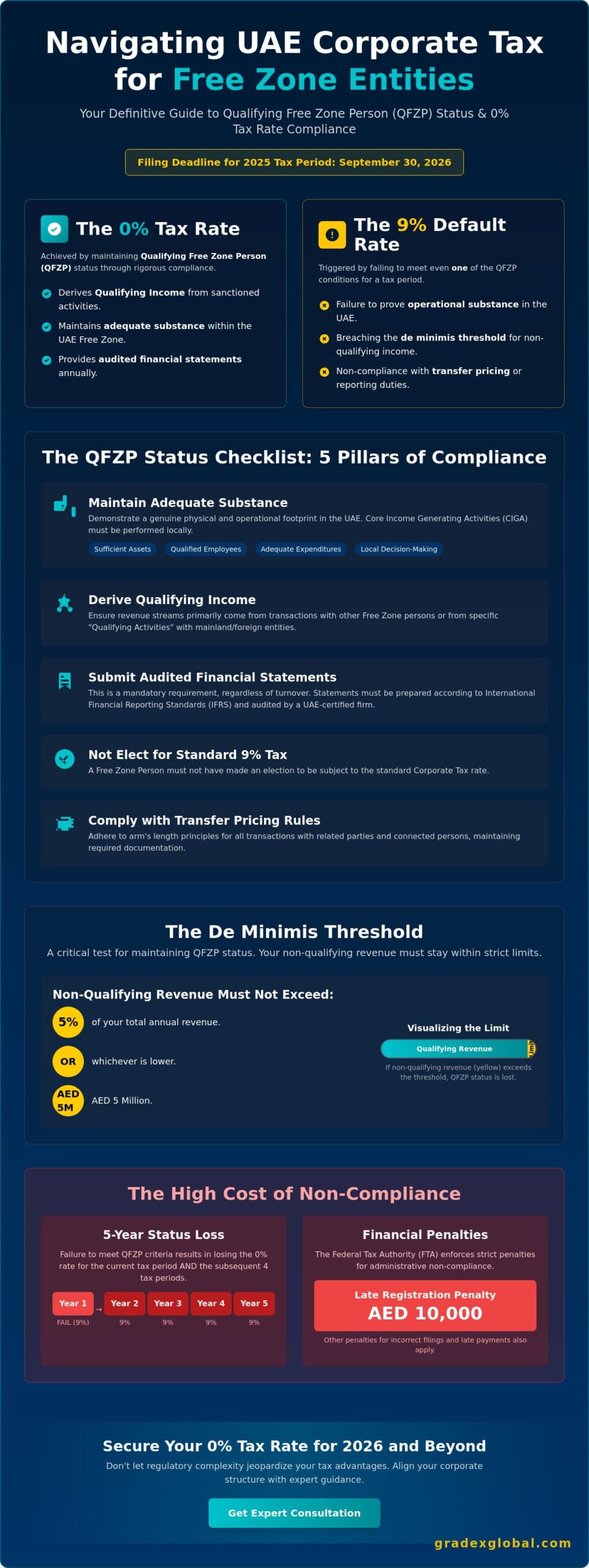
The 0% corporate tax rate in UAE Free Zones is no longer a default privilege; it’s a status maintained only through rigorous operational substance and documented compliance. As we approach the September 30, 2026, filing deadline for the 2025 tax period, understanding the uae corporate tax implications for free zone companies has transitioned from a back-office task to a core strategic priority. Failure to meet even one Qualifying Free Zone Person condition triggers a standard 9% tax rate for the current year and the subsequent four tax periods.
You’ve likely found that the definitions of Qualifying Income and the mandatory requirement for audited financial statements add significant administrative weight to your operations. We’re here to provide the precision your business needs to navigate these regulations without fear of the AED 10,000 late registration penalty. This guide details the specific QFZP criteria, explains the de minimis threshold of AED 5 million, and provides a definitive checklist to ensure your entity remains tax-exempt through 2026.
Key Takeaways
- Define the specific operational parameters required to maintain Qualifying Free Zone Person status and secure the 0% preferential tax rate.
- Analyze the uae corporate tax implications for free zone companies by categorizing revenue streams into Qualifying and Excluded Activities.
- Establish a precise compliance roadmap that includes mandatory EmaraTax registration and the submission of audited financial statements.
- Maintain operational integrity by ensuring adequate substance through localized assets, dedicated personnel, and documented expenditures.
- Utilize strategic document attestation and expert consultancy to align your international corporate structure with the 2026 regulatory standards.
Understanding the UAE Corporate Tax Framework for Free Zone Entities
The implementation of Federal Decree-Law No. 47 of 2022 marks a definitive transition in the Emirates’ economic infrastructure. This legislation isn’t merely a fiscal update; it’s a comprehensive restructuring that brings the nation into alignment with global standards of transparency. For many, the uae corporate tax implications for free zone companies represent the most complex aspect of this shift. While the legacy of tax-free zones remains a cornerstone of the economy, the current regime demands a higher level of operational precision. The UAE’s corporate tax system operates on a two-tier structure where a 9% standard rate applies to taxable income exceeding AED 375,000. For Free Zone entities, the 0% rate is preserved only for those who satisfy the rigorous criteria of a Qualifying Free Zone Person (QFZP).
As we enter 2026, the tax administration has reached a maturity phase. The initial grace periods have concluded, and the Federal Tax Authority (FTA) now expects full compliance. This year serves as a critical benchmark for stability. Businesses must prove their substance and qualify their income with engineering-like accuracy to avoid the standard 9% levy. The 0% rate is an earned advantage, not a default right.
The Shift from Tax-Free to Tax-Regulated
The era of the unconditional tax holiday has evolved into a system based on Qualifying Person status. It’s a fundamental misunderstanding to believe that being in a Free Zone equates to automatic tax exemption. Every entity, regardless of its projected tax liability, must complete mandatory registration through the EmaraTax portal. The FTA serves as the central governing body. Its mandate is to ensure that the 0% benefit is reserved for companies that contribute genuine economic value within the UAE borders. This shift requires a move from passive presence to active, documented compliance.
Key Terminology for Free Zone Stakeholders
A Free Zone Person is defined as a juridical person incorporated, established, or otherwise registered in a Free Zone, including a branch of a mainland or foreign person. Distinguishing between income sources is vital; Mainland source income generally refers to revenue derived from the UAE mainland, while Free Zone source income originates from transactions with other Free Zone persons or foreign entities. Qualifying Income serves as the specific gateway to the 0% rate, representing revenue derived from sanctioned activities that meet all regulatory conditions. Understanding these uae corporate tax implications for free zone companies is the first step in protecting your entity’s financial standing.
Criteria for the “Qualifying Free Zone Person” (QFZP) Status
Achieving the status of a Qualifying Free Zone Person (QFZP) is a technical exercise in operational integrity. It requires more than a valid trade license; it demands a demonstrable link between the company’s income and its physical presence within the UAE. Understanding the uae corporate tax implications for free zone companies involves recognizing that the 0% rate is contingent upon meeting several cumulative conditions. If an entity fails to satisfy even one of these criteria, it loses its QFZP status for the current year and the subsequent four tax periods, reverting to the standard 9% rate on all taxable income.
Establishing Adequate Operational Substance
Substance is defined by the physical footprint and decision-making processes of the entity. A QFZP must maintain adequate assets, employ a sufficient number of qualified full-time employees, and incur adequate operating expenditures within the Free Zone. Core Income Generating Activities (CIGA) must be performed locally, not outsourced to entities outside the Free Zone or overseas. Strategic decision-making, such as Board of Directors meetings, must physically occur within the UAE to confirm that the management and control of the company are localized. Ensuring that corporate records are properly verified through strategic document attestation serves as a primary layer of defense during an FTA audit.
The Necessity of Audited Financial Statements
Under the UAE’s official corporate tax framework, the requirement for audited financial statements is absolute for any entity seeking the 0% rate. This mandate applies regardless of the company’s annual turnover. These statements must be prepared in accordance with International Financial Reporting Standards (IFRS) and audited by a certified firm registered in the UAE. This requirement ensures that the calculation of Qualifying Income is transparent and verifiable. Failure to maintain these records or provide them upon request can lead to immediate disqualification from the preferential tax regime and the imposition of administrative penalties.
Compliance with Transfer Pricing rules is also non-negotiable. All transactions with Related Parties and Connected Persons must adhere to the arm’s length principle. This means the pricing must mirror what independent parties would have agreed upon under similar circumstances. Companies must maintain master files and local files to document these transactions, ensuring that the uae corporate tax implications for free zone companies don’t include unforeseen liabilities arising from inter-company transfers. Precise documentation is the only way to safeguard your tax-exempt status in the 2026 fiscal landscape.
0% vs. 9% Tax Rates: Qualifying vs. Excluded Activities
Distinguishing between revenue streams is a structural requirement for any Free Zone entity. While previous sections established the necessity of substance, the actual nature of the transaction determines the final tax liability. The uae corporate tax implications for free zone companies hinge on whether income is derived from Qualifying Activities or Excluded Activities. This distinction requires a granular analysis of every invoice processed within the 2026 fiscal year to ensure the 0% advantage isn’t compromised by non-compliant revenue.
Qualifying Activities for the 0% Regime
Specific activities enjoy the 0% regime due to their contribution to the UAE’s strategic infrastructure. Manufacturing and processing of goods, along with the wholesale distribution of qualifying commodities from a designated zone, remain core pillars of this framework. Shipping services and reinsurance also fall under this protective umbrella. By 2026, the regulatory focus has sharpened on headquarters services provided to related parties, where centralized management functions must be performed locally with engineering-like precision. The outlook for digital services is equally specific; only tech-based activities that meet the exact definitions in Ministerial Decisions will maintain their tax-exempt status.
The Impact of Excluded Activities
Excluded activities are those that trigger the standard 9% rate regardless of the entity’s Free Zone location. This category includes transactions with natural persons, such as retail trade or personal banking services. Income from commercial immovable property located in a Free Zone is also excluded when the transaction involves a person who isn’t a Free Zone entity. Providing professional services directly to mainland entities remains a high-risk area for disqualification. To mitigate this, stable enterprises often adopt a strategy of structural isolation, separating qualifying and non-qualifying income into distinct accounting silos to prevent cross-contamination of tax rates.
The “De Minimis” rule provides a narrow safety margin for companies earning non-qualifying income. A Qualifying Free Zone Person can earn non-qualifying revenue up to the lower of 5% of their total revenue or AED 5 million per tax period. Exceeding this threshold results in the immediate loss of QFZP status for five years. Trading with the UAE mainland further complicates this landscape; income from mainland branches is subject to the 9% rate on all taxable income exceeding AED 375,000. Precision in revenue mapping is the only way to safeguard the 0% advantage in a high-stakes regulatory environment.
Compliance Roadmap for Free Zone Entities in 2026
Stability in the UAE market is now synonymous with tax compliance. For executives and shareholders, the uae corporate tax implications for free zone companies require a structured transition plan that moves beyond theoretical understanding into technical execution. The 2026 fiscal year represents the period where the Federal Tax Authority (FTA) shifts from education to enforcement. A precise roadmap is essential to protect your company’s 0% tax advantage and ensure long-term operational durability.
The first milestone in this journey is mandatory Corporate Tax Registration via the EmaraTax portal. This applies to every Free Zone entity, regardless of whether it expects to pay tax. Following registration, a comprehensive Tax Impact Assessment is required. This assessment serves as your strategic blueprint; it identifies which of your revenue streams meet the Qualifying Income criteria and ensures your business doesn’t accidentally breach the 5% de minimis threshold. Without this diagnostic step, your entity remains vulnerable to the standard 9% rate.
Document Preparation and Legal Translation
The FTA requires absolute clarity in all supporting evidence. If your foundational corporate documents, such as Articles of Association or international service agreements, are in a foreign language, legal translations are mandatory. Precision here is non-negotiable. Utilizing online notary services allows for the swift validation of board resolutions and power of attorney documents, ensuring they meet UAE regulatory standards. For entities within international corporate structures, verifying that all parent company documents possess the correct equivalence certificate or attestation is vital. These documents form the evidentiary basis for your substance claims during a 2026 audit, proving that management and control are localized.
Managing Deadlines and Avoiding Penalties
The FTA has established a stringent penalty regime to ensure administrative discipline. A late registration penalty of AED 10,000 is currently enforced, but the financial risk extends further. Incorrect filings or the failure to maintain records can lead to the immediate loss of Qualifying Free Zone Person status. UAE law mandates that all businesses maintain their financial and tax records for at least 7 years. This requirement ensures that any retrospective audit can be met with verified data. You must file your annual Corporate Tax Return within nine months of your financial year-end. For companies with a fiscal year ending December 31, 2025, the final submission deadline is September 30, 2026. Secure your operational stability by consulting with experts who specialize in UAE business setup and regulatory approvals.
Implementing Transfer Pricing policies is the final critical step. Any intra-group transactions must be documented to prove they adhere to the arm’s length principle. This involves maintaining a Master File and a Local File if your revenue exceeds the specified thresholds. By treating these compliance steps with the same precision as a large-scale engineering project, you ensure that your Free Zone entity remains a stable and profitable asset in the evolving UAE economy.
Strategic Advisory for a Seamless Tax Transition
Operational stability in the UAE depends on the precision with which an entity handles its regulatory obligations. As the 2026 tax landscape matures, the transition from a simple incorporation model to a tax-compliant corporate structure is a technical necessity. Successful navigation of the uae corporate tax implications for free zone companies requires a partner capable of managing complex documentation with the same accuracy as a large-scale engineering project. Grad-Ex Consultancy provides this stability, ensuring that your business remains a durable asset within the Emirates’ evolving fiscal framework.
Professional Business Setup and Licensing
Choosing a jurisdiction is no longer a matter of administrative convenience. It’s a strategic decision that dictates your eligibility for the 0% tax regime. Our advisory services focus on aligning your specific business activities with the exhaustive lists of Qualifying Activities defined by Ministerial Decisions. We handle Ejari registrations and UAE authority approvals with meticulous attention to detail, ensuring that your physical office space and operational setup meet the “adequate substance” requirements. By integrating tax planning into the initial company formation or renewal process, we eliminate the risks of accidental disqualification from the preferential rate. This engineered approach to setup provides a foundation that can withstand the scrutiny of a Federal Tax Authority audit.
The Grad-Ex Advantage in Corporate Documentation
The burden of proof regarding substance often rests on the validity of corporate records. International corporate structures face unique challenges when proving management and control are localized. We specialize in streamlining certificate attestation for foreign directors and shareholders, ensuring every foundational document is legally recognized by UAE authorities. This process is critical for validating board resolutions and inter-company agreements that support your Transfer Pricing policies. We provide fixed-fee document processing to ensure budget predictability, removing the uncertainty often associated with international legalizations.
Proving your status as a Qualifying Free Zone Person requires a comprehensive paper trail that links your income to your local operations. Many entities fail this test not because they lack substance, but because their documentation is incomplete or unverified. We fill this gap by providing a single point of control for all your regulatory needs, from legal translations to authority approvals. Consult with our strategic advisors to secure your Free Zone company’s tax status and ensure your 2026 strategy is built on a foundation of professional precision and verified compliance. Our role is to transform the complexity of the uae corporate tax implications for free zone companies into a clear, manageable path for your long-term success.
Securing Your Corporate Future in the 2026 UAE Tax Landscape
The transition to a regulated tax environment demands a shift from passive presence to active, precision-engineered compliance. Maintaining your entity’s 0% tax advantage requires a rigorous adherence to substance requirements and a granular understanding of qualifying income streams. As the September 30, 2026, filing deadline approaches, the distinction between qualifying and excluded activities will define the financial health of your enterprise. Navigating the uae corporate tax implications for free zone companies isn’t merely an administrative task; it’s a strategic necessity for long-term operational durability.
With 15+ years of strategic advisory experience in the GCC, Grad-Ex Consultancy provides the professional stability your business requires. We leverage deep institutional relationships with UAE authorities to streamline your transition, offering fixed-fee document attestation for total cost transparency. Our team ensures your corporate structure is built on a foundation of verified compliance and engineering-level precision. Contact Grad-Ex Consultancy for Professional Business Setup and Tax Compliance Support to safeguard your commercial interests. Your commitment to precision today ensures a stable and prosperous future in the Emirates.
Frequently Asked Questions
Do all Free Zone companies need to register for UAE Corporate Tax?
Yes, every Free Zone entity must register for Corporate Tax through the EmaraTax portal, regardless of its annual turnover or tax liability. This registration is a foundational requirement under Federal Decree-Law No. 47 of 2022. Entities that fail to register are excluded from tax benefits and face immediate administrative penalties. Registration ensures your company is recognized by the Federal Tax Authority as a valid taxpayer within the 2026 fiscal framework.
What happens if a Free Zone company fails to meet the substance requirements?
If a company fails to maintain adequate substance, it loses its Qualifying Free Zone Person status for the current year and the next four tax periods. This results in the application of the standard 9% tax rate on all taxable income. Substance is verified through physical assets, qualified employees, and core income-generating activities conducted within the Free Zone. It’s a structural failure that compromises the entity’s long-term financial stability.
Can a Free Zone company still enjoy 0% tax if it trades with the UAE mainland?
A Free Zone entity can maintain its 0% status while trading with the mainland, provided the income qualifies under specific ministerial decisions or falls within the de minimis threshold. However, income derived from transactions with mainland persons is generally subject to the 9% rate unless it involves specific qualifying activities. Understanding these uae corporate tax implications for free zone companies is vital for maintaining precise fiscal efficiency during the 2026 tax year.
Is an audit mandatory for all Free Zone entities under the new tax law?
Yes, an audit is mandatory for all Free Zone entities that wish to benefit from the 0% corporate tax rate. The Federal Tax Authority requires audited financial statements to verify the calculation of Qualifying Income and ensure compliance with International Financial Reporting Standards. This rule applies even if the company’s revenue is below the standard audit thresholds used in other jurisdictions. Accurate financial reporting is the only way to secure your tax-exempt status.
What is the “De Minimis” threshold for Free Zone companies?
The “De Minimis” threshold allows a Qualifying Free Zone Person to earn a limited amount of non-qualifying income without losing their 0% status. This threshold is defined as the lower of 5% of total revenue or AED 5 million in a tax period. Exceeding this limit triggers the standard 9% tax rate for the entire entity for a duration of five years. This rule requires engineering-level precision in revenue categorization and accounting.
How does the UAE Corporate Tax affect companies with an Equivalence Certificate?
An Equivalence Certificate or strategic document attestation is critical for validating the credentials of foreign directors and the legitimacy of international corporate records. These documents prove that the entity’s management has the necessary expertise to conduct core activities locally. In the context of uae corporate tax implications for free zone companies, this documentation serves as primary evidence of operational substance during an official audit by the Federal Tax Authority.
What are the penalties for late Corporate Tax registration in 2026?
The penalty for late Corporate Tax registration is currently fixed at AED 10,000 as per Cabinet Decision No. 75 of 2023. This fine is imposed on any business that fails to submit its registration application within the timelines specified by the Federal Tax Authority. Beyond the immediate fine, late registration can lead to increased scrutiny and potential disqualification from preferential tax regimes. Timely compliance is a hallmark of a stable and professional enterprise.
Can a Free Zone company opt-out of the 0% regime and choose the 9% rate?
Yes, a Free Zone company can voluntarily elect to be subject to the standard 9% corporate tax rate. This election is binding for a specified period and might be strategic for entities that find the compliance costs of maintaining QFZP status exceed the actual tax savings. Once this choice is made, the company cannot revert to the 0% regime for five years. This decision requires a thorough tax impact assessment to ensure long-term profitability.