
A single administrative oversight at the Indian state level can result in the immediate rejection of your UAE residency application, costing you weeks of professional momentum. For professionals and entrepreneurs, the uae embassy attestation process from india is not merely a bureaucratic hurdle; it’s a critical verification chain that demands engineering precision. You likely recognize the anxiety of entrusting original degree certificates or commercial contracts to a multi-stage system where the sequence of authorities is often opaque.
We understand that the fear of document loss or rejection due to minor clerical errors is a significant burden during international transitions. This guide ensures you master the 4-stage attestation hierarchy, from Indian state-level HRD verification to the final UAE Ministry of Foreign Affairs (MoFA) digital endorsement. By following this strategic framework, you’ll secure the necessary legalizations for visa or business operations while managing the 2026 digital shift. We’ll examine the integrated MoFA smart service, the specific AED 315 fee for personal documents, the AED 2,165 requirement for commercial papers, and the precise logistics required to complete your attestation in 7 to 15 working days.
Key Takeaways
- Identify the mandatory 4-stage verification hierarchy to ensure your Indian documents meet the strict legal standards required for UAE residency and business operations.
- Master the uae embassy attestation process from india by leveraging the 2026 eDAS digital integration for more secure and efficient document handling.
- Learn the distinct workflows for educational, personal, and commercial certificates to avoid common rejection triggers like smudged seals or name discrepancies.
- Secure budget stability with a clear understanding of official fees, including the AED 315 charge for personal documents and AED 2,165 for commercial legalization.
- Discover how a precision-driven approach to document transit safeguards your original certificates and mitigates administrative delays throughout the entire chain.
Understanding the Legal Necessity of UAE Embassy Attestation (2026)
The uae embassy attestation process from india represents a mandatory sovereign verification protocol. It functions as a structured chain of authentication where each government authority verifies the validity of the seal applied by the preceding office. Because the UAE operates outside the Hague Apostille Convention, Indian documents require this specific legalization rather than a standard apostille. Understanding the Legal Necessity of UAE Embassy Attestation is critical for maintaining professional and corporate stability. Without the UAE Embassy’s stamp, an Indian degree or contract lacks the legal infrastructure to be recognized by UAE authorities.
The Indian Ministry of External Affairs (MEA) acts as the central bridge between the two nations. It validates state-level signatures before the UAE Embassy applies its sovereign seal. You must distinguish between simple notarization, which merely witnesses a signature, and formal attestation, which confirms the document’s origin for international use. In 2026, the UAE Ministry of Foreign Affairs (MoFA) requires this entire chain to be intact before granting the final digital endorsement. Any break in this sequence results in the immediate rejection of the application.
The Legal Framework for Cross-Border Document Recognition
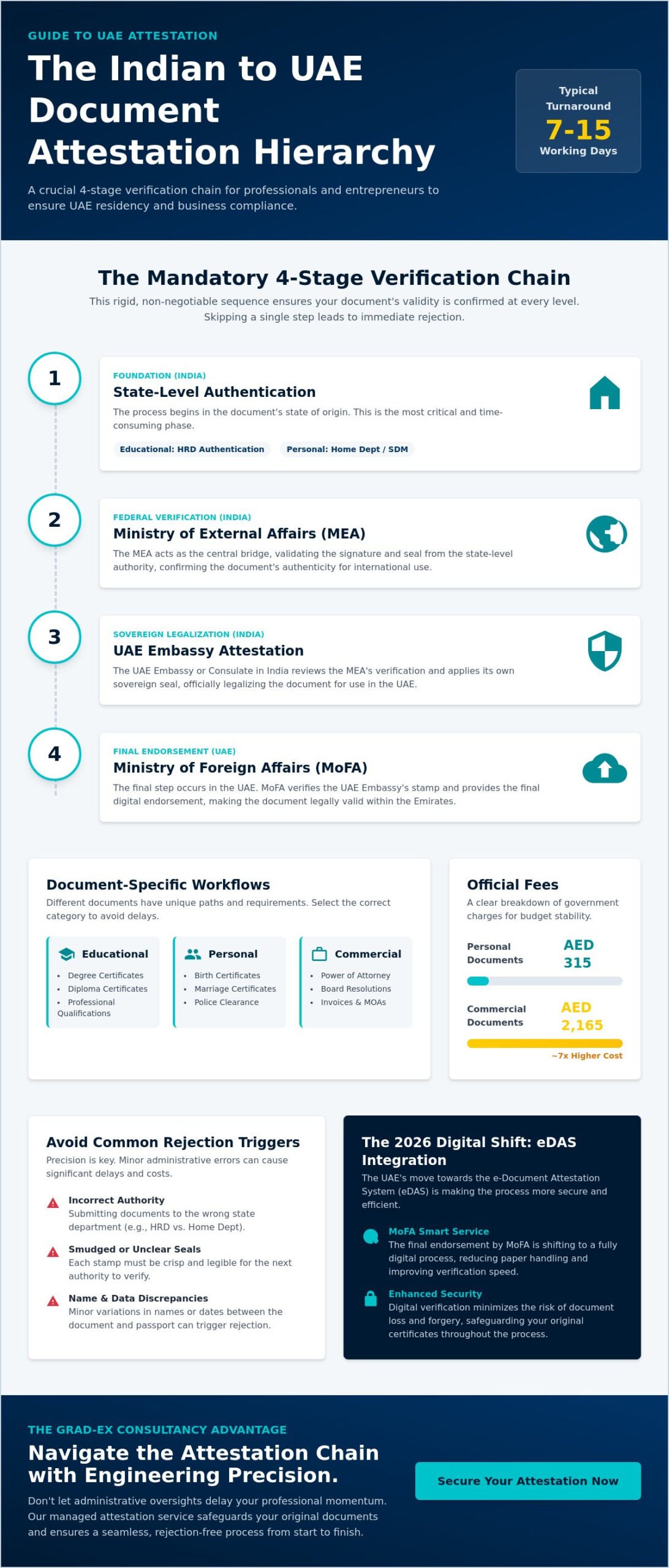
The UAE-India bilateral agreements govern the movement of all official records. These frameworks ensure that certificates issued in India are technically and legally equivalent to those in the Emirates. Legalization is mandatory for employment, family residency, and cross-border trade. Improper attestation results in immediate visa denials and administrative delays. These failures often stem from a lack of precision during the state-level verification phase, which serves as the foundation for the entire process. For 2026, the UAE Embassy fee is fixed at AED 315 for personal documents and AED 2,165 for commercial papers, reflecting the rigorous verification required for business operations.
Primary Use Cases for Attested Documents in the UAE
Legalized documents are the building blocks of residency and business operations in the Emirates. The uae embassy attestation process from india is required for several critical transitions:
- Employment Visas: Attested degrees are required for all professional and management-level roles to satisfy Ministry of Human Resources and Emiratisation (MoHRE) regulations.
- Family Residency: Sponsoring dependents or processing school admissions requires attested marriage and birth certificates to prove legal relationships.
- Business Operations: Company formation in UAE mainland or free zones requires attested Power of Attorney, Board Resolutions, and Memorandums of Association.
Ensuring these documents are correctly legalized prevents the risk of administrative rejection and provides a stable foundation for your professional or commercial presence in the UAE.
The 4-Stage Hierarchy of the Indian-to-UAE Attestation Chain
The legalization of Indian certificates for use in the Emirates follows a rigid, non-negotiable architecture. Success in the uae embassy attestation process from india requires a sequential approach that mirrors engineering precision. You can’t bypass state-level verification to reach the federal level. Skipping a single tier leads to immediate rejection at the UAE Embassy. This hierarchy ensures that the document’s validity is confirmed at every level of Indian governance before it reaches the sovereign representatives of the Emirates. It’s a chain of trust where each seal validates the one before it.
Step 1 & 2: Local Notarization and State-Level Authentication
The foundation begins with a Notary Public. This is the primary verification of the signature on personal and educational papers. For educational documents, the Human Resource Development (HRD) department of the respective state must provide authentication. This is often the most time-consuming phase because it involves university-level verification of the original degree. Personal certificates, such as birth or marriage records, typically follow the Home Department or Sub-Divisional Magistrate (SDM) route. Precision at this stage is vital. A single mismatch in a seal or a smudged signature can compromise the entire chain.
Step 3 & 4: MEA Legalization and UAE Embassy Finalization
Once state verification is complete, the Ministry of External Affairs (MEA) provides the central government’s endorsement. The 4-Stage Hierarchy of the Indian-to-UAE Attestation Chain reaches its final Indian milestone at the MEA before moving to the Embassy. The MEA maintains regional branches, but the seal remains the ultimate Indian authority. The final Embassy attestation verifies the MEA seal, authorizing the document for use within the UAE. In the 2026 cycle, Embassy processing typically spans 3 to 5 working days, provided the preceding verifications are flawless.
Commercial documents require an additional layer of scrutiny. These often necessitate “True Copy” verification by the Chamber of Commerce before MEA submission. Throughout this 2026 processing cycle, the physical integrity of the original certificate is paramount. If you require expert oversight to manage these complex logistical tiers, Grad-Ex Consultancy’s certificate attestation services provide the institutional control needed to prevent administrative delays. Maintaining the document’s condition during transit is as important as the stamps themselves.
Document-Specific Workflows: Educational, Personal, and Commercial
The uae embassy attestation process from india begins with a precise categorization of the source document. Each document type requires a specific technical path before it reaches the final sovereign endorsement. You can’t apply a universal template to this process; educational, personal, and commercial papers follow distinct trajectories dictated by Indian state regulations and UAE federal requirements. Identifying the correct “foundational” authority in India is the most critical step to ensure your documents aren’t rejected during the 2026 processing cycle.
Educational Certificates: The HRD and University Verification Path
Educational credentials represent the most complex engineering challenge in the attestation chain. Before the state Human Resource Development (HRD) department applies its seal, mandatory verification from the issuing university is required. This often involves the university confirming the certificate’s authenticity directly with the state department. For new graduates, managing provisional versus original degree certificates is vital. Most UAE authorities require the original degree for long term residency. This process is the prerequisite for obtaining an equivalence certificate, which is necessary for professional recognition in the Emirates. Precision at the university level prevents structural failures in your visa application.
Personal and Commercial Legalization Requirements
Personal documents like birth, marriage, and police clearance certificates follow the Sub-Divisional Magistrate (SDM) or Home Department route. Ensuring the SDM seal is recognized by the UAE requires a clean, legible application that matches your passport data exactly. For business operations, commercial attestation involves coordination with the Indian Chamber of Commerce. This includes board resolutions and Power of Attorney documents. These commercial papers carry a higher UAE Embassy fee of AED 2,165, compared to the AED 315 for personal documents.
Legal translation becomes mandatory once the primary attestation is complete. If your document isn’t in English or Arabic, you’ll need global translation services to meet UAE Ministry of Justice standards. Utilizing the official UAE resources for Strategic Navigation: Avoiding Rejections and Digital MoFA Integration ensures you’re aware of the latest 2026 electronic standards. This integrated approach minimizes administrative friction and protects your professional interests in the UAE market.
Strategic Navigation: Avoiding Rejections and Digital MoFA Integration
Navigating the uae embassy attestation process from india requires more than just administrative awareness; it demands a meticulous audit of the document’s physical and data integrity. Structural failures in the legalization chain frequently occur due to smudged seals, name mismatches between passports and certificates, or the submission of expired documents. In the 2026 regulatory environment, the margin for error has narrowed. UAE authorities now utilize high-resolution scanning to verify the authenticity of Indian MEA seals. If a stamp is faint or partially obscured, the eDAS system may fail to recognize the document, necessitating a complete restart of the multi-stage process.
The 2026 transition to the UAE Ministry of Foreign Affairs (MoFA) Electronic Document Attestation System (eDAS) has fundamentally altered how physical Indian seals are recognized in the Emirates. This system bridges the gap between traditional ink-and-paper verification and modern digital governance. You must ensure that your document’s physical state is preserved during transit to facilitate this digital handshake. Any degradation of the paper or the ink seals can lead to a failure in the digital scanning phase, delaying your residency or business setup.
The 2026 Digital Evolution: MoFA eDAS and QR-Coded Attestations
The implementation of eDAS allows residents and businesses to verify their attested documents via the official MoFA mobile application. Each successfully processed document now receives a unique QR code, which significantly accelerates UAE residency visa processing. This digital seal acts as a permanent ledger of the document’s legitimacy. You’ll find that having a scannable, QR-coded attestation reduces the time spent at government counters in Dubai or Abu Dhabi. However, you must confirm that your Indian MEA seal is compatible with these digital scanning requirements before the document leaves India. If the Indian authorities use outdated ink or non-standard formats, the UAE’s digital system won’t accept the submission.
Mitigating Risk in the Global Document Chain
Protecting original certificates during international transit is a logistical priority that requires engineering levels of control. The necessity of professional courier tracking and established institutional relationships can’t be overstated. While “Express” services are available, they must still adhere to mandatory government timelines; no service provider can bypass the sovereign verification periods of the MEA or the UAE Embassy. Use this checklist for verifying seals before the document leaves Indian soil:
- Confirm all ink seals are dry and haven’t bled into the paper fibers.
- Verify that the spelling of your name matches your passport’s machine-readable zone (MRZ) exactly.
- Ensure the document hasn’t been laminated, as this prevents the application of mandatory physical seals.
If you require a secure, managed solution that guarantees compliance with these 2026 digital standards, our professional certificate attestation services provide the precision and oversight needed to eliminate the risk of rejection. Our protocols are designed to safeguard your original documents while navigating the complexities of the eDAS transition.
Managed Attestation Services: The Grad-Ex Consultancy Advantage
Grad-Ex Consultancy provides the institutional stability required to navigate the uae embassy attestation process from india with absolute precision. With over 15 years of operational expertise in the GCC market, we manage the entire verification chain as a complex engineering project. We eliminate the administrative burden by overseeing every transition from Indian state departments to the final UAE MoFA digital seals. Our fixed-fee model ensures total transparency, providing expats and corporate entities with the budget stability needed for successful international relocation. We don’t just facilitate document movement; we provide a guarantee of quality and compliance.
Our strategic advisory extends beyond the final stamp. We understand that attestation is often the first step in a larger commercial or professional journey. By providing guidance on business licensing and UAE authority approvals, we help you transition from document legalization to active operations without the friction of administrative delays. This holistic approach ensures that your legal foundation is robust enough to support long term residency or large scale business expansion in the Emirates.
Precision and Reliability in Document Processing
Reliability in document handling is built on deep government relationships and a rigorous internal chain of custody. We treat your original certificates as high-value assets, ensuring they remain secure throughout the multi-stage transit between India and the UAE. Beyond the basic stamps, we provide strategic support for equivalence certificate acquisition. This post-attestation phase is essential for professionals seeking recognition from the UAE Ministry of Education, and our consultants ensure your legalized documents meet every technical prerequisite for this transition. We leverage our own resources to expedite workflows that typically stall in less experienced hands.
Next Steps: Initiating Your Legalization Journey
Complex cases involving name changes, legacy certificates, or documents spanning multiple Indian states require a customized strategic approach. We don’t just process papers; we provide the infrastructure for your success in the Emirates. By integrating the uae embassy attestation process from india with our broader business setup and Ejari services, we allow you to focus on your professional objectives while we handle the regulatory hurdles. Whether you’re expanding a commercial enterprise or securing a family residency, our team manages the timelines to prevent project delays and ensure a predictable outcome.
To secure your professional future in the UAE with a partner that values precision and stability, Contact Grad-Ex Consultancy for professional attestation support. We’re ready to manage your document legalization with the same rigor we apply to the most complex engineering solutions.
Securing Your Legal Infrastructure for UAE Success
Establishing a compliant professional presence in the Emirates requires more than just submitting paperwork; it demands a technical understanding of the sovereign verification chain. Success in the uae embassy attestation process from india depends on navigating a strict 4-stage hierarchy where Indian state-level accuracy dictates federal approval. The 2026 transition to digital MoFA eDAS integration further emphasizes the necessity for high-integrity documents that meet modern UAE scanning standards without delay.
Managing these multi-tiered complexities shouldn’t be a source of administrative anxiety. With over 15 years of GCC market expertise and established institutional relationships with both UAE and Indian ministries, Grad-Ex Consultancy provides the stability your certificates require. Our commitment to fixed-fee transparency ensures your budget remains predictable throughout the entire legalization journey. We treat every document with the same engineering precision we apply to large-scale infrastructure projects.
Secure your UAE future with professional attestation services from Grad-Ex Consultancy. We’ll manage the technical tiers of authentication so you can focus on your professional and commercial growth in the Emirates. Your international transition is a significant milestone, and we’re dedicated to ensuring your foundation is built on absolute precision and legal certainty.
Frequently Asked Questions
How long does the UAE Embassy attestation process from India take in 2026?
The complete attestation chain for an Indian certificate typically requires 7 to 15 working days as of February 2026. This duration accounts for the sequential movement of the document through state departments, the Ministry of External Affairs, and the final sovereign verification. Timelines can vary based on the efficiency of the issuing university or the specific state’s Human Resource Development department.
Is it mandatory to get HRD attestation for my degree certificate?
State-level HRD attestation is a non-negotiable requirement for all educational documents. The Ministry of External Affairs and the UAE Embassy will not apply their seals unless the document’s authenticity has first been confirmed by the relevant state’s education department. Skipping this stage results in immediate rejection at the federal level, as it’s the foundation of the 4-stage hierarchy.
Can I attest my documents for the UAE online from India?
You can initiate the application digitally through the UAE MoFA website or smart app using a UAE Pass. However, the uae embassy attestation process from india still requires the physical movement of the original document. An approved service provider must collect your certificate to apply the mandatory physical seals before the final digital QR code is issued.
What is the difference between MEA attestation and UAE Embassy attestation?
MEA attestation is the final verification provided by the Indian government to confirm a document’s legitimacy for international use. UAE Embassy attestation is the subsequent step where the Emirates’ sovereign representatives validate the MEA seal. Both are essential components of the chain; the MEA seal acts as the bridge that allows the UAE Embassy to recognize the document.
Will the UAE Embassy accept a laminated certificate for attestation?
The UAE Embassy won’t accept laminated documents because seals and stamps must be applied directly to the original paper surface. If your certificate is laminated, you must professionally remove it before beginning the process. Any damage to the paper during lamination removal can lead to rejection if the original text or signatures become illegible.
What are the fees for UAE Embassy attestation from India?
The official fee for personal or educational documents is AED 315 per document. Commercial documents, such as board resolutions or power of attorney, require a higher fee of AED 2165. These costs are separate from the Indian state and MEA service charges, which are approximately INR 649 to INR 749 depending on the specific verification route.
Is an Arabic translation required for Indian documents in the UAE?
Legal Arabic translation is mandatory for documents that must be submitted to the UAE Ministry of Justice or local courts. While the attestation process is performed on the original English or regional language document, certain residency and legal procedures require a certified translation. This translation must be completed by a MoJ-licensed translator after the final MoFA attestation is secured.
What happens if my document is rejected by the UAE Embassy?
If a document is rejected, you must rectify the specific error, such as a faint seal or a name discrepancy, and restart the process from the relevant stage. Rejections often occur during the digital scanning phase of the eDAS system if the previous stamps aren’t clearly visible. Ensuring every seal is applied with precision during the initial Indian stages prevents these costly administrative delays.